Place · site
Puʻuhonua o Hōnaunau National Historical Park
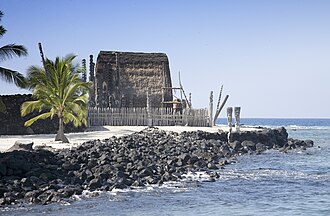
Puʻuhonua o Hōnaunau National Historical Park, on the west coast of the island of Hawaiʻi, preserves a puʻuhonua, a place of refuge where until the early 19th century Hawaiians who had broken a kapu could escape death, be absolved by a priest and go free; defeated warriors and non-combatants could also shelter there in war. Its Hale o Keawe heiau, built about 1650 as the burial place of the ruler Keaweʻīkekahialiʻiokamoku, held 23 remains; the last bones were removed in 1829 and the temple destroyed, then reconstructed in the 1960s. Established in 1955 as City of Refuge National Historical Park, the 420-acre site took its Hawaiian spelling in 2000.
See also
Cite this entry
- APA
- The Epoch Institute. (2026). Puʻuhonua o Hōnaunau National Historical Park. In The Epoch Institute Encyclopedia. https://the-epoch-institute.org/encyclopedia/pu-uhonua-o-honaunau-national-historical-park
- MLA
- “Puʻuhonua o Hōnaunau National Historical Park.” The Epoch Institute Encyclopedia, The Epoch Institute, 2026, https://the-epoch-institute.org/encyclopedia/pu-uhonua-o-honaunau-national-historical-park. Accessed .
- Chicago
- The Epoch Institute. “Puʻuhonua o Hōnaunau National Historical Park.” The Epoch Institute Encyclopedia. 2026. https://the-epoch-institute.org/encyclopedia/pu-uhonua-o-honaunau-national-historical-park.
- Harvard
- The Epoch Institute (2026) ‘Puʻuhonua o Hōnaunau National Historical Park’, The Epoch Institute Encyclopedia. Available at: https://the-epoch-institute.org/encyclopedia/pu-uhonua-o-honaunau-national-historical-park (Accessed: ).
Last reviewed October 2026Random entry ↻