Inventions & Discoveries · Science and discovery
Trigonometry
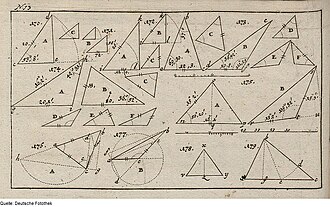
Trigonometry is the branch of mathematics that relates the angles of triangles to the lengths of their sides. It emerged in the Hellenistic world in the 3rd century BCE, when Euclid and Archimedes proved theorems on chords equivalent to later trigonometric formulae, and in 140 BCE Hipparchus gave the first tables of chords. Ptolemy set out detailed tables in his Almagest in the 2nd century CE, and the modern definition of the sine is first attested in the Indian Surya Siddhanta. Persian mathematicians such as Abu al-Wafa used all six trigonometric functions by the 10th century, and Nasir al-Din al-Tusi treated trigonometry as a discipline apart from astronomy.
On the inventions tree
- First known
- 140 BCE
- Where
- Hellenistic world
- Credited to
- Hipparchus
See also





Cite this entry
- APA
- The Epoch Institute. (2026). Trigonometry. In The Epoch Institute Encyclopedia. https://the-epoch-institute.org/encyclopedia/trigonometry
- MLA
- “Trigonometry.” The Epoch Institute Encyclopedia, The Epoch Institute, 2026, https://the-epoch-institute.org/encyclopedia/trigonometry. Accessed .
- Chicago
- The Epoch Institute. “Trigonometry.” The Epoch Institute Encyclopedia. 2026. https://the-epoch-institute.org/encyclopedia/trigonometry.
- Harvard
- The Epoch Institute (2026) ‘Trigonometry’, The Epoch Institute Encyclopedia. Available at: https://the-epoch-institute.org/encyclopedia/trigonometry (Accessed: ).
Last reviewed October 2026Random entry ↻