Inventions & Discoveries · Writing and counting
Braille
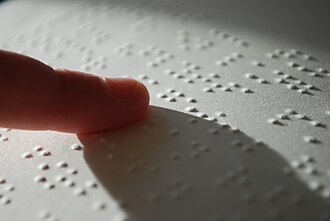
Braille is a tactile writing system used by blind and visually impaired people, in which characters are formed by six raised dots arranged in two columns of three, the braille cell. Louis Braille, a Frenchman who had lost his sight in a childhood accident, developed it in 1824 at the age of fifteen as an improvement on Charles Barbier's night writing, whose sets of 12 embossed dots encoded 36 sounds; Braille's cells stood for the letters of the French alphabet and added numerals and punctuation. He published the system, with musical notation, in 1829. Braille codes now exist for over 133 languages.
On the inventions tree
- First known
- 1824
- Credited to
- Louis Braille
Cite this entry
- APA
- The Epoch Institute. (2026). Braille. In The Epoch Institute Encyclopedia. https://the-epoch-institute.org/encyclopedia/braille
- MLA
- “Braille.” The Epoch Institute Encyclopedia, The Epoch Institute, 2026, https://the-epoch-institute.org/encyclopedia/braille. Accessed .
- Chicago
- The Epoch Institute. “Braille.” The Epoch Institute Encyclopedia. 2026. https://the-epoch-institute.org/encyclopedia/braille.
- Harvard
- The Epoch Institute (2026) ‘Braille’, The Epoch Institute Encyclopedia. Available at: https://the-epoch-institute.org/encyclopedia/braille (Accessed: ).
Last reviewed October 2026Random entry ↻