Inventions & Discoveries · Medicine and health
De Motu Cordis
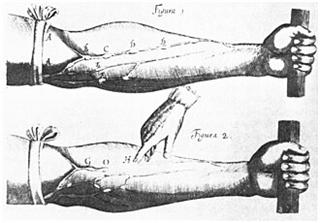
De Motu Cordis is William Harvey's treatise on the motion of the heart and blood, first published in 1628, which established that the blood circulates through the body. Treating the heart as a pump and measuring the blood it sends out, Harvey concluded that the same blood keeps returning in a closed circuit, out through the arteries and back by the veins. He had presented the case in lectures by 1616; in 1660 Marcello Malpighi saw blood moving in the capillaries, supplying the missing link in the proof.
On the inventions tree
- First known
- 1628
- Credited to
- William Harvey
NoteIbn al-Nafis had described the pulmonary circulation in the 13th century and Michael Servetus in 1553; the complete circulation is Harvey’s.
Built onModern anatomy1543
See also

Cite this entry
- APA
- The Epoch Institute. (2026). De Motu Cordis. In The Epoch Institute Encyclopedia. https://the-epoch-institute.org/encyclopedia/de-motu-cordis
- MLA
- “De Motu Cordis.” The Epoch Institute Encyclopedia, The Epoch Institute, 2026, https://the-epoch-institute.org/encyclopedia/de-motu-cordis. Accessed .
- Chicago
- The Epoch Institute. “De Motu Cordis.” The Epoch Institute Encyclopedia. 2026. https://the-epoch-institute.org/encyclopedia/de-motu-cordis.
- Harvard
- The Epoch Institute (2026) ‘De Motu Cordis’, The Epoch Institute Encyclopedia. Available at: https://the-epoch-institute.org/encyclopedia/de-motu-cordis (Accessed: ).
Last reviewed October 2026Random entry ↻