Inventions & Discoveries · Transport and navigation
Kite
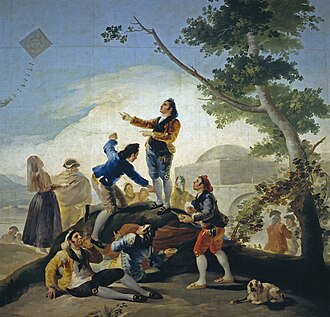
A kite is a tethered craft heavier than air whose wing surfaces react against the wind to give lift. It was first made in China, where kites of silk and bamboo, and of paper after its invention in the Han dynasty, served to measure distances, test the wind, lift men and signal in war; by 549 CE a kite carried a message for a rescue mission. Kites spread to India, where the fighter kite developed, and across Polynesia, but reached Europe late: Konrad Kyeser described dragon kites about 1400. Benjamin Franklin published an account of a kite experiment on lightning in 1752, and kites served the research of the Wright brothers toward the first airplane.
On the inventions tree
- First known
- by 549
- Where
- China
NoteThe kite has been claimed as the invention of the 5th-century BCE Chinese philosophers Mozi and Lu Ban, who are said to have flown wooden kites called muyuan.
See also





Cite this entry
- APA
- The Epoch Institute. (2026). Kite. In The Epoch Institute Encyclopedia. https://the-epoch-institute.org/encyclopedia/kite
- MLA
- “Kite.” The Epoch Institute Encyclopedia, The Epoch Institute, 2026, https://the-epoch-institute.org/encyclopedia/kite. Accessed .
- Chicago
- The Epoch Institute. “Kite.” The Epoch Institute Encyclopedia. 2026. https://the-epoch-institute.org/encyclopedia/kite.
- Harvard
- The Epoch Institute (2026) ‘Kite’, The Epoch Institute Encyclopedia. Available at: https://the-epoch-institute.org/encyclopedia/kite (Accessed: ).
Last reviewed October 2026Random entry ↻