Inventions & Discoveries · Chemistry
Lacquerware
Lacquerware consists of objects coated with lacquer, in East Asia an urushiol-based lacquer from the dried sap of the lacquer tree, Toxicodendron vernicifluum. The oldest known lacquerware, burial ornaments from an Initial Jōmon pit grave at the Kakinoshima site in Hakodate, Hokkaido, Japan, is about 9,000 years old, and the earliest in China is a red wooden bowl from a Hemudu culture site in Zhejiang. Chinese lacquer became a decorative art under the Shang dynasty and a commercial industry in the state of Chu under the Eastern Zhou, and spread to Korea and Japan; the traditions of Southeast Asia, South Asia and the Americas arose independently.
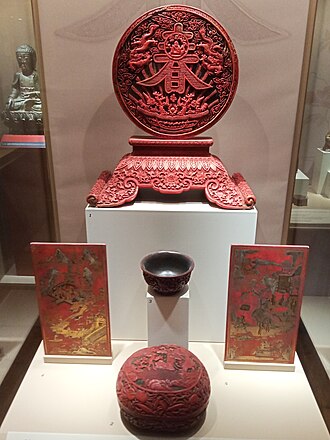
On the inventions tree
- First known
- c. 7000 BCE
- Where
- Kakinoshima, Hakodate, Hokkaido, Japan
- Credited to
- Jōmon culture
Also arose independentlyZhejiang, China (Hemudu culture) (5th millennium BCE)
NoteThe Kakinoshima pieces are also dated to the 9th millennium BCE, and a lacquer tree of the Jōmon period is 12,600 years old. Experts are divided on whether Jōmon lacquer was invented independently or derived from Chinese techniques.
See also





Cite this entry
- APA
- The Epoch Institute. (2026). Lacquerware. In The Epoch Institute Encyclopedia. https://the-epoch-institute.org/encyclopedia/lacquer
- MLA
- “Lacquerware.” The Epoch Institute Encyclopedia, The Epoch Institute, 2026, https://the-epoch-institute.org/encyclopedia/lacquer. Accessed .
- Chicago
- The Epoch Institute. “Lacquerware.” The Epoch Institute Encyclopedia. 2026. https://the-epoch-institute.org/encyclopedia/lacquer.
- Harvard
- The Epoch Institute (2026) ‘Lacquerware’, The Epoch Institute Encyclopedia. Available at: https://the-epoch-institute.org/encyclopedia/lacquer (Accessed: ).
Last reviewed October 2026Random entry ↻