Inventions & Discoveries · Tools and materials
Loom
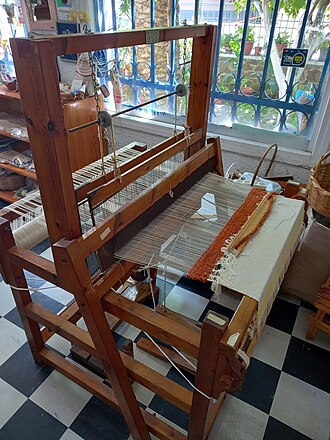
A loom is a device for weaving cloth and tapestry that holds the warp threads under tension while the weft threads are passed over and under them. The earliest evidence of a horizontal loom is a picture on a pottery dish from ancient Egypt dated to 4400 BCE, showing a frame loom with treadles that left the weaver's hands free to pass and beat the weft. The warp-weighted loom, whose warp is kept taut by hanging weights, may go back to the Neolithic. The drawloom for patterned silk is first confirmed by fabrics from the State of Chu of about 400 BCE; it sped up Chinese silk weaving and was introduced to Persia, India and Europe.
On the inventions tree
- First known
- c. 4400 BCE
- Where
- Egypt
NoteThe warp-weighted loom may have originated earlier, in the Neolithic period.
See also






Cite this entry
- APA
- The Epoch Institute. (2026). Loom. In The Epoch Institute Encyclopedia. https://the-epoch-institute.org/encyclopedia/loom
- MLA
- “Loom.” The Epoch Institute Encyclopedia, The Epoch Institute, 2026, https://the-epoch-institute.org/encyclopedia/loom. Accessed .
- Chicago
- The Epoch Institute. “Loom.” The Epoch Institute Encyclopedia. 2026. https://the-epoch-institute.org/encyclopedia/loom.
- Harvard
- The Epoch Institute (2026) ‘Loom’, The Epoch Institute Encyclopedia. Available at: https://the-epoch-institute.org/encyclopedia/loom (Accessed: ).
Last reviewed October 2026Random entry ↻