Inventions & Discoveries · Science and discovery
Periodic table
The periodic table is an ordered arrangement of the chemical elements into rows (periods) and columns (groups), in which elements of the same group tend to show similar chemical properties; the first to become generally accepted was that of the Russian chemist Dmitri Mendeleev, published in 1869. He left gaps for elements not yet known and predicted the properties of three of them; gallium, scandium and germanium, discovered between 1875 and 1886, matched his predictions. The periodic law it depicts was explained early in the 20th century by the discovery of atomic numbers.
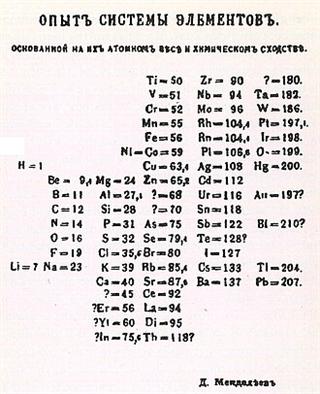
On the inventions tree
- First known
- 1869
- Where
- Russia
- Credited to
- Dmitri Mendeleev · Russian Empire
NoteLothar Meyer’s book of 1864 and John Newlands’s work of 1863–1864 held earlier versions; Mendeleev’s was the first to be generally accepted.
Cite this entry
- APA
- The Epoch Institute. (2026). Periodic table. In The Epoch Institute Encyclopedia. https://the-epoch-institute.org/encyclopedia/periodic-table
- MLA
- “Periodic table.” The Epoch Institute Encyclopedia, The Epoch Institute, 2026, https://the-epoch-institute.org/encyclopedia/periodic-table. Accessed .
- Chicago
- The Epoch Institute. “Periodic table.” The Epoch Institute Encyclopedia. 2026. https://the-epoch-institute.org/encyclopedia/periodic-table.
- Harvard
- The Epoch Institute (2026) ‘Periodic table’, The Epoch Institute Encyclopedia. Available at: https://the-epoch-institute.org/encyclopedia/periodic-table (Accessed: ).
Last reviewed October 2026Random entry ↻