Europe
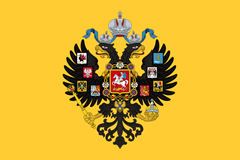
Russian Empire
At a glance
- Proclaimed by Peter the Great in 1721 after defeating Sweden, the Russian Empire grew to cover some 22.8 million square kilometres.
- It spread Russian rule from the Baltic to the Pacific and Central Asia, and freed some 23 million serfs in 1861.
- Autocracy, rural discontent and the strain of the First World War brought revolution and Nicholas II's abdication in 1917.
Rise & Fall
- 1703Peter I begins building Saint Petersburg on conquered Swedish territory
- 1709Peter's reformed army defeats Charles XII of Sweden at Poltava
- 1721The Senate proclaims Peter I Emperor of All Russia after the Treaty of Nystad
- 1812Napoleon's Grande Armée invades Russia and is destroyed in the winter retreat
- 1861Alexander II's Emancipation Edict frees some 23 million privately owned serfs
- 1891Construction of the Trans-Siberian Railway begins
- 1905Defeat at Tsushima and revolution force Nicholas II to issue the October Manifesto
- 1917Nicholas II abdicates after the Petrograd garrison mutinies
Foundation
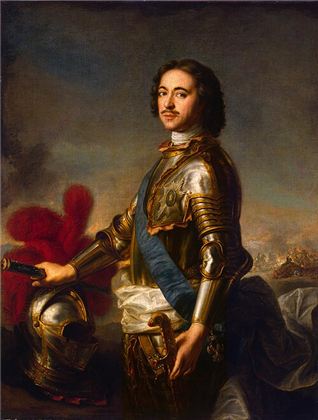
The Russian Empire was formally proclaimed on 2 November 1721, when the Senate conferred upon Peter I the titles of Emperor of All Russia, Peter the Great and Father of the Fatherland, following his victory over Sweden in the Great Northern War (1700–1721) and the acquisition of the Baltic provinces by the Treaty of Nystad. Yet the empire's foundations were laid across the preceding two centuries of Muscovite expansion, beginning with Ivan III's repudiation of Mongol suzerainty in 1480 and the gradual absorption of rival Russian principalities into the Grand Duchy of Moscow. Ivan IV ('the Terrible'), who reigned from 1547 to 1584, was crowned Tsar and began the eastward expansion beyond the Ural Mountains into Siberia, a process accelerated by the Cossack campaigns of Yermak Timofeyevich from the early 1580s that would carry Russian sovereignty to the Pacific coast by 1639. Peter I's foundational contribution was the systematic reorientation of Russia towards Western European institutional models: reorganising the army, building a navy almost from nothing, subordinating the Russian Orthodox Church to the state by replacing the Patriarchate with the Holy Synod in 1721, founding Saint Petersburg as a purpose-built European capital on conquered Swedish territory from 1703, and introducing the Table of Ranks in 1722, which tied noble status to state service rather than birth alone. The enabling conditions for the imperial proclamation were the defeat of Charles XII's Sweden, previously the dominant Baltic power, and the international recognition that followed, establishing Russia for the first time as an undeniable participant in the European state system.
Socioeconomy
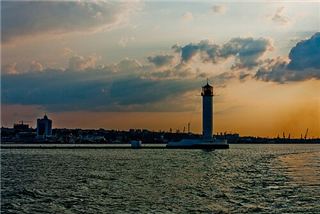
The Russian Empire's social structure was defined above all by serfdom, which bound roughly a third of the total population, and a far higher proportion of the rural workforce, to the land and to the legal authority of noble landowners until Tsar Alexander II's Emancipation Edict of 19 February 1861. The social hierarchy descended from the imperial family through the hereditary nobility (dvoryanstvo), the clergy, the urban merchants (kupechestvo), state peasants and privately owned serfs, with the 1722 Table of Ranks creating a parallel ladder of ennobling state service that Peter I intended to compete with hereditary privilege. Agriculture dominated the imperial economy throughout its existence, with grain from the black-earth belt of Ukraine and southern Russia forming the primary source of both subsistence and export revenue; by the 1890s Russia was among the world's leading grain exporters, shipping vast quantities through the Black Sea ports of Odessa and Novorossiysk. The Trans-Siberian Railway, begun in 1891 and substantially completed by 1904, was the most ambitious infrastructure project in the empire's history, linking European Russia to the Pacific across some 9,288 kilometres and enabling both military projection and the commercial exploitation of Siberian resources. Sergei Witte's industrialisation programme of the 1890s drove annual industrial growth of around 8 per cent, making Russia one of the world's five largest industrial economies by 1900, though this transformation remained concentrated in Saint Petersburg, Moscow, the Donbas coalfields and the Baku oilfields, leaving vast agricultural regions largely unchanged.
Military

The imperial Russian military underwent four major transformations across the empire's 196-year existence, each prompted by the exposure of inadequacy in a major conflict. Peter I's reforms after the defeat at Narva in 1700, where roughly 10,000 Swedish troops routed a Russian army of some 35,000 to 40,000, created a standing army organised into regiments on the Western European model, equipped with standardised weapons and officered through promotion by service, which defeated Charles XII at Poltava in 1709. Catherine II's armies, under Field Marshals Rumyantsev and Suvorov, proved highly effective against the Ottomans in the Russo-Turkish Wars of 1768–1774 and 1787–1792, with Suvorov developing an offensive doctrine emphasising speed, shock and the exploitation of disorder that was devastating against both Ottoman and Polish opponents. The Patriotic War of 1812, in which Napoleon's Grande Armée of around 600,000 men invaded Russia in June and was reduced to a small fraction of that number by December through Russian strategic withdrawal, the burning of Moscow, partisan warfare and the catastrophic winter retreat, established the template of Russian military identity. The Crimean War (1853–1856), however, exposed the military consequences of serfdom and administrative backwardness: Russian troops armed largely with smoothbore muskets faced Anglo-French infantry equipped with Minié rifles, and the empire's inability to supply its own Crimean peninsula revealed a logistical weakness that the Great Reforms partly addressed through the modernisation overseen by Dmitry Milyutin, War Minister from 1861 to 1881, culminating in universal military service in 1874.
Governance & Law
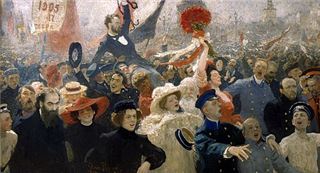
The Russian Empire was governed as an autocracy throughout its existence, with the emperor holding theoretically unlimited authority over legislation, administration, justice and the military, constrained in practice by the capacity of the bureaucracy to implement decisions across a territory that at its greatest extent covered some 22.8 million square kilometres. The central apparatus evolved significantly over the imperial period: Peter I's collegiate system of administrative boards (1718) gave way under Alexander I to eight ministries (1802), creating a more rational functional division of executive authority. The Senate, originally conceived by Peter I as a governing council during his absences, gradually became primarily a supreme court of appeal and supervisory body rather than a legislature. Catherine II's Provincial Reform of 1775 reorganised the empire into some 50 governorates (gubernii) of roughly 300,000 to 400,000 inhabitants each, administered by governors answerable to the centre, with governors-general overseeing groups of provinces, a framework that substantially improved local administration and persisted in outline until 1917. The most significant legal reform of the period was Alexander II's Judicial Reform of 1864, which introduced independent courts, trial by jury, adversarial procedure and a professionally trained judiciary, creating for the first time a court system that operated according to codified law rather than administrative discretion. The October Manifesto of 1905, issued under revolutionary pressure, and the Fundamental Laws of 1906 created the State Duma as a legislative assembly with genuine if limited representative authority, a constitutional order that Nicholas II consistently undermined in practice.
Global & Regional Impact
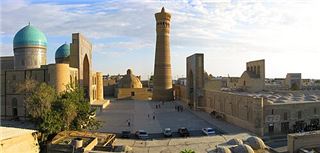
The Russian Empire's expansion across northern Asia was one of the most consequential territorial transformations of the early modern and modern periods, bringing Siberia, Central Asia, the Caucasus and, until 1867, Alaska under a single political authority and fundamentally reshaping the Eurasian geopolitical order. The conquest of the Khanate of Sibir in the late sixteenth century opened the fur trade that financed further eastward expansion, while the subjugation of the Central Asian khanates of Bukhara (1868), Khiva (1873) and Kokand (1876) brought the frontier to the borders of Afghanistan and British India, generating the 'Great Game' rivalry with Britain that shaped Central Asian political geography until the Anglo-Russian Convention of 1907. Russian cultural influence, spread through the Orthodox Church, the Russian language imposed on subject peoples from Poles to Kazakhs, and the extraordinary literary and musical flowering of the nineteenth century represented by Pushkin, Tolstoy, Dostoevsky, Tchaikovsky and Mussorgsky, created a distinctive civilisational sphere that both drew on and resisted Western European cultural dominance. At the Congress of Vienna (1814–1815), where Alexander I played a leading role, Russia was confirmed as one of the great powers of the Concert of Europe, a status it maintained through active intervention in European affairs, including the suppression of the Hungarian Revolution in 1849 and repeated wars with the Ottoman Empire. The abolition of serfdom in 1861, freeing some 23 million privately owned serfs, was one of the largest single acts of legal emancipation in world history, though its burdensome redemption terms fed the rural discontent that sustained revolutionary movements until 1917.
Decline & Fall

The Russian Empire's collapse in February 1917 resulted from the convergence of long-term structural weaknesses with the catastrophic pressures of the First World War, compressed into a political crisis that the Romanov autocracy proved institutionally incapable of managing. The structural weaknesses were multiple and mutually reinforcing: the incomplete emancipation of 1861 left the peasantry economically marginalised and politically alienated; rapid industrialisation created an urban working class, or proletariat, concentrated in the major cities without the trade unions, representative bodies and welfare mechanisms that had absorbed working-class radicalism in Western Europe; and the autocratic system consistently excluded experienced public figures from executive authority. The Russo-Japanese War of 1904–1905, in which Russia lost both its Pacific squadron at Port Arthur and the Baltic Fleet, annihilated at the Battle of Tsushima in May 1905 after a voyage of some 18,000 nautical miles, demonstrated that the empire could no longer project power against a modernising Asian adversary, and helped trigger the Revolution of 1905 and the grudging concessions of the October Manifesto. Nicholas II's personal shortcomings, his autocratic conviction combined with indecision, the influence of Grigori Rasputin over ministerial appointments, and his decision to assume personal command of the army in August 1915, which tied the dynasty directly to subsequent military failures, accelerated the erosion of legitimacy. By early 1917, after well over a million military dead and severe supply failures, bread riots in Petrograd turned into revolution when the garrison mutinied, and with his generals urging abdication, Nicholas II gave up the throne on 15 March 1917 (2 March in the Julian calendar then used in Russia).
The Russian Empire transformed the Muscovite state into one of the largest contiguous empires in history, leaving as its most consequential legacy not its institutions, which collapsed in 1917, but the geopolitical fact of a vast Eurasian landmass under centralised authority, a reality that its Soviet and post-Soviet successors inherited and perpetuated.
References
- Figes, O. (1996) A People's Tragedy: The Russian Revolution, 1891–1924. London: Jonathan Cape.
- Hosking, G. (1997) Russia: People and Empire, 1552–1917. London: HarperCollins.
- Kappeler, A. (2001) The Russian Empire: A Multiethnic History. Translated by A. Clayton. London: Longman.
- Lieven, D. (2000) Empire: The Russian Empire and Its Rivals. London: John Murray.
- Lincoln, W.B. (1981) The Romanovs: Autocrats of All the Russias. New York: Dial Press.
- Pipes, R. (1974) Russia under the Old Regime. New York: Charles Scribner's Sons.
- Riasanovsky, N.V. and Steinberg, M.D. (2011) A History of Russia. 8th edn. Oxford: Oxford University Press.
Connections
Open the full connections map →