Europe
French Empire
At a glance
- France built two colonial empires: one in North America and the Caribbean, lost in 1763, and a larger one in Africa and Asia.
- Plantation slavery made Saint-Domingue the world's richest colony, while the later empire extracted raw materials for French industry.
- Nationalist wars from Dien Bien Phu to Algeria ended it, leaving French as an official language in twenty-nine countries.
Rise & Fall
- 1534Jacques Cartier reaches the Gulf of St. Lawrence and claims land for Francis I
- 1608Samuel de Champlain founds Quebec as the capital of New France
- 1664Colbert establishes the French East India Company
- 1763Treaty of Paris cedes Canada and lands east of the Mississippi to Britain
- 1830France invades Algiers, beginning the second colonial empire
- 1954The Viet Minh force the surrender of the French garrison at Dien Bien Phu
- 1960Fourteen sub-Saharan colonies and trust territories become independent
- 1962The Evian Accords bring Algerian independence after eight years of war
Foundation
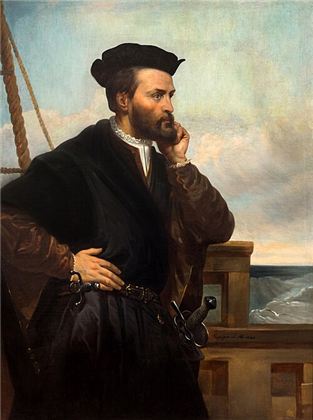
The French colonial enterprise began not with settlement but with exploration. Jacques Cartier reached the Gulf of St. Lawrence in 1534, claiming territory for Francis I, but decades of religious civil war prevented meaningful colonisation. The first colonial empire took genuine root only in 1608, when Samuel de Champlain founded Quebec as the capital of New France and the centre of the fur trade. Jean-Baptiste Colbert, Louis XIV's chief minister for finance and the navy, then systematised expansion as economic policy, establishing the French East India Company in 1664 and building a powerful fleet, while the western part of Hispaniola, Saint-Domingue, passed formally to France in 1697 and became the most profitable sugar colony in the Caribbean. By around 1710, the first empire stretched from Acadia along the St. Lawrence through the Great Lakes and down the Mississippi to Louisiana, covering some ten million square kilometres. The Seven Years' War destroyed it. The 1763 Treaty of Paris forced France to cede Canada and all North American territory east of the Mississippi to Britain, leaving it with Caribbean islands, Saint-Pierre and Miquelon, and five Indian trading posts. A second empire, begun with the 1830 invasion of Algiers, eventually surpassed the first in every measurable dimension.
Socioeconomy

The economic logic of the first empire rested on mercantilism and plantation slavery. By the 1780s Saint-Domingue alone produced around forty percent of the sugar and some sixty percent of the coffee consumed in Europe, making it the most lucrative colony in the world. The second empire operated on a different model, combining resource extraction with administrative integration. Algeria, organised into French departments from 1848, attracted around one million European settlers, the pieds-noirs, creating a dual economy in which European landowners dominated export agriculture while indigenous Algerians worked marginal land under legal discrimination. Across the empire, the doctrine of mise en valeur framed colonial economies around producing raw materials for French industry: rubber from Indochina, phosphates from North Africa, groundnuts from Senegal, cotton from the Sahel. The indigénat legal regime imposed a separate and inferior status on colonial subjects, institutionalising economic exclusion and forced labour. The empire's ideological framing as a mission civilisatrice obscured a largely extractive relationship, a contradiction that French republican intellectuals struggled increasingly to rationalise as the twentieth century advanced.
Military

French imperial military power was built on naval strength and specialised colonial forces. Colbert's naval construction programme made France one of the leading maritime powers of Europe by the late seventeenth century, enabling oceanic projection. The loss of naval supremacy to Britain, confirmed at the Battle of Lagos and at Quiberon Bay in 1759, was the proximate military cause of the first empire's collapse. The second empire relied heavily on the Foreign Legion, founded in 1831, and the tirailleurs, colonial infantry recruited from Senegal, Algeria, Indochina, and elsewhere, who fought in both world wars and whose pay and pensions lagged far behind those of their French counterparts. Under Napoleon III, colonial campaigns added Cochinchina, New Caledonia, and an expanded Senegal under Louis Faidherbe, and the Third Republic later pushed into Tunisia, Tonkin, Madagascar, and the Sahel. The catastrophic defeat that broke the second empire was Dien Bien Phu in May 1954, where General Vo Nguyen Giap's Viet Minh besieged and forced the surrender of a French garrison after fifty-six days, the most consequential colonial military defeat of the twentieth century. The Algerian War that followed, costing an estimated 300,000 to 1.5 million Algerian lives across eight years, confirmed that no military solution existed for a colonial relationship the subject population had decided to end.
Governance & Law

France governed its two empires through structurally different models. The first empire relied on chartered companies, appointed governors, and trading monopolies loosely supervised from Versailles, with little institutional coherence. The second empire developed a more systematic apparatus. Algeria was governed as an extension of France itself after 1848, with departments, prefects, and French civil law applying to European settlers while most indigenous Algerians remained under the indigénat. Indochina was administered as five distinct territories under a governor-general, based in Hanoi from 1902. West and Equatorial Africa were organised into two vast federations headquartered at Dakar and Brazzaville. The 1946 constitution attempted to reframe this system as the French Union, extending citizenship to colonial subjects and granting limited representation in Paris, but the reform was applied inconsistently and satisfied almost no one. De Gaulle's French Community of 1958 offered autonomy within a French framework; Guinea under Sékou Touré rejected it outright and took immediate independence, and within two years the remaining African territories had followed, dissolving the entire administrative edifice.
Global & Regional Impact

The French Empire's most durable legacy is linguistic and institutional. French remains an official language in twenty-nine countries, more than any language except English. The Napoleonic Code, exported across continental Europe during Napoleon's brief continental dominance, fundamentally shaped the legal systems of France's European neighbours and, through them and through French colonial rule, those of states across Africa and the Americas. French educational institutions of the colonial period produced the post-independence leadership class of much of Francophone Africa, and the close networks between Paris and these elites, known as Françafrique, shaped African politics long after formal decolonisation. The Haitian Revolution of 1791 to 1804, which destroyed Saint-Domingue and produced the first Black republic in history under the leadership of Toussaint Louverture and Jean-Jacques Dessalines, was itself a direct consequence of the first empire's plantation economy and a transformative moment in Atlantic history.
Decline & Fall

The first empire collapsed through military defeat in 1763 and the loss of its richest colony in the Haitian Revolution. The second empire's dissolution was driven by nationalist resistance the French state could not suppress without costs that democratic public opinion would not sustain. Dien Bien Phu in 1954 ended French Indochina; Morocco and Tunisia gained independence in 1956; fourteen sub-Saharan colonies and trust territories became independent in 1960; and the Évian Accords of March 1962 brought Algerian independence after eight years of war. Vanuatu's independence in 1980 completed the process. Unlike empires dissolved by external conquest, the French colonial empire collapsed because the contradiction between France's republican identity and its colonial practice proved ultimately irresolvable.
The French Empire's historical significance lies in its double arc: a rare modern empire that collapsed, rebuilt, and peaked again at greater scale, before being undone not by a rival power but by the incompatibility of its own values with its own conduct.
References
- Bell, D.A. (2015) Napoleon: A Concise Biography. Oxford: Oxford University Press.
- Broers, M. (2012) Napoleon: Soldier of Destiny. London: Faber and Faber.
- Chandler, D.G. (1966) The Campaigns of Napoleon. New York: Macmillan.
- Esdaile, C. (2007) Napoleon's Wars: An International History, 1803–1815. London: Allen Lane.
- Grab, A. (2003) Napoleon and the Transformation of Europe. Basingstoke: Palgrave Macmillan.
- Schroeder, P.W. (1994) The Transformation of European Politics, 1763–1848. Oxford: Clarendon Press.
- Woolf, S. (1991) Napoleon's Integration of Europe. London: Routledge.
Connections
Open the full connections map →