Europe
Kingdom of Denmark
At a glance
- Traced to Gorm the Old around 936, Denmark is among the oldest continuous monarchies in the world.
- Its kings ruled England under Cnut, led the Kalmar Union of 1397 and taxed Baltic shipping through the Sound Toll.
- Defeats by Sweden in 1658 and by Prussia and Austria in 1864 left a small state that rebuilt itself as a welfare democracy.
Rise & Fall
- c. 965Harald Bluetooth adopts Christianity and raises the great Jelling stone
- 1219Valdemar II wins at Lyndanisse and establishes Danish rule in northern Estonia
- 1397Margaret I unites Denmark, Norway and Sweden in the Kalmar Union
- 1536Christian III introduces the Lutheran Reformation
- 1658The Treaty of Roskilde cedes Scania, Halland and Blekinge to Sweden
- 1814The Treaty of Kiel transfers Norway to Sweden
- 1849The Constitution of 5 June ends absolute monarchy
- 1864Defeat in the Second Schleswig War costs Schleswig and Holstein
Foundation

Danish kings appear in Frankish sources from the late eighth century: Godfred defied Charlemagne and strengthened the Danevirke, the earthwork across the base of the Jutland peninsula, around 808. But the continuous line of the Danish monarchy is traced to Gorm the Old, who ruled from Jelling in central Jutland from about 936 until his death around 958. Gorm raised a runestone at Jelling in memory of his wife Thyra, one of the earliest monuments to name the land as Denmark.
His son Harald Bluetooth (r. c. 958–c. 986) set up the larger Jelling stone, which declares that he “won for himself all Denmark and Norway and made the Danes Christian”. Harald’s conversion, usually dated to about 965 and linked by the chronicler Widukind of Corvey to the missionary Poppo, tied the kingdom to the German church. Harald also built the bridge at Ravning Enge and the circular fortresses of Trelleborg, Fyrkat and Aggersborg, which tree-ring dating places around 980. According to Adam of Bremen his son Sweyn Forkbeard rebelled and drove him into exile, where he died. Sweyn’s raids on England culminated in its conquest in 1013, and his son Cnut the Great ruled England from 1016 and Denmark from about 1018, adding Norway in 1028.
Socioeconomy
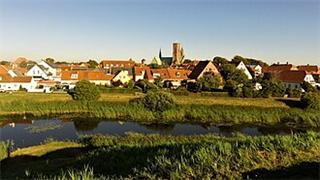
Medieval Denmark was a land of grain-growing villages on the fertile clays of eastern Jutland, the islands and Scania, with fisheries that boomed when the Scania herring market drew merchants from across northern Europe each autumn from the twelfth century. Towns such as Ribe, Roskilde, Lund and later Copenhagen were small by continental standards, and the Hanseatic League dominated much of their trade. Lund became the seat of an archbishopric for all Scandinavia in 1103–1104, and the church grew into the largest landowner. Eric of Pomerania introduced the Sound Toll around 1429, a levy on ships passing Helsingør that helped fund the crown until its abolition in 1857.
After the Lutheran Reformation of 1536 the crown seized church lands, and the nobility consolidated large manors worked by dependent peasants; the stavnsbånd of 1733 bound male peasants to their home estates until the agrarian reforms of 1788. Trading companies operated from Tranquebar in India, Christiansborg on the Gold Coast and the Danish West Indies, where the sugar plantations of St Croix depended on enslaved Africans. Denmark declared the transatlantic slave trade illegal in 1792, with effect from 1803. Cooperative dairies and the folk high schools inspired by N.F.S. Grundtvig later transformed rural life, and the twentieth century built a tax-funded welfare state.
Military
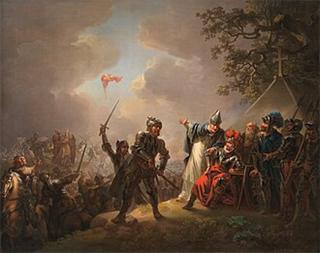
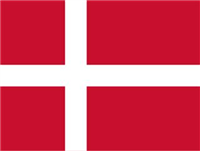
Viking-age Danish power rested on fleets and royal fortresses, and Sweyn Forkbeard and Cnut raised the armies that extracted Danegeld from England. Under Valdemar I the Great and Bishop Absalon, Danish fleets fought the Wendish pirates of the southern Baltic and in 1168 took Arkona on Rügen, destroying the temple of Svantevit. Valdemar II “the Victorious” led a crusade to Estonia, where, according to a legend first recorded in the sixteenth century, the Dannebrog flag fell from heaven during the Battle of Lyndanisse in 1219. His capture by Count Henry of Schwerin in 1223 and defeat at the Battle of Bornhöved in 1227 ended Danish dominance over northern Germany. Valdemar IV Atterdag sacked Visby on Gotland in 1361 but lost the ensuing war with the Hanseatic League, ended by the Treaty of Stralsund in 1370.
Denmark–Norway later fought Sweden repeatedly for the Baltic. Christian IV won the Kalmar War of 1611–1613 but was beaten by Tilly at the Battle of Lutter am Barenberge in 1626 during the Thirty Years’ War, and the Torstenson War ended in the losses of the Treaty of Brömsebro in 1645. In 1658 Charles X Gustav of Sweden marched his army across the frozen belts. The navy remained formidable until the British attacked it at the Battle of Copenhagen in 1801 and seized it in 1807. Defeat at Dybbøl in 1864 ended its military ambitions.
Governance & Law
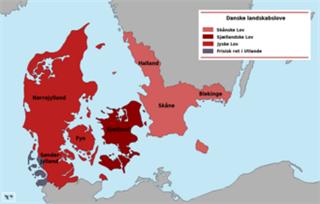
The medieval king was chosen by the magnates and acclaimed at regional assemblies (landsting), usually from the royal family. Provincial laws were written down in the thirteenth century, above all the Jutland Code of 1241 issued by Valdemar II, which opens with the words “with law shall the land be built”. From 1282 kings had to accept a coronation charter (håndfæstning) limiting their power, and the council of the realm (Rigsrådet) of nobles and bishops took a large share in government. The crisis of the 1320s, when Christopher II pawned most of the kingdom to the counts of Holstein, left Denmark without a king from 1332 to 1340. Margaret I restored royal authority and, through the Kalmar Union of 1397, ruled all three Scandinavian kingdoms in the name of her grandnephew Eric of Pomerania.
The Oldenburg dynasty, beginning with Christian I in 1448, governed Norway as part of a composite monarchy and acquired Schleswig and Holstein in 1460. In 1660 Frederick III used the support of burghers and clergy to make the crown hereditary and absolute, codified in the Royal Law (Kongeloven) of 1665, and Christian V’s Danish Law of 1683 unified the legal system. The Constitution of 5 June 1849 created a constitutional monarchy, and since 1901 governments have answered to the elected chamber, the Folketing.
Global & Regional Impact
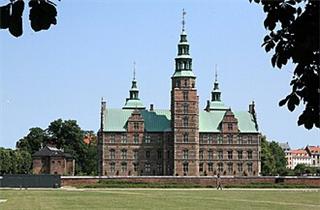
Danish kings shaped the whole North Sea world. Cnut’s reign bound England to Scandinavia for a generation, and medieval Denmark carried Latin Christianity and crusading warfare into the Baltic; Danish rule of Reval (Tallinn) from 1219 to 1346 left its mark on the Estonian capital. The union of crowns with Norway from 1380 to 1814 made Danish the written language of Norway, and Iceland, the Faroe Islands and Greenland stayed under the Danish crown after Norway’s departure, so that Danish administration and language shaped the whole North Atlantic. The Sound Toll made Copenhagen a crossroads of European diplomacy, and Christian IV’s buildings, among them the Round Tower and Rosenborg Castle, still define the city. Tycho Brahe’s observatory of Uraniborg on the island of Hven, granted to him by Frederick II in 1576, produced the observations from which Johannes Kepler derived his laws of planetary motion.
Later Danish figures of wide influence include the philosopher Søren Kierkegaard, the writer Hans Christian Andersen and the physicist Niels Bohr, whose Copenhagen institute became a centre of quantum physics. In the twentieth century the rescue of most Danish Jews to Sweden in October 1943, the Nordic welfare model and an early commitment to wind power gave a small state an influence well beyond its size.
Into the Present

Denmark shrank from a Baltic great power to a small nation-state through a series of losses. The Treaty of Roskilde in 1658 surrendered Scania, Halland and Blekinge, the rich eastern provinces, to Sweden, and the Scanian War of 1675–1679 failed to win them back. Having sided with Napoleon after 1807, Denmark went bankrupt in 1813 and by the Treaty of Kiel of 1814 ceded Norway to Sweden, keeping Iceland, the Faroe Islands and Greenland. The national conflict over Schleswig and Holstein led to the First Schleswig War of 1848–1851 and the Second Schleswig War of 1864, after which the Treaty of Vienna gave both duchies and Lauenburg to Prussia and Austria. The saying “what is lost outwardly must be won inwardly” captured the small kingdom’s turn to land reclamation and education.
The Danish West Indies were sold to the United States in 1917, and northern Schleswig returned after a plebiscite in 1920. Iceland became a separate kingdom in union with Denmark in 1918 and a republic in 1944. After the German occupation of 9 April 1940 to May 1945 Denmark became a founding member of NATO in 1949 and joined the European Community in 1973. The Faroe Islands gained home rule in 1948 and Greenland in 1979. Queen Margrethe II abdicated in January 2024 in favour of her son, Frederik X.
Denmark is one of Europe’s oldest continuous kingdoms: from Viking-age Jelling its kings ruled England, Norway and the approaches to the Baltic, taxed the Sound for four centuries, and after losing most of their realm remade it as a constitutional monarchy and welfare state that still includes the Faroe Islands and Greenland.
Test yourself
5 questions on this page, from its key events and facts.
The questions open here once the page has loaded.
References
- Sawyer, B. and Sawyer, P. (1993) Medieval Scandinavia: From Conversion to Reformation, circa 800–1500. Minneapolis: University of Minnesota Press.
- Roesdahl, E. (1982) Viking Age Denmark. London: British Museum Publications.
- Lockhart, P.D. (2007) Denmark, 1513–1660: The Rise and Decline of a Renaissance Monarchy. Oxford: Oxford University Press.
- Jespersen, K.J.V. (2004) A History of Denmark. Basingstoke: Palgrave Macmillan.
- Derry, T.K. (1979) A History of Scandinavia: Norway, Sweden, Denmark, Finland and Iceland. London: George Allen & Unwin.
Connections
Open the full connections map →