Europe
Papal States
At a glance
- The lands of central Italy ruled by the popes as temporal sovereigns from the Frankish donations of the 750s until 1870.
- Papal control was often weak, but Renaissance popes made the state a real power and Rome an artistic capital.
- Napoleon and then Italian unification dismantled it; Vatican City, created in 1929, is its last remnant.
Rise & Fall
- 754Pope Stephen II wins the protection of Pepin the Short against the Lombards
- 800Leo III crowns Charlemagne emperor in Rome
- 1357Cardinal Albornoz issues the Egidian Constitutions
- 1506Julius II takes Bologna and founds the Swiss Guard
- 1527Imperial troops sack Rome
- 1809Napoleon annexes the Papal States to the French Empire
- 1860Defeat at Castelfidardo; the Marche and Umbria join Italy
- 1870Italian troops enter Rome through the breach at Porta Pia
Foundation

The temporal power of the popes grew out of the collapse of Byzantine authority in Italy. From the time of Gregory the Great (590–604) the bishops of Rome administered the extensive estates of the Roman church, fed the city and negotiated with the Lombards, and the Byzantine Duchy of Rome increasingly looked to the pope rather than to distant Constantinople. The quarrel over Iconoclasm in the eighth century widened the gap. In 728 the Lombard king Liutprand handed the town of Sutri to Pope Gregory II, an act often seen as the first territorial grant to the papacy. When King Aistulf seized Ravenna in 751 and threatened Rome, Pope Stephen II crossed the Alps and in 754 met the Frankish king Pepin the Short, whom he anointed at Saint-Denis. Pepin defeated the Lombards in 754 and 756 and gave the pope the lands of the former Exarchate of Ravenna, the so-called Donation of Pepin. In 774 Charlemagne conquered the Lombard kingdom and confirmed the grant to Pope Hadrian I, and in 800 Pope Leo III crowned him emperor in Rome. Around this time the forged Donation of Constantine, claiming that the first Christian emperor had granted the pope authority over the West, was produced; Lorenzo Valla proved it a forgery in 1440.
Socioeconomy
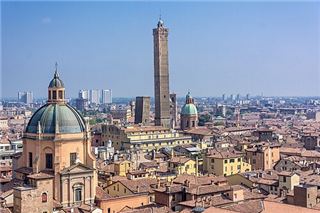
The Papal States were largely agrarian. The Roman Campagna was given over to great estates and grazing, increasingly malarial and thinly populated, while the Marche and Umbria grew grain, wine and olives, and Bologna, the richest city of the state, had a large silk industry and Europe’s oldest university. Rome itself was exceptional. Its population fell to perhaps 20,000–30,000 in the fourteenth century but recovered to about 100,000 by 1600, and the city lived largely on the presence of the papal court, pilgrims and the revenues of the universal church. Jubilee years, first proclaimed by Boniface VIII in 1300, brought great crowds of pilgrims. The discovery of alum at Tolfa in the 1460s gave the papacy a valuable monopoly, and from the sixteenth century the popes financed themselves through the sale of offices and a funded public debt organised in monti. Society was dominated by baronial families such as the Colonna and Orsini and by the relatives of successive popes, who acquired land and titles. The Jews of Rome, present since antiquity, were confined to a ghetto by Paul IV in 1555 and remained subject to restrictions until 1870. Catholic religious life shaped the calendar, charity and education, while in the nineteenth century the state was widely regarded as one of the most backward in Europe.
Military
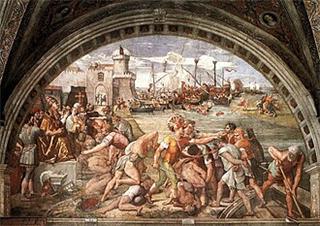
The popes were weak military rulers and usually relied on others to protect them: the Franks against the Lombards, the Normans of southern Italy, who became papal vassals at Melfi in 1059, and later France, Spain or Austria. After Arab raiders sacked the basilica of Saint Peter in 846, Leo IV enclosed the Vatican with the Leonine Wall, and a papal-allied fleet defeated another Arab force at the Battle of Ostia in 849. In the later Middle Ages the papacy hired mercenary companies and condottieri. Cardinal Gil Álvarez Carrillo de Albornoz reconquered the papal provinces in 1353–1367 with mercenary armies and a ring of fortresses. Around 1500 Cesare Borgia, son of Pope Alexander VI, subdued the lords of the Romagna with French help, and Pope Julius II personally led his troops, recovering Perugia and Bologna in 1506 and besieging Mirandola in 1511. Julius founded the Pontifical Swiss Guard in 1506. Papal galleys under Marcantonio Colonna served at the Battle of Lepanto in 1571, and the War of Castro of 1641–1644 showed the limits of papal arms against small Italian princes. In the nineteenth century the small papal army, reinforced by foreign volunteers including the papal Zouaves, was defeated by Piedmont at Castelfidardo in 1860 and held Rome only with French help, winning at Mentana in 1867.
Governance & Law

The Papal States were an elective monarchy. From 1059 popes were elected by the cardinals, a two-thirds majority was required from 1179, and from 1274 elections took place in a closed conclave. The pope ruled as both spiritual head of the Catholic Church and temporal sovereign, and the two roles were never separated. For much of the Middle Ages papal control outside Rome was weak: cities such as Bologna, Perugia and Viterbo governed themselves as communes, local lords ruled as papal vicars, and in Rome itself a commune with its own senate challenged papal rule from 1143. Innocent III (1198–1216) recovered the Duchy of Spoleto and the March of Ancona and organised the state into provinces under rectors. During the residence of the popes at Avignon, Cardinal Albornoz restored order and issued the Egidian Constitutions in 1357, which remained the basic law of the state until 1816. Finances were managed by the Apostolic Camera. Sixtus V reorganised the central government in 1588 into congregations of cardinals, including one for the administration of the state, and provinces were governed by cardinal legates and delegates. Nepotism, by which popes enriched relatives and made them cardinals, was a recurring feature until Innocent XII restricted it in 1692. Clergy dominated the administration until the end, which made reform and lay participation difficult.
Global & Regional Impact
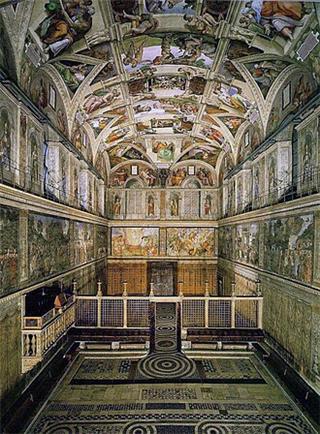
The Papal States gave the papacy a territorial base that allowed it to act as an independent power in European politics, but they also entangled it in Italian wars and dynastic ambitions. The Donation of Pepin and the coronation of Charlemagne in 800 created a lasting partnership between the papacy and the western empire and shaped the political theory of medieval Europe. Under the Renaissance and Baroque popes, Rome became the artistic capital of Europe: Sixtus IV built the Sistine Chapel and founded the Vatican Library, Julius II commissioned Michelangelo’s ceiling of the Sistine Chapel and Raphael’s frescoes in the Vatican, and the new basilica of Saint Peter, begun in 1506, was completed by Carlo Maderno and Gian Lorenzo Bernini in the seventeenth century. Gregory XIII introduced the Gregorian calendar in 1582, now used worldwide. Machiavelli blamed the papacy’s temporal state for keeping Italy divided, and in the nineteenth century the existence of the Papal States became the main obstacle to Italian unification, the so-called Roman Question. Their loss in 1870 freed the papacy from the burdens of territorial government and, after the Lateran Treaty of 1929, left it with the small sovereign state of Vatican City, which allows the Holy See to act in international affairs as a sovereign entity today.
Decline & Fall

The Papal States were dismantled in stages between the French Revolution and Italian unification. Revolutionary France annexed Avignon and the Comtat Venaissin in 1791, Napoleon forced Pius VI to cede the Legations of Bologna, Ferrara and Romagna at the Treaty of Tolentino in 1797, and in 1798 French troops proclaimed a Roman Republic and carried the pope into exile, where he died in 1799. Pius VII returned in 1800, but in 1809 Napoleon annexed the remaining states to the French Empire and the pope was held captive until 1814. The Congress of Vienna restored almost all the territories in 1815, but papal government was unpopular among the educated classes, and revolts in 1831 were put down by Austrian troops. Pius IX began as a reforming pope in 1846, but after the murder of his minister Pellegrino Rossi in 1848 he fled to Gaeta, and a Roman Republic was declared in 1849 until French troops restored him. In 1859–1860 the Romagna rebelled, the papal army was defeated at Castelfidardo, and the Marche and Umbria voted to join the new Kingdom of Italy. Rome survived under French protection until the Franco-Prussian War forced France to withdraw its garrison. On 20 September 1870 Italian troops entered Rome through the breach at Porta Pia, and Rome became the capital of Italy in 1871.
The Papal States made the pope a temporal ruler of central Italy for over eleven centuries, giving the papacy the independence and wealth that sustained its role in European politics and Renaissance art, while keeping Italy divided until the capture of Rome in 1870 and leaving Vatican City as its last remnant.
References
- Noble, T.F.X. (1984) The Republic of St. Peter: The Birth of the Papal State, 680–825. Philadelphia: University of Pennsylvania Press.
- Waley, D. (1961) The Papal State in the Thirteenth Century. London: Macmillan.
- Partner, P. (1972) The Lands of St Peter: The Papal State in the Middle Ages and the Early Renaissance. London: Eyre Methuen.
- Prodi, P. (1987) The Papal Prince: One Body and Two Souls: The Papal Monarchy in Early Modern Europe. Trans. S. Haskins. Cambridge: Cambridge University Press.
- Kertzer, D.I. (2004) Prisoner of the Vatican: The Popes’ Secret Plot to Capture Rome from the New Italian State. Boston: Houghton Mifflin.
Connections
Open the full connections map →