Europe
Tsardom of Russia
Rise & Fall
- 1547Ivan IV is crowned Tsar of All Russia
- 1552Russian forces capture Kazan
- 1565Ivan IV creates the oprichnina
- 1613Michael Romanov is elected tsar, ending the Time of Troubles
- 1649The Sobornoe Ulozhenie law code completes the enserfment of the peasantry
- 1667Truce of Andrusovo gives Russia Kyiv and left-bank Ukraine
- 1709Peter I defeats Charles XII of Sweden at the Battle of Poltava
- 1721Treaty of Nystad; Peter I takes the title of emperor
Foundation
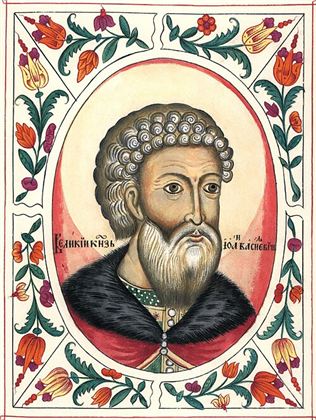
The Tsardom of Russia grew out of the Grand Duchy of Moscow, which under Ivan III (r. 1462–1505) and Vasily III (r. 1505–1533) had absorbed Novgorod, Tver, Pskov and Ryazan, thrown off the overlordship of the Great Horde and become the dominant power among the Russian principalities. Ivan III had married Sophia Palaiologina, niece of the last Byzantine emperor, used the double-headed eagle and occasionally styled himself tsar, and Russian churchmen developed the idea of Moscow as the heir of Rome and Constantinople, a ‘Third Rome’. On 16 January 1547 his grandson Ivan IV, then sixteen, was crowned Tsar of All Russia by Metropolitan Macarius in the Dormition Cathedral of the Moscow Kremlin. The title, derived from the Latin caesar and used in Russia for Byzantine emperors and Mongol khans, asserted that the ruler of Moscow owed allegiance to no one and stood equal to any emperor. The early years of Ivan’s reign brought reforms by his circle of advisers, and in 1552 his army stormed Kazan, followed by the annexation of the Khanate of Astrakhan in 1556. These conquests gave Moscow control of the entire Volga and made the tsardom, for the first time, a multi-ethnic state ruling large Muslim and other non-Russian populations.
Socioeconomy

Muscovite society was overwhelmingly rural, with most people peasants growing rye, oats and barley in a harsh northern climate with poor soils and a short growing season. Over the period the peasantry was progressively bound to the land. Peasant movement had already been restricted to a fortnight around St George’s Day in late autumn, ‘forbidden years’ suspending even that right were introduced from the 1580s, and the law code of 1649 abolished any time limit for recovering runaways, completing the legal establishment of serfdom. Slaves (kholopy) formed a significant further category. Trade grew steadily: the English navigator Richard Chancellor reached the White Sea in 1553, the Muscovy Company was chartered in London in 1555, and Arkhangelsk, founded in 1584, became the main port for trade with western Europe. Furs, especially sable, collected in Siberia as tribute (yasak), were among the most valuable exports and a key source of revenue. The Orthodox Church shaped daily life and culture, and a patriarchate was created in 1589. In the 1650s the liturgical reforms of Patriarch Nikon split the church: the Old Believers who rejected them were condemned in 1666–1667, and their leader Avvakum was burned in 1682. Urban unrest, as in the Salt Riot of 1648 and the Copper Riot of 1662, and the great Cossack and peasant revolt of Stepan Razin in 1670–1671, showed deep social tensions.
Military

The army rested on the provincial gentry cavalry, whose members held service estates (pomestia) in return for campaigning, supplemented from about 1550 by the streltsy, a permanent infantry corps armed with handguns, and by artillery. Ivan IV’s capture of Kazan in 1552 was followed by the long Livonian War of 1558–1583, which began with conquests in Livonia but ended in defeat by Poland-Lithuania under Stephen Báthory and by Sweden, with the loss of Russia’s gains. The Crimean Tatars burned Moscow in 1571, but were defeated at the Battle of Molodi in 1572. During the Time of Troubles Polish forces occupied Moscow from 1610 until a national militia led by Kuzma Minin and Prince Dmitry Pozharsky expelled them in 1612, and the peace treaties of Stolbovo (1617) and Deulino (1618) cost Russia its Baltic coast and Smolensk. From the 1630s the government raised ‘new-order’ regiments trained by foreign officers. In the Thirteen Years’ War of 1654–1667, after the Pereiaslav agreement with the Ukrainian Cossacks, Russia regained Smolensk and won Kyiv and left-bank Ukraine by the Truce of Andrusovo. Peter I took Azov in 1696 with a newly built fleet, was defeated by Charles XII of Sweden at Narva in 1700, rebuilt his army and won decisively at the Battle of Poltava in 1709, and later at sea off Hangö in 1714.
Governance & Law

The tsar was an autocrat in theory, ruling with the Boyar Duma, a council of leading aristocrats, and in close alliance with the Orthodox Church. Government business was handled by a growing number of central chancelleries (prikazy), each responsible for a function or territory, staffed by professional secretaries and clerks, while provincial governors (voevody) ruled the towns and districts. Precedence among noble families, mestnichestvo, governed appointments until it was abolished in 1682. Assemblies of the land (zemskie sobory) met from 1549 and were at their most important in the seventeenth century, when one elected Michael Romanov tsar in 1613 and another approved the law code of 1649, the Sobornoe Ulozhenie, which remained the basis of Russian law until the 1830s. Ivan IV’s reign also produced the law code of 1550 and the oprichnina of 1565–1572, a separate realm under the tsar’s personal control in which his black-clad servants terrorised boyars, clergy and towns, culminating in the massacre at Novgorod in 1570. The Romanov tsars Michael (r. 1613–1645), Alexei (r. 1645–1676) and Feodor III (r. 1676–1682) strengthened the bureaucracy. Peter I transformed it, creating the Senate in 1711, provinces (gubernii) from 1708 and administrative colleges from 1717, and replacing the patriarchate with a Holy Synod in 1721.
Global & Regional Impact

The tsardom turned Moscow’s principality into the largest state in the world. After the cossack leader Yermak Timofeyevich attacked the Khanate of Sibir in 1582, Russian traders, cossacks and soldiers advanced across Siberia along its rivers, founding Tobolsk, Tomsk and Yakutsk, and reached the Pacific at the Sea of Okhotsk in 1639. In 1648 Semyon Dezhnev is believed to have sailed through the strait between Asia and America. The Treaty of Nerchinsk of 1689, Russia’s first treaty with Qing China, fixed a border north of the Amur, leaving the river to China. In the west, Russia’s acquisition of Kyiv and left-bank Ukraine in 1667 began the long and contested intertwining of Russian and Ukrainian history. The tsardom also created lasting institutions and symbols: the autocratic tsar, serfdom, the service nobility and the image of Moscow as the centre of Orthodoxy. Its architecture includes St Basil’s Cathedral on Red Square, built in 1555–1561 to commemorate the capture of Kazan, and the tent-roofed churches and painted interiors of the seventeenth century, and Ivan Fyodorov printed the first dated book in Moscow, the Apostol, in 1564. The schism with the Old Believers created communities that persist today, and Peter I’s reforms, built on seventeenth-century foundations, launched Russia as a European great power.
Decline & Fall

The tsardom did not fall; Peter I transformed it into the Russian Empire. Proclaimed co-tsar with his half-brother Ivan V in 1682 under the regency of their sister Sophia, Peter took real power in 1689. After his Grand Embassy to western Europe in 1697–1698, he crushed a revolt of the streltsy, ordered nobles to shave their beards and wear western dress, introduced a new calendar from 1700 and demanded lifelong state service from the nobility. The Great Northern War against Sweden drove further change. Peter founded Saint Petersburg on the Neva in 1703, building a fleet and a new capital to which the court moved during the 1710s, and created a conscript army maintained by heavy taxation. The victory at Poltava destroyed Swedish power in the east, though a campaign against the Ottomans ended in near-disaster on the Pruth in 1711 and the loss of Azov. The Treaty of Nystad, signed on 10 September 1721, gave Russia Livonia, Estonia, Ingria and part of Karelia, securing its Baltic coast. On 2 November 1721 (22 October Old Style) the Senate conferred on Peter the titles of Emperor of All Russia, Father of the Fatherland and ‘the Great’. The tsardom thus became the Russian Empire, which lasted until the revolution of 1917, while the title of tsar remained in everyday use.
The Tsardom of Russia turned Muscovy into a vast multi-ethnic state stretching from the Baltic approaches to the Pacific, entrenched autocracy, serfdom and Orthodox identity, survived the Time of Troubles under the Romanovs, and was transformed by Peter the Great into the Russian Empire in 1721.
References
- Hellie, R. (1971) Enserfment and Military Change in Muscovy. Chicago: University of Chicago Press.
- Perrie, M. (ed.) (2006) The Cambridge History of Russia, Volume I: From Early Rus’ to 1689. Cambridge: Cambridge University Press.
- Dunning, C.S.L. (2001) Russia’s First Civil War: The Time of Troubles and the Founding of the Romanov Dynasty. University Park: Pennsylvania State University Press.
- Hughes, L. (1998) Russia in the Age of Peter the Great. New Haven: Yale University Press.
- Riasanovsky, N.V. (1963) A History of Russia. New York: Oxford University Press.
Connections
Open the full connections map →