Inventions & Discoveries · Chemistry
Vulcanization
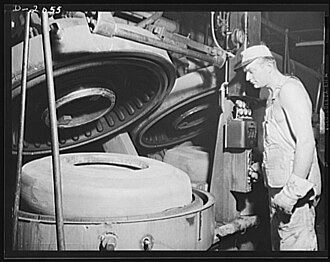
Vulcanization is the hardening of rubber, originally of natural rubber treated with sulfur and heat, which forms cross-links between its polymer chains and makes it firmer and more durable. Ancient Mesoamerican cultures already cured rubber with sulfur-rich plant juices, an early form of the process. Charles Goodyear, who worked in the 1830s to strengthen rubber, found in 1839 that a mixture of rubber and sulfur dropped on a hot pan hardened instead of melting, and by 1844 he had patented the process and produced the rubber on an industrial scale. Thomas Hancock had taken out a British patent eight weeks earlier, in November 1843.
On the inventions tree
- First known
- 1839
- Where
- United States
- Credited to
- Charles Goodyear · Thomas Hancock
NoteThomas Hancock took out a British patent for vulcanization with sulfur on 21 November 1843, eight weeks before Goodyear’s US patent of 30 January 1844; accounts differ on whether Hancock had studied samples of Goodyear’s rubber.
See also
Cite this entry
- APA
- The Epoch Institute. (2026). Vulcanization. In The Epoch Institute Encyclopedia. https://the-epoch-institute.org/encyclopedia/vulcanization
- MLA
- “Vulcanization.” The Epoch Institute Encyclopedia, The Epoch Institute, 2026, https://the-epoch-institute.org/encyclopedia/vulcanization. Accessed .
- Chicago
- The Epoch Institute. “Vulcanization.” The Epoch Institute Encyclopedia. 2026. https://the-epoch-institute.org/encyclopedia/vulcanization.
- Harvard
- The Epoch Institute (2026) ‘Vulcanization’, The Epoch Institute Encyclopedia. Available at: https://the-epoch-institute.org/encyclopedia/vulcanization (Accessed: ).
Last reviewed October 2026Random entry ↻