Inventions & Discoveries · Science and discovery
Barometer
A barometer is an instrument that measures air pressure, from which changes in the weather can be forecast. Evangelista Torricelli is usually credited with inventing it in 1643, though the historian W. E. Knowles Middleton holds 1644, when Torricelli first reported his experiments, the more likely date. After a water-tube experiment by Gasparo Berti and Raffaello Magiotti, Torricelli argued that the weight of the atmosphere, not the pull of a vacuum, held up the liquid, and he used mercury so that a tube of only 80 cm was needed. In September 1648 Florin Perier carried a barometer up the Puy de Dôme for Blaise Pascal and found that the mercury stood lower at altitude.
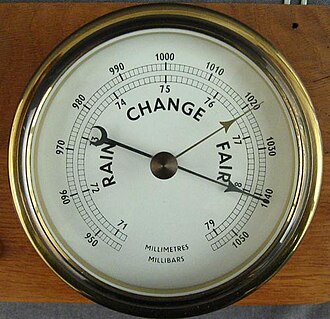
On the inventions tree
- First known
- 1644
- Credited to
- Evangelista Torricelli
NoteThe 1643 date was suggested only after Torricelli's death. Gasparo Berti built a rudimentary water barometer between 1640 and 1644, and René Descartes described an experiment to measure atmospheric pressure as early as 1631, with no evidence that he built one.
Mentioned in 1 profile
See also




Cite this entry
- APA
- The Epoch Institute. (2026). Barometer. In The Epoch Institute Encyclopedia. https://the-epoch-institute.org/encyclopedia/barometer
- MLA
- “Barometer.” The Epoch Institute Encyclopedia, The Epoch Institute, 2026, https://the-epoch-institute.org/encyclopedia/barometer. Accessed .
- Chicago
- The Epoch Institute. “Barometer.” The Epoch Institute Encyclopedia. 2026. https://the-epoch-institute.org/encyclopedia/barometer.
- Harvard
- The Epoch Institute (2026) ‘Barometer’, The Epoch Institute Encyclopedia. Available at: https://the-epoch-institute.org/encyclopedia/barometer (Accessed: ).
Last reviewed October 2026Random entry ↻