Inventions & Discoveries · Building and engineering
Hypocaust
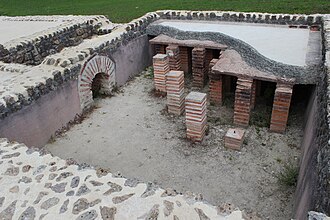
A hypocaust is a system of central heating in which hot air and smoke from a furnace circulate beneath a floor raised on stacks of tiles, the pilae, and rise through clay or tile flues in the walls. Vitruvius attributes its invention to Sergius Orata around 80 BCE, and described its construction in his De architectura of about 15 BCE. Hypocausts heated public baths and the villas of the wealthy throughout the Roman Empire, and their remains survive across Europe, western Asia and northern Africa. The system fell out of use in the western provinces as the empire declined, but lived on in the Eastern Roman Empire and in the baths of Al Andalus.
On the inventions tree
- First known
- c. 80 BCE
- Where
- Italy
- Credited to
- Sergius Orata · Roman Republic
NoteThe earliest reference suggests that the Temple of Ephesus was heated in this way in 350 BCE, and Garrett G. Fagan has disputed Orata’s priority.
See also




Cite this entry
- APA
- The Epoch Institute. (2026). Hypocaust. In The Epoch Institute Encyclopedia. https://the-epoch-institute.org/encyclopedia/hypocaust
- MLA
- “Hypocaust.” The Epoch Institute Encyclopedia, The Epoch Institute, 2026, https://the-epoch-institute.org/encyclopedia/hypocaust. Accessed .
- Chicago
- The Epoch Institute. “Hypocaust.” The Epoch Institute Encyclopedia. 2026. https://the-epoch-institute.org/encyclopedia/hypocaust.
- Harvard
- The Epoch Institute (2026) ‘Hypocaust’, The Epoch Institute Encyclopedia. Available at: https://the-epoch-institute.org/encyclopedia/hypocaust (Accessed: ).
Last reviewed October 2026Random entry ↻