Inventions & Discoveries · Communication and computing
Lithography
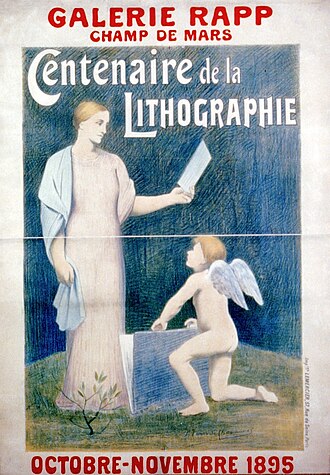
Lithography is a planographic method of printing based on the immiscibility of oil and water: an image drawn with a greasy substance on smooth limestone or a metal plate takes the oily ink, while the wetted, etched surface around it repels it. The German author and actor Alois Senefelder invented it in the Electorate of Bavaria in 1796, and it was first used mostly for musical scores and maps. Godefroy Engelmann introduced multicolour printing, chromolithography, in 1837, and offset lithography, in which a rubber cylinder carries the ink from plate to paper, has printed most books and magazines since the 1960s.
On the inventions tree
- First known
- 1796
- Where
- Electorate of Bavaria
- Credited to
- Alois Senefelder
See also



Cite this entry
- APA
- The Epoch Institute. (2026). Lithography. In The Epoch Institute Encyclopedia. https://the-epoch-institute.org/encyclopedia/lithography
- MLA
- “Lithography.” The Epoch Institute Encyclopedia, The Epoch Institute, 2026, https://the-epoch-institute.org/encyclopedia/lithography. Accessed .
- Chicago
- The Epoch Institute. “Lithography.” The Epoch Institute Encyclopedia. 2026. https://the-epoch-institute.org/encyclopedia/lithography.
- Harvard
- The Epoch Institute (2026) ‘Lithography’, The Epoch Institute Encyclopedia. Available at: https://the-epoch-institute.org/encyclopedia/lithography (Accessed: ).
Last reviewed October 2026Random entry ↻