Inventions & Discoveries · Energy and power
Lithium-ion battery
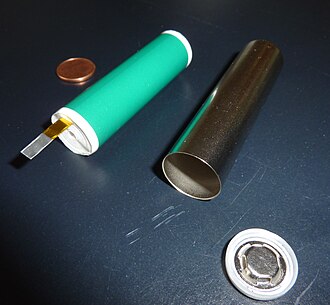
A lithium-ion battery is a rechargeable battery that stores energy by moving lithium ions in and out of electronically conducting solids. M. Stanley Whittingham conceived intercalation electrodes in the 1970s and made the first rechargeable lithium-ion battery, with a titanium disulfide cathode, though safety problems kept it from being commercialized. John Goodenough used lithium cobalt oxide as a cathode in 1980, and Akira Yoshino developed the first prototype of the modern battery, with a carbonaceous anode, in 1985. A Sony and Asahi Kasei team led by Yoshio Nishi brought it to market in 1991, and the three inventors shared the 2019 Nobel Prize in Chemistry.
On the inventions tree
- First known
- 1970s
- Credited to
- M. Stanley Whittingham · John Goodenough · Akira Yoshino
See also

Cite this entry
- APA
- The Epoch Institute. (2026). Lithium-ion battery. In The Epoch Institute Encyclopedia. https://the-epoch-institute.org/encyclopedia/lithium-ion-battery
- MLA
- “Lithium-ion battery.” The Epoch Institute Encyclopedia, The Epoch Institute, 2026, https://the-epoch-institute.org/encyclopedia/lithium-ion-battery. Accessed .
- Chicago
- The Epoch Institute. “Lithium-ion battery.” The Epoch Institute Encyclopedia. 2026. https://the-epoch-institute.org/encyclopedia/lithium-ion-battery.
- Harvard
- The Epoch Institute (2026) ‘Lithium-ion battery’, The Epoch Institute Encyclopedia. Available at: https://the-epoch-institute.org/encyclopedia/lithium-ion-battery (Accessed: ).
Last reviewed October 2026Random entry ↻