Inventions & Discoveries · Medicine and health
Organ transplantation
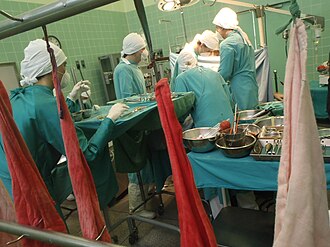
Organ transplantation is the removal of an organ or tissue from one body and its placement in another, to replace a damaged or missing function. The first transplant in the modern sense was performed in 1883 by the Swiss surgeon Theodor Kocher, who reversed the symptoms that followed the complete removal of the thyroid by implanting thyroid tissue. Alexis Carrel's techniques for joining blood vessels, from the early 1900s, laid the groundwork for later transplant surgery, but rejection defeated most attempts until Joseph Murray's kidney transplant between identical twins in Boston in 1954. Christiaan Barnard performed the first human-to-human heart transplant in 1967.
On the inventions tree
- First known
- 1883
- Where
- Switzerland
- Credited to
- Theodor Kocher
NoteSkin grafts are older: Sushruta used grafted skin to rebuild noses in the 2nd century BCE. The first successful kidney transplant is given as Joseph Murray's in Boston in 1954, though a timeline of transplants lists one by Richard H. Lawler in Chicago in 1950.
See also


Cite this entry
- APA
- The Epoch Institute. (2026). Organ transplantation. In The Epoch Institute Encyclopedia. https://the-epoch-institute.org/encyclopedia/organ-transplantation
- MLA
- “Organ transplantation.” The Epoch Institute Encyclopedia, The Epoch Institute, 2026, https://the-epoch-institute.org/encyclopedia/organ-transplantation. Accessed .
- Chicago
- The Epoch Institute. “Organ transplantation.” The Epoch Institute Encyclopedia. 2026. https://the-epoch-institute.org/encyclopedia/organ-transplantation.
- Harvard
- The Epoch Institute (2026) ‘Organ transplantation’, The Epoch Institute Encyclopedia. Available at: https://the-epoch-institute.org/encyclopedia/organ-transplantation (Accessed: ).
Last reviewed October 2026Random entry ↻