Inventions & Discoveries · Writing and counting
Pencil
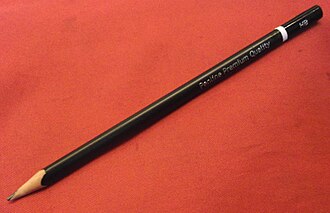
A pencil is a writing or drawing implement with a solid core of pigment, usually graphite, in a protective casing. Around 1560 the Italian couple Simonio and Lyndiana Bernacotti made what are likely the first plans for a wood-encased pencil, from a hollowed stick of juniper. In 1565 a large deposit of pure, solid graphite, then thought to be a form of lead and called plumbago, was found at Seathwaite in Borrowdale, Cumbria, England, and its sticks were at first wrapped in string or sheepskin. The first attempt to make graphite sticks from powder was in Nuremberg in 1662, and in 1795 Nicolas-Jacques Conté fired powdered graphite with clay, the method still in use.
On the inventions tree
- First known
- 1560s
- Where
- Borrowdale, Cumbria, England
- Credited to
- Simonio Bernacotti · Lyndiana Bernacotti
NoteSome sources date the discovery of the Borrowdale graphite as early as 1500.
See also



Cite this entry
- APA
- The Epoch Institute. (2026). Pencil. In The Epoch Institute Encyclopedia. https://the-epoch-institute.org/encyclopedia/pencil
- MLA
- “Pencil.” The Epoch Institute Encyclopedia, The Epoch Institute, 2026, https://the-epoch-institute.org/encyclopedia/pencil. Accessed .
- Chicago
- The Epoch Institute. “Pencil.” The Epoch Institute Encyclopedia. 2026. https://the-epoch-institute.org/encyclopedia/pencil.
- Harvard
- The Epoch Institute (2026) ‘Pencil’, The Epoch Institute Encyclopedia. Available at: https://the-epoch-institute.org/encyclopedia/pencil (Accessed: ).
Last reviewed October 2026Random entry ↻