Inventions & Discoveries · Transport and navigation
Wheelbarrow
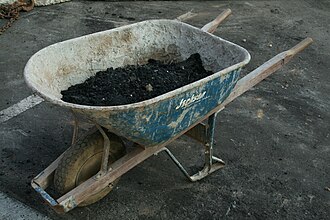
A wheelbarrow is a small hand-propelled vehicle, usually with one wheel, pushed and guided by a single person using two handles at the rear. The earliest evidence comes from Han dynasty China: a painted tomb mural at Chengdu in Sichuan, dated to 118 CE, shows a man pushing one. The Records of the Three Kingdoms credit the minister Zhuge Liang with a 'wooden ox' that carried military supplies in 231 CE. Chinese wheelbarrows mostly carried the load over a large central wheel, while those that appeared in medieval Europe between 1170 and 1250 had the wheel at or near the front.
On the inventions tree
- First known
- 118 CE
- Where
- Chengdu, Sichuan, China
- Credited to
- Han Dynasty
NoteThe Records of the Three Kingdoms credit Zhuge Liang with its invention in 231 CE; M. J. T. Lewis read a 'one-wheeler' in temple inventories at Eleusis of 408–406 BCE as a Greek wheelbarrow, but there is no evidence for it in Greece or Rome.
See also






Cite this entry
- APA
- The Epoch Institute. (2026). Wheelbarrow. In The Epoch Institute Encyclopedia. https://the-epoch-institute.org/encyclopedia/wheelbarrow
- MLA
- “Wheelbarrow.” The Epoch Institute Encyclopedia, The Epoch Institute, 2026, https://the-epoch-institute.org/encyclopedia/wheelbarrow. Accessed .
- Chicago
- The Epoch Institute. “Wheelbarrow.” The Epoch Institute Encyclopedia. 2026. https://the-epoch-institute.org/encyclopedia/wheelbarrow.
- Harvard
- The Epoch Institute (2026) ‘Wheelbarrow’, The Epoch Institute Encyclopedia. Available at: https://the-epoch-institute.org/encyclopedia/wheelbarrow (Accessed: ).
Last reviewed October 2026Random entry ↻