Inventions & Discoveries · Science and discovery
Armillary sphere
An armillary sphere is a model of the sky made of rings that stand for the celestial equator, the ecliptic and other circles, centred on the Earth or the Sun. It was invented separately in ancient Greece and in China. Hipparchus credited Eratosthenes (276–194 BCE) with its invention, and Greek armillary spheres served as teaching tools in the 3rd century BCE. In China, Geng Shouchang introduced a fixed equatorial ring in 52 BCE, and Zhang Heng completed the sphere with horizon and meridian rings in 125 CE and turned it by water power. Islamic and medieval European astronomers took it up, and it remained the main instrument for finding celestial positions until the telescope.
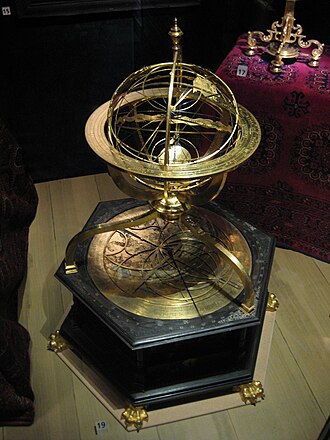
On the inventions tree
- First known
- 3rd century BCE
- Where
- Ancient Greece
- Credited to
- Eratosthenes
Also arose independentlyChina (1st century BCE)
NoteJoseph Needham traced the Chinese armillary sphere to the single-ring instrument of Shi Shen and Gan De in the 4th century BCE, a dating that Christopher Cullen rejects.
See also




Cite this entry
- APA
- The Epoch Institute. (2026). Armillary sphere. In The Epoch Institute Encyclopedia. https://the-epoch-institute.org/encyclopedia/armillary-sphere
- MLA
- “Armillary sphere.” The Epoch Institute Encyclopedia, The Epoch Institute, 2026, https://the-epoch-institute.org/encyclopedia/armillary-sphere. Accessed .
- Chicago
- The Epoch Institute. “Armillary sphere.” The Epoch Institute Encyclopedia. 2026. https://the-epoch-institute.org/encyclopedia/armillary-sphere.
- Harvard
- The Epoch Institute (2026) ‘Armillary sphere’, The Epoch Institute Encyclopedia. Available at: https://the-epoch-institute.org/encyclopedia/armillary-sphere (Accessed: ).
Last reviewed October 2026Random entry ↻