Inventions & Discoveries · Medicine and health
Artificial cardiac pacemaker
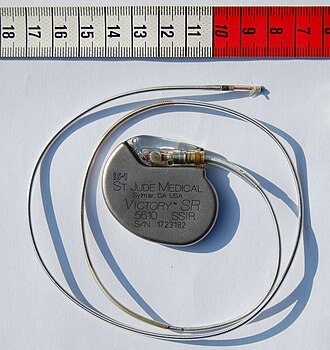
An artificial cardiac pacemaker is a medical device that sends electrical pulses through electrodes to the chambers of the heart to keep an even heart rate. The first fully implantable pacemaker, designed by the inventor Rune Elmqvist and the surgeon Åke Senning, was implanted on 8 October 1958 at the Karolinska Institute in Solna, Sweden; it failed after three hours, and its patient, Arne Larsson, went on to receive 26 pacemakers. Earlier devices were external, from Mark C Lidwill's apparatus of 1926 in Sydney to John Hopps's of 1950. Wilson Greatbatch's lithium iodide cell of 1971 led to pacemakers lasting up to eleven years.
On the inventions tree
- First known
- 1958
- Where
- Solna, Sweden
- Credited to
- Rune Elmqvist · Åke Senning
NoteMark C Lidwill's portable apparatus of 1926 in Sydney already paced the heart from outside the body, and Albert Hyman called his hand-cranked instrument of 1932 an artificial pacemaker; the first implanted one dates from 1958.
See also


Cite this entry
- APA
- The Epoch Institute. (2026). Artificial cardiac pacemaker. In The Epoch Institute Encyclopedia. https://the-epoch-institute.org/encyclopedia/artificial-cardiac-pacemaker
- MLA
- “Artificial cardiac pacemaker.” The Epoch Institute Encyclopedia, The Epoch Institute, 2026, https://the-epoch-institute.org/encyclopedia/artificial-cardiac-pacemaker. Accessed .
- Chicago
- The Epoch Institute. “Artificial cardiac pacemaker.” The Epoch Institute Encyclopedia. 2026. https://the-epoch-institute.org/encyclopedia/artificial-cardiac-pacemaker.
- Harvard
- The Epoch Institute (2026) ‘Artificial cardiac pacemaker’, The Epoch Institute Encyclopedia. Available at: https://the-epoch-institute.org/encyclopedia/artificial-cardiac-pacemaker (Accessed: ).
Last reviewed October 2026Random entry ↻