Inventions & Discoveries · Energy and power
Chicago Pile-1
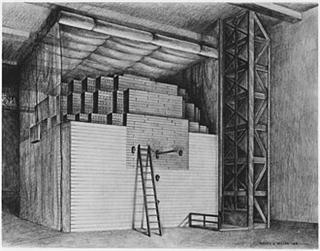
Chicago Pile-1 (CP-1) was the first artificial nuclear reactor, built under the west stands of Stagg Field at the University of Chicago, where the first human-made self-sustaining nuclear chain reaction was initiated on 2 December 1942. A team of about 30 led by Enrico Fermi assembled it from natural uranium and ultra-pure graphite blocks, which served as the neutron moderator. It ran at about half a watt, without shielding or cooling, and was the first major technical achievement of the Manhattan Project. In 1943 it was rebuilt near Chicago as Chicago Pile-2.
On the inventions tree
- First known
- 1942
- Where
- Chicago
- Credited to
- Enrico Fermi · United States
Built onNuclear fission1938
Led toAtomic bomb1945
See also
Cite this entry
- APA
- The Epoch Institute. (2026). Chicago Pile-1. In The Epoch Institute Encyclopedia. https://the-epoch-institute.org/encyclopedia/chicago-pile-1
- MLA
- “Chicago Pile-1.” The Epoch Institute Encyclopedia, The Epoch Institute, 2026, https://the-epoch-institute.org/encyclopedia/chicago-pile-1. Accessed .
- Chicago
- The Epoch Institute. “Chicago Pile-1.” The Epoch Institute Encyclopedia. 2026. https://the-epoch-institute.org/encyclopedia/chicago-pile-1.
- Harvard
- The Epoch Institute (2026) ‘Chicago Pile-1’, The Epoch Institute Encyclopedia. Available at: https://the-epoch-institute.org/encyclopedia/chicago-pile-1 (Accessed: ).
Last reviewed October 2026Random entry ↻