Inventions & Discoveries · Science and discovery
Nuclear fission
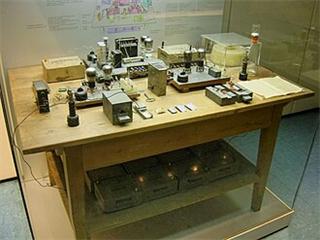
Nuclear fission is a reaction in which the nucleus of an atom splits into two or more smaller nuclei, releasing a very large amount of energy; it was discovered in Berlin in December 1938, when the chemists Otto Hahn and Fritz Strassmann found barium among the products of uranium bombarded with neutrons. Lise Meitner and Otto Robert Frisch explained the result in January 1939, and Frisch named the process after the division of living cells. The extra neutrons it releases make a chain reaction possible, the basis of nuclear power and nuclear weapons.
On the inventions tree
- First known
- 1938
- Where
- Berlin
- Credited to
- Otto Hahn · Fritz Strassmann · Lise Meitner · Otto Robert Frisch
NoteHahn and Strassmann found the evidence in Berlin; Meitner and Frisch, who explained it in January 1939, were then in exile.
See also

Cite this entry
- APA
- The Epoch Institute. (2026). Nuclear fission. In The Epoch Institute Encyclopedia. https://the-epoch-institute.org/encyclopedia/nuclear-fission
- MLA
- “Nuclear fission.” The Epoch Institute Encyclopedia, The Epoch Institute, 2026, https://the-epoch-institute.org/encyclopedia/nuclear-fission. Accessed .
- Chicago
- The Epoch Institute. “Nuclear fission.” The Epoch Institute Encyclopedia. 2026. https://the-epoch-institute.org/encyclopedia/nuclear-fission.
- Harvard
- The Epoch Institute (2026) ‘Nuclear fission’, The Epoch Institute Encyclopedia. Available at: https://the-epoch-institute.org/encyclopedia/nuclear-fission (Accessed: ).
Last reviewed October 2026Random entry ↻