Inventions & Discoveries · Science and discovery
Quantum mechanics
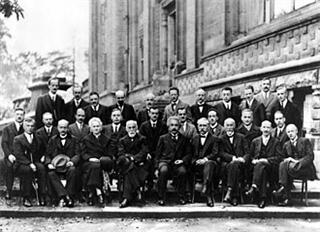
Quantum mechanics is the physical theory that describes the behaviour of matter and light at and below the scale of atoms; it arose from early theories such as Max Planck's hypothesis of 1900 that energy is radiated and absorbed in discrete "quanta". Albert Einstein used the idea in 1905 to explain the photoelectric effect, and modern quantum mechanics was born in 1925, when Werner Heisenberg, Max Born and Pascual Jordan developed matrix mechanics and Erwin Schrödinger invented wave mechanics. Its applications include the laser, the transistor and magnetic resonance imaging.
On the inventions tree
- First known
- 1900
- Credited to
- Max Planck · Werner Heisenberg · Erwin Schrödinger
NotePlanck’s quantum hypothesis of 1900 began it; modern quantum mechanics was formulated in 1925–1926.
See also


Cite this entry
- APA
- The Epoch Institute. (2026). Quantum mechanics. In The Epoch Institute Encyclopedia. https://the-epoch-institute.org/encyclopedia/quantum-mechanics
- MLA
- “Quantum mechanics.” The Epoch Institute Encyclopedia, The Epoch Institute, 2026, https://the-epoch-institute.org/encyclopedia/quantum-mechanics. Accessed .
- Chicago
- The Epoch Institute. “Quantum mechanics.” The Epoch Institute Encyclopedia. 2026. https://the-epoch-institute.org/encyclopedia/quantum-mechanics.
- Harvard
- The Epoch Institute (2026) ‘Quantum mechanics’, The Epoch Institute Encyclopedia. Available at: https://the-epoch-institute.org/encyclopedia/quantum-mechanics (Accessed: ).
Last reviewed October 2026Random entry ↻