Work / monument · text
Emancipation Proclamation
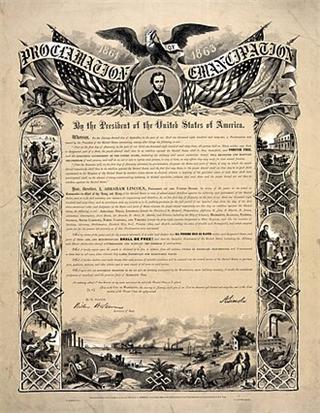
The Emancipation Proclamation was an executive order issued by President Abraham Lincoln on 1 January 1863, during the American Civil War, declaring free all enslaved people in the states then in rebellion against the Union. It did not apply to the slave states loyal to the Union or to areas already under Union control, but it made the end of slavery a war aim, opened the Union army and navy to Black men, and discouraged Britain and France from supporting the Confederacy. Slavery was abolished throughout the United States by the Thirteenth Amendment in 1865.
Mentioned in 1 profile
Great speeches
See also





Cite this entry
- APA
- The Epoch Institute. (2026). Emancipation Proclamation. In The Epoch Institute Encyclopedia. https://the-epoch-institute.org/encyclopedia/emancipation-proclamation
- MLA
- “Emancipation Proclamation.” The Epoch Institute Encyclopedia, The Epoch Institute, 2026, https://the-epoch-institute.org/encyclopedia/emancipation-proclamation. Accessed .
- Chicago
- The Epoch Institute. “Emancipation Proclamation.” The Epoch Institute Encyclopedia. 2026. https://the-epoch-institute.org/encyclopedia/emancipation-proclamation.
- Harvard
- The Epoch Institute (2026) ‘Emancipation Proclamation’, The Epoch Institute Encyclopedia. Available at: https://the-epoch-institute.org/encyclopedia/emancipation-proclamation (Accessed: ).
Last reviewed October 2026Random entry ↻