Inventions & Discoveries · Transport and navigation
Helicopter
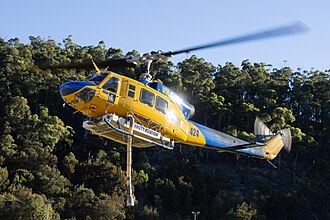
A helicopter is a rotorcraft whose lift and thrust come from horizontally spinning rotors, so that it can take off and land vertically and hover. Chinese children played with bamboo flying toys from around 400 BCE, and Leonardo da Vinci designed an 'aerial screw' in the early 1480s. In 1907 the Breguet brothers' Gyroplane No. 1 lifted its pilot about 0.6 metres while men held it steady, and on 13 November 1907 Paul Cornu's machine made the first free flight with a pilot, in France. The Focke-Wulf Fw 61 of 1936 was the first practical helicopter, and Igor Sikorsky's R-4 of 1942 the first in full-scale production.
On the inventions tree
- First known
- 1907
- Where
- France
- Credited to
- Jacques Breguet · Louis Breguet · Paul Cornu
NoteHermann Ganswindt's helicopter may have carried people in Berlin-Schöneberg in July 1901, but the film of the flight is lost; the Breguet machine was held steady by a man at each corner, so Cornu's flight of 13 November 1907 is reported as the first free one.
See also




Cite this entry
- APA
- The Epoch Institute. (2026). Helicopter. In The Epoch Institute Encyclopedia. https://the-epoch-institute.org/encyclopedia/helicopter
- MLA
- “Helicopter.” The Epoch Institute Encyclopedia, The Epoch Institute, 2026, https://the-epoch-institute.org/encyclopedia/helicopter. Accessed .
- Chicago
- The Epoch Institute. “Helicopter.” The Epoch Institute Encyclopedia. 2026. https://the-epoch-institute.org/encyclopedia/helicopter.
- Harvard
- The Epoch Institute (2026) ‘Helicopter’, The Epoch Institute Encyclopedia. Available at: https://the-epoch-institute.org/encyclopedia/helicopter (Accessed: ).
Last reviewed October 2026Random entry ↻