Glossary · Term
Lettres de cachet
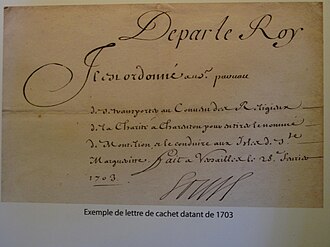
Lettres de cachet were letters signed by the king of France, countersigned by one of his ministers and closed with the royal seal, carrying the king's orders, often beyond appeal. Written orders of this kind arose in the 14th century from the principle that the king was released from the laws. The best known were penal: a subject could be imprisoned without trial or defence, confined or exiled, often at a family's request, as with the Marquis de Sade, held from 1777 to 1790, and Mirabeau, whose attack on them was published in 1782. A symbol of the abuses of the Ancien Régime, they were suppressed during the French Revolution, though Napoleon revived their penal equivalent in 1801.
Mentioned in 1 profile
See also




Cite this entry
- APA
- The Epoch Institute. (2026). Lettres de cachet. In The Epoch Institute Encyclopedia. https://the-epoch-institute.org/encyclopedia/lettres-de-cachet
- MLA
- “Lettres de cachet.” The Epoch Institute Encyclopedia, The Epoch Institute, 2026, https://the-epoch-institute.org/encyclopedia/lettres-de-cachet. Accessed .
- Chicago
- The Epoch Institute. “Lettres de cachet.” The Epoch Institute Encyclopedia. 2026. https://the-epoch-institute.org/encyclopedia/lettres-de-cachet.
- Harvard
- The Epoch Institute (2026) ‘Lettres de cachet’, The Epoch Institute Encyclopedia. Available at: https://the-epoch-institute.org/encyclopedia/lettres-de-cachet (Accessed: ).
Last reviewed October 2026Random entry ↻