Inventions & Discoveries · Communication and computing
Morse code
Morse code is a method of telecommunication that encodes letters, numerals and punctuation as standard sequences of two signal durations, dots and dashes. Around 1837 the American artist Samuel Morse devised a code of numerals for the electrical telegraph he was developing with Joseph Henry and Alfred Vail; in 1840 Vail extended it to letters, giving the shortest signs to the commonest ones, and this code was first used in 1844. Friedrich Gerke's simpler Hamburg alphabet of 1848, adopted in Germany and Austria in 1851, led to the International Morse code of 1865, which also carried early radio communication from the 1890s.
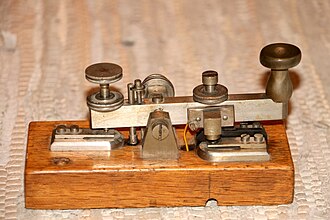
On the inventions tree
- First known
- c. 1837
- Where
- United States
- Credited to
- Samuel Morse · Alfred Vail
NoteThe alphabet that carries Morse's name was Alfred Vail's, who extended Morse's numerals-only design in 1840, and most of the present international code comes from Friedrich Gerke's revision of 1848.
See also




Cite this entry
- APA
- The Epoch Institute. (2026). Morse code. In The Epoch Institute Encyclopedia. https://the-epoch-institute.org/encyclopedia/morse-code
- MLA
- “Morse code.” The Epoch Institute Encyclopedia, The Epoch Institute, 2026, https://the-epoch-institute.org/encyclopedia/morse-code. Accessed .
- Chicago
- The Epoch Institute. “Morse code.” The Epoch Institute Encyclopedia. 2026. https://the-epoch-institute.org/encyclopedia/morse-code.
- Harvard
- The Epoch Institute (2026) ‘Morse code’, The Epoch Institute Encyclopedia. Available at: https://the-epoch-institute.org/encyclopedia/morse-code (Accessed: ).
Last reviewed October 2026Random entry ↻