Inventions & Discoveries · Building and engineering
Portland cement
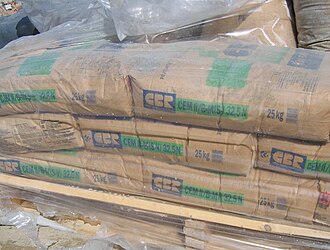
Portland cement is a hydraulic cement made by heating limestone and clay minerals in a kiln to form clinker, then grinding it with a little gypsum; it is the most common cement and the basic ingredient of concrete and mortar. Joseph Aspdin patented it in England in 1824 and named it after Portland stone, quarried on the Isle of Portland in Dorset. It grew out of the natural cements made in Britain from the middle of the 18th century, John Smeaton’s experiments of 1756 and Louis Vicat’s artificial hydraulic lime. His son William Aspdin improved it in the 1840s at Rotherhithe, and the rotary kiln, patented in 1885, allowed continuous manufacture.
On the inventions tree
- First known
- 1824
- Where
- England
- Credited to
- Joseph Aspdin · William Aspdin
NoteThe name Portland cement was recorded in a directory of 1823 with a William Lockwood. Aspdin’s cement has been called a proto-Portland cement: his son William is regarded as the inventor of the modern form, and Isaac Charles Johnson claimed to be its real father.
See also


Cite this entry
- APA
- The Epoch Institute. (2026). Portland cement. In The Epoch Institute Encyclopedia. https://the-epoch-institute.org/encyclopedia/portland-cement
- MLA
- “Portland cement.” The Epoch Institute Encyclopedia, The Epoch Institute, 2026, https://the-epoch-institute.org/encyclopedia/portland-cement. Accessed .
- Chicago
- The Epoch Institute. “Portland cement.” The Epoch Institute Encyclopedia. 2026. https://the-epoch-institute.org/encyclopedia/portland-cement.
- Harvard
- The Epoch Institute (2026) ‘Portland cement’, The Epoch Institute Encyclopedia. Available at: https://the-epoch-institute.org/encyclopedia/portland-cement (Accessed: ).
Last reviewed October 2026Random entry ↻