Inventions & Discoveries · Building and engineering
Reinforced concrete
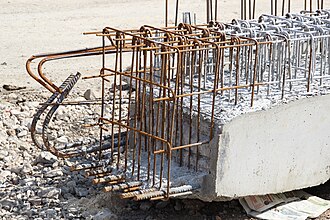
Reinforced concrete is concrete with embedded iron or steel bars or mesh, which take the tension plain concrete cannot bear while the concrete resists compression. It was developed in parallel in England and France in the mid-19th century. The French builder François Coignet built the first iron-reinforced concrete structure, a four-story house in the suburbs of Paris, in 1853–55, and in 1854 the English builder William B. Wilkinson reinforced the roof and floors of a house with knowledge of tensile stresses. Joseph Monier patented reinforced flowerpots in 1867 and columns and girders in 1877, and the firm Wayss & Freytag made the first commercial use of it in 1884.
On the inventions tree
- First known
- 1853
- Where
- Near Paris, France
- Credited to
- François Coignet · William B. Wilkinson · Joseph Monier
NoteCoignet seems to have used the iron to keep monolithic walls from overturning rather than to add strength; Wilkinson’s reinforcement of 1854 shows knowledge of tensile stresses.
Mentioned in 1 profile
See also







Cite this entry
- APA
- The Epoch Institute. (2026). Reinforced concrete. In The Epoch Institute Encyclopedia. https://the-epoch-institute.org/encyclopedia/reinforced-concrete
- MLA
- “Reinforced concrete.” The Epoch Institute Encyclopedia, The Epoch Institute, 2026, https://the-epoch-institute.org/encyclopedia/reinforced-concrete. Accessed .
- Chicago
- The Epoch Institute. “Reinforced concrete.” The Epoch Institute Encyclopedia. 2026. https://the-epoch-institute.org/encyclopedia/reinforced-concrete.
- Harvard
- The Epoch Institute (2026) ‘Reinforced concrete’, The Epoch Institute Encyclopedia. Available at: https://the-epoch-institute.org/encyclopedia/reinforced-concrete (Accessed: ).
Last reviewed October 2026Random entry ↻