83 or 84 CE · Mons Graupius, Caledonia
Calgacus to the Caledonians
The setting
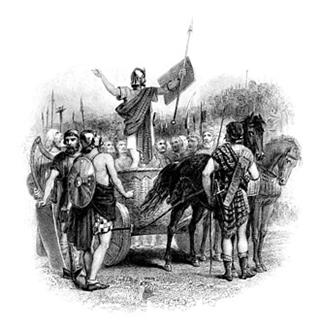
Pushing Roman power into the far north of Britain, the governor Gnaeus Julius Agricola met the gathered Caledonian peoples at Mons Graupius, a battlefield never securely identified. Tacitus, Agricola's son-in-law, gives the Caledonian leader Calgacus a speech before the battle: an indictment of Roman conquest, written by a Roman.
Key passage
To robbery, slaughter, plunder, they give the lying name of empire; they make a solitude and call it peace.
Tacitus, Agricola, 30, tr. A. J. Church and W. J. Brodribb (1876). Calgacus is known only from this work, and the speech is Tacitus' own composition.
The full speech
Read the full speech
"Whenever I consider the origin of this war and the necessities of our position, I have a sure confidence that this day, and this union of yours, will be the beginning of freedom to the whole of Britain. To all of us slavery is a thing unknown; there are no lands beyond us, and even the sea is not safe, menaced as we are by a Roman fleet. And thus in war and battle, in which the brave find glory, even the coward will find safety. Former contests, in which, with varying fortune, the Romans were resisted, still left in us a last hope of succour, inasmuch as being the most renowned nation of Britain, dwelling in the very heart of the country, and out of sight of the shores of the conquered, we could keep even our eyes unpolluted by the contagion of slavery. To us who dwell on the uttermost confines of the earth and of freedom, this remote sanctuary of Britain's glory has up to this time been a defence. Now, however, the furthest limits of Britain are thrown open, and the unknown always passes for the marvellous. But there are no tribes beyond us, nothing indeed but waves and rocks, and the yet more terrible Romans, from whose oppression escape is vainly sought by obedience and submission. Robbers of the world, having by their universal plunder exhausted the land, they rifle the deep. If the enemy be rich, they are rapacious; if he be poor, they lust for dominion; neither the east nor the west has been able to satisfy them. Alone among men they covet with equal eagerness poverty and riches. To robbery, slaughter, plunder, they give the lying name of empire; they make a solitude and call it peace.
"Nature has willed that every man's children and kindred should be his dearest objects. Yet these are torn from us by conscriptions to be slaves elsewhere. Our wives and our sisters, even though they may escape violation from the enemy, are dishonoured under the names of friendship and hospitality. Our goods and fortunes they collect for their tribute, our harvests for their granaries. Our very hands and bodies, under the lash and in the midst of insult, are worn down by the toil of clearing forests and morasses. Creatures born to slavery are sold once for all, and are, moreover, fed by their masters; but Britain is daily purchasing, is daily feeding, her own enslaved people. And as in a household the last comer among the slaves is always the butt of his companions, so we in a world long used to slavery, as the newest and the most contemptible, are marked out for destruction. We have neither fruitful plains, nor mines, nor harbours, for the working of which we may be spared. Valour, too, and high spirit in subjects, are offensive to rulers; besides, remoteness and seclusion, while they give safety, provoke suspicion. Since then you cannot hope for quarter, take courage, I beseech you, whether it be safety or renown that you hold most precious. Under a woman's leadership the Brigantes were able to burn a colony, to storm a camp, and had not success ended in supineness, might have thrown off the yoke. Let us, then, a fresh and unconquered people, never likely to abuse our freedom, show forthwith at the very first onset what heroes Caledonia has in reserve.
"Do you suppose that the Romans will be as brave in war as they are licentious in peace? To our strifes and discords they owe their fame, and they turn the errors of an enemy to the renown of their own army, an army which, composed as it is of every variety of nations, is held together by success and will be broken up by disaster. These Gauls and Germans, and, I blush to say, these numerous Britons, who, though they lend their lives to support a stranger's rule, have been its enemies longer than its subjects, you cannot imagine to be bound by fidelity and affection. Fear and terror there certainly are, feeble bonds of attachment; remove them, and those who have ceased to fear will begin to hate. All the incentives to victory are on our side. The Romans have no wives to kindle their courage; no parents to taunt them with flight; many have either no country or one far away. Few in number, dismayed by their ignorance, looking around upon a sky, a sea, and forests which are all unfamiliar to them; hemmed in, as it were, and enmeshed, the gods have delivered them into our hands. Be not frightened by idle display, by the glitter of gold and of silver, which can neither protect nor wound. In the very ranks of the enemy we shall find our own forces. Britons will acknowledge their own cause; Gauls will remember past freedom; the other Germans will abandon them, as but lately did the Usipii. Behind them there is nothing to dread. The forts are ungarrisoned; the colonies in the hands of aged men; what with disloyal subjects and oppressive rulers, the towns are ill-affected and rife with discord. On the one side you have a general and an army; on the other, tribute, the mines, and all the other penalties of an enslaved people. Whether you endure these for ever, or instantly avenge them, this field is to decide. Think, therefore, as you advance to battle, at once of your ancestors and of your posterity."
Text: Wikisource, tr. A. J. Church and W. J. Brodribb (1876). The text is in the public domain; the Wikisource transcription is shared under CC BY-SA 4.0.
What followed
The legions won the battle, but Agricola was recalled soon afterwards and Rome never conquered the far north. Within forty years the frontier had been fixed far to the south at Hadrian's Wall. Calgacus' words became one of the most quoted judgements on empire ever written.