Europe
Roman Empire
At a glance
- Augustus turned the war-torn Roman Republic into a monarchy in 27 BCE while keeping the Senate and consuls as a republican facade.
- Its professional legions, 80,000 km of roads and Roman law bound a realm stretching from Britain to Mesopotamia.
- The West fell gradually through civil war, Gothic and Vandal invasions and lost revenues, ending when Odoacer deposed Romulus Augustulus in 476.
Rise & Fall
- 31 BCEOctavian defeats Mark Antony and Cleopatra VII at the Battle of Actium
- 27 BCEThe Senate grants Octavian the title Augustus, making him Rome's first emperor
- 9Arminius destroys three legions under Varus in the Teutoburg Forest, fixing the Rhine frontier
- 212The Edict of Caracalla extends citizenship to virtually all free inhabitants of the empire
- 313Constantine and Licinius agree the Edict of Milan, ending the persecution of Christians
- 378Gothic forces kill Emperor Valens and much of the Eastern field army at Adrianople
- 410Alaric's Visigoths sack Rome, shattering the myth of Roman invulnerability
- 476Odoacer deposes Romulus Augustulus, the last Western Roman emperor
Foundation
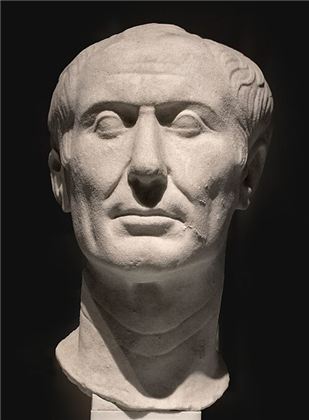
The Roman Empire emerged from the ruins of the Roman Republic, itself the product of centuries of expansion from a small city-state on the banks of the Tiber in central Italy. The Republic's collapse followed a century of civil conflict rooted in the tension between an oligarchic Senate and the ambitions of military strongmen whose power derived from professional armies loyal to individual commanders rather than to the state. Julius Caesar's crossing of the Rubicon in 49 BCE, his assassination in 44 BCE and the wars of the Second Triumvirate culminated in Octavian's decisive victory over Mark Antony and Cleopatra VII at the Battle of Actium in 31 BCE. Octavian, granted the honorific Augustus by the Senate in 27 BCE, became Rome's first emperor while carefully preserving the outward forms of republican government, retaining the Senate, the consulship and the traditional magistracies as instruments of legitimacy. The transition from Republic to Empire was therefore not a formal revolution but a constitutional fiction: Augustus styled himself princeps (first citizen) rather than rex (king), a distinction that proved politically essential in a culture that had expelled its last king, Tarquinius Superbus, nearly five centuries earlier. The enabling conditions for this transformation were the exhaustion of the Roman populace after decades of civil war, the loyalty of a professional army, and Augustus's extraordinary skill in consolidating power without appearing to do so.
Socioeconomy
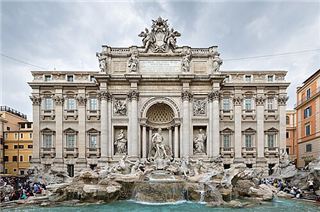
Roman society was rigidly stratified between the senatorial order, the equestrian order, the plebeian citizenry, freedmen and the enslaved, who at the empire's height are estimated to have made up perhaps a quarter or more of the population of Italy. Agriculture formed the economic backbone of the empire, organised around both the small family farm (fundus) and the large slave-worked estate (latifundium), and such latifundia came to dominate much of the Italian and North African countryside. Economic integration was facilitated by some 80,000 kilometres of paved roads, a common silver currency based on the denarius, and generally modest customs dues (portoria) levied at provincial boundaries across a territory stretching from Britain to Mesopotamia. Trade networks connected Rome to the Silk Road through Parthian intermediaries and to East Africa and India via the Red Sea ports of Egypt, as documented in the Periplus of the Erythraean Sea (1st century CE). Some economic historians have estimated that the empire's GDP at its Trajanic peak (c. 117 CE) amounted to around a fifth of global output, though such figures are necessarily speculative. Revenue came from the tributum (direct provincial tax), customs duties and Augustus's five per cent inheritance tax, with provincial assessments based on periodic censuses. The grain dole (annona), distributed to roughly 200,000 citizens in Rome, was both a social stabiliser and a significant burden on the imperial treasury.
Military

The Roman legion, a professional heavy infantry unit of roughly 5,000 men supported by a comparable number of auxiliary troops, was the instrument of Roman expansion and the foundation of imperial security. Augustus reduced the roughly 60 legions inherited from the civil wars to 28; after the loss of three in the Teutoburg disaster of 9 CE the total stood at 25, rising gradually to around 33 by the reign of Septimius Severus. This created a permanent standing army of some 300,000 men, which Diocletian later expanded, perhaps to as many as 500,000. The legionary system combined tactical flexibility (the manipular and later cohort formations), sophisticated engineering (roads, siege works and fortified camps) and a logistical professionalism that no contemporary rival could match. Trajan's two Dacian Wars (101–102 and 105–106 CE) brought Dacia's gold and silver mines under Roman control and added a large new province north of the Danube. The Rhine-Danube frontier, fixed after Arminius ambushed three legions under Publius Quinctilius Varus in the Teutoburg Forest, defined the northern limit of Roman expansion and shaped the subsequent course of European history. Roman naval supremacy, confirmed decisively at Actium, made the Mediterranean (Mare Nostrum) a Roman lake, enabling the commerce and communication that held the empire together.
Governance & Law

The imperial administrative system combined central authority with substantial provincial autonomy, operating through a hierarchy of senatorial and equestrian officials appointed by the emperor. Provinces were classed as either senatorial (governed by proconsuls, nominally under Senate control) or imperial (governed by legates appointed by and answerable to the emperor), while Egypt, strategically vital and critical to the grain supply, was placed under an equestrian governor, the Praefectus Aegypti, of proven personal loyalty. Roman law represents perhaps the empire's most enduring institutional contribution: the jurisprudence fostered from Augustus onwards, consolidated by Hadrian's fixing of the Perpetual Edict and refined by the great classical jurists Gaius, Papinian, Ulpian and Paulus, produced a legal corpus of extraordinary sophistication. Justinian I's Corpus Juris Civilis (529–534 CE), though compiled in the Eastern Empire, preserved and transmitted this tradition to medieval Europe and underlies most modern civil law systems. The Edict of Caracalla (212 CE) extended citizenship to virtually all free inhabitants of the empire, transforming the legal relationship between centre and periphery while also broadening the tax base. The Principate's constitutional fiction gave way under Diocletian (r. 284–305 CE) to an openly autocratic model, the Dominate, in which the emperor was addressed as dominus (lord) and surrounded by elaborate court ceremonial, formalising the military monarchy that had in practice replaced Augustan forms during the Crisis of the Third Century.
Global & Regional Impact

The Roman Empire's cultural diffusion was without precedent in the ancient Western world, spreading the Latin language, Roman law, urban infrastructure and Mediterranean religious traditions from the Scottish lowlands to the borders of Persia. The interpretatio romana, the Roman habit of absorbing and reinterpreting foreign deities within the Roman pantheon, fostered a religious syncretism that paradoxically helped prepare the ground for Christianity's eventual triumph under Constantine I (r. 306–337 CE). The Edict of Milan (313 CE), agreed by Constantine and Licinius, and Constantine's subsequent patronage of the Church transformed a persecuted sect into the empire's dominant institution, with consequences that extended across two millennia. Roman roads, aqueducts, bridges and urban planning shaped the geography of European settlement for centuries after the empire's fall; many modern cities, among them London, Paris, Cologne and Vienna, grew directly from Roman castra (forts) or administrative centres. Through its commercial reach the empire linked the economies of the Mediterranean with Arabia, East Africa, India and, indirectly, China, and Roman coins have been found as far afield as southern India and the Mekong Delta. The transmission of Greek philosophy, science and literature through Latin translation and commentary preserved classical learning for the medieval and Renaissance worlds.
Decline & Fall
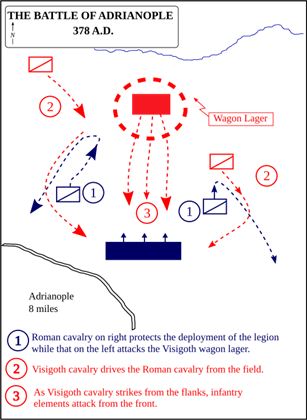
The decline of the Western Roman Empire was a process spanning some three centuries rather than a single event, driven by the interaction of structural vulnerabilities, external pressures and contingent catastrophe. The Crisis of the Third Century (235–284 CE) exposed the fundamental weakness of an imperial system without a reliable succession mechanism: in those five decades some two dozen recognised emperors and many more usurpers claimed the purple, and for a time the empire fragmented into three competing polities, the Gallic Empire, the Palmyrene Empire and the central Roman state. Diocletian's Tetrarchy (293 CE) and Constantine's reforms temporarily stabilised the system, but the Battle of Adrianople in 378 CE, in which Emperor Valens was killed together with perhaps two-thirds of the Eastern field army by Gothic forces, proved a structural turning point. In its aftermath, armed Gothic peoples were settled within the empire's borders as autonomous allies, beginning a reliance on federate troops that would hollow out Roman military capacity. The division of the empire on the death of Theodosius I in 395 CE separated the wealthier, more defensible East from the increasingly vulnerable Western provinces. The sack of Rome by Alaric's Visigoths in 410 CE shattered the myth of Roman invulnerability, and the loss of North Africa to the Vandals (429–442 CE), culminating in the fall of Carthage in 439, deprived the West of its richest revenue-producing territory. On 4 September 476 CE the Germanic commander Odoacer deposed Romulus Augustulus, the last Western emperor, and sent the imperial regalia to Constantinople, an act that contemporaries barely remarked upon, so gradual and complete had the erosion of Western Roman authority become.
The Roman Empire remains the foundational political and cultural reference point of Western civilisation, whose legal inheritance, linguistic legacy, urban geography and religious transformation continue to shape the modern world more than fifteen centuries after the end of imperial rule in the West.
References
- Garnsey, P. and Saller, R. (1987) The Roman Empire: Economy, Society and Culture. London: Duckworth.
- Gibbon, E. (1776–1789) The History of the Decline and Fall of the Roman Empire. 6 vols. London: Strahan and Cadell.
- Goldsworthy, A. (2009) How Rome Fell: Death of a Superpower. New Haven: Yale University Press.
- Jones, A.H.M. (1964) The Later Roman Empire, 284–602: A Social, Economic and Administrative Survey. 3 vols. Oxford: Blackwell.
- Millar, F. (1977) The Emperor in the Roman World. London: Duckworth.
- Scullard, H.H. (1982) From the Gracchi to Nero: A History of Rome from 133 BC to AD 68. 5th edn. London: Methuen.
- Wells, C. (1992) The Roman Empire. 2nd edn. London: Fontana.
Connections
Open the full connections map →