Europe
Byzantine Empire
At a glance
- The eastern Roman Empire, ruled from Constantinople, whose people called themselves Romans for over 1,100 years.
- It preserved Roman law in Justinian's Code and Greek learning, and spread Orthodox Christianity to Russia and the Balkans.
- Manzikert in 1071 and the crusader sack of 1204 crippled it; the Ottomans took Constantinople in 1453.
Rise & Fall
- 330Constantine I dedicates Constantinople on the site of Byzantion
- 395Death of Theodosius I divides the empire permanently into east and west
- 537Justinian completes the Hagia Sophia
- 717–718Leo III's Greek fire helps defeat the second Arab siege of Constantinople
- 1071Seljuk Turks defeat and capture Romanos IV Diogenes at Manzikert
- 1204The Fourth Crusade sacks Constantinople and founds a Latin Empire
- 1261Michael VIII Palaiologos recovers Constantinople from the Latins
- 1453Mehmed II captures Constantinople; Constantine XI dies on the walls
Foundation

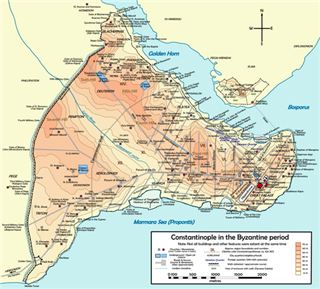
The Byzantine Empire was not founded in any conventional sense but emerged as the surviving eastern half of a state that had dominated the Mediterranean world for centuries — the Roman Empire. Emperor Constantine I's dedication of Constantinople on 11 May 330 CE, on the site of the ancient Greek colony of Byzantion at the strategic crossing of the Bosphorus, is the conventional founding moment of what later scholars called the Byzantine Empire, though its inhabitants called themselves Romans and recognised no break in Roman continuity. Constantine's choice of site was strategically brilliant: it commanded the sea route between the Mediterranean and the Black Sea, gave access to Black Sea grain, and occupied a peninsula that any attacker had to assault by land and sea simultaneously. His gold coin, the solidus, introduced around 309 and struck at seventy-two to the Roman pound, about 4.5 grams of gold, became so reliable that it served as the Mediterranean world's leading international currency for some seven centuries. The eastern empire took on a lasting separate identity after the death of Theodosius I in 395 CE, when rule was divided between his sons Arcadius in the east and Honorius in the west, and the two halves were never again governed as one. The east proved structurally more durable than the west: its urban culture was denser, its tax revenues greater, its frontiers more defensible relative to its resources, and its capacity to absorb, pay off or diplomatically manage barbarian pressure superior. The Theodosian Walls, whose main line was completed in 413 CE under Theodosius II and which were strengthened after an earthquake in 447 with an outer wall and moat, made the city effectively impregnable to any army that lacked both command of the surrounding waters and the means to breach the most formidable fortifications of the age.
Socioeconomy
The Byzantine economy was one of the most sophisticated and durable commercial systems of the pre-modern world, sustained across eleven centuries by the stability of the gold solidus (later called the nomisma), Constantinople's position at the crossroads of intercontinental trade, and the agricultural surpluses of Anatolia and the Balkans. The solidus's long reliability as an international currency was unprecedented in monetary history and underpinned Byzantine commerce across the Mediterranean, the Black Sea and the routes to Persia and beyond: the sixth-century merchant Cosmas Indicopleustes boasted that the emperor's coin was accepted from one end of the earth to the other. Constantinople's position at the junction of the Black Sea and Mediterranean trade systems allowed it to tax goods moving between the northern lands (grain, fish, furs and slaves) and the luxury markets of the south, and the state further profited from tightly regulated industries such as silk, whose production it controlled after silkworm eggs were smuggled into the empire in the reign of Justinian. The most devastating economic blow was the Muslim conquest of the Levant and Egypt between 634 and 642 CE, which stripped away the empire's richest provinces and a large share of its tax revenue. The recovery under the Macedonian dynasty (867–1056) rested on a smaller but more coherent base: the Anatolian plateau supplied soldiers and grain, the revival of Balkan and Black Sea trade generated customs revenue, and the theme system of military landholding sustained frontier defence. The chrysobull of 1082, in which Alexios I Komnenos granted Venice tax-free trade throughout the empire in return for naval support against the Normans, gradually handed much of Constantinople's maritime commerce to Venetian merchants, creating the dependency that later helped make the Fourth Crusade's diversion to Constantinople attractive to the Venetians.
Military
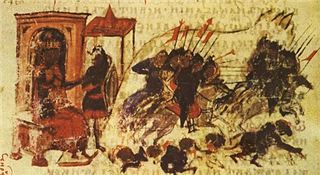
The Byzantine military system was one of the longest-lived and most adaptable in history, evolving across eleven centuries from the late Roman field armies through the theme-based provincial defence system to the mercenary-heavy forces of the later empire, and retaining enough capacity to preserve the state even through periods of catastrophic territorial loss. The empire's greatest military asset was Constantinople itself: its walls withstood repeated sieges over eight centuries — by Avars and Persians in 626, Arabs in 674–678 and 717–718, Bulgarians and Rus' — and each failure of an attacker bought the empire more time. In the second Arab siege of 717–718, Emperor Leo III used Greek fire to devastate the Umayyad fleet. Greek fire — an incendiary weapon whose exact composition remains unknown, reputedly introduced by the engineer Kallinikos around 672 — was the empire's most celebrated military secret, burning even on water and used to devastating effect against Arab and later Rus' fleets. The theme system, developed during the seventh and eighth centuries in response to the Arab conquests, reorganised the remaining empire into military-administrative districts whose soldiers were supported by land grants in return for service, creating a largely self-sustaining provincial defence that reduced dependence on costly mercenaries. Basil II (r. 976–1025) used these resources to conquer Bulgaria after decades of war, earning the epithet Bulgar-slayer, and left the empire stretching from the Danube to northern Syria — its greatest extent since the seventh century. The decisive blow to Byzantine military power came at the Battle of Manzikert in 1071, where the Seljuk Turks under Alp Arslan defeated and captured Emperor Romanos IV Diogenes. The decade of civil war that followed allowed Turkmen groups to penetrate and permanently settle much of the Anatolian plateau — the heartland that had provided the empire's main source of soldiers and revenue for four centuries — a loss from which the empire never structurally recovered.
Governance & Law

Byzantine government combined the Roman tradition of codified law and professional administration with a distinctively Christian ideology that made the emperor both God's chosen representative on earth and the patron and protector of the Orthodox Church. Justinian I's Corpus Juris Civilis — the Codex Justinianus, Digest and Institutes, issued between 529 and 534 CE, later supplemented by his Novels (Novellae, new laws) — was the most systematic codification of Roman law ever undertaken, and its transmission to medieval and Renaissance Europe through Italian legal scholars made it the foundation of the civil law tradition that shapes the legal systems of much of the world today. The Byzantine administration maintained a salaried civil service organised in elaborate hierarchies of titles, offices and precedence, governed from the imperial palace through a network of themes and provincial centres whose officials reported to Constantinople through chains of command kept functional across great distances by the state post, the cursus publicus, known in Greek as the dromos. The relationship between emperor and church was close and in theory harmonious — the emperor summoned councils, influenced the choice of patriarchs and shaped religious policy, while the church legitimised imperial authority — but in practice it was frequently contested, most dramatically during the Iconoclast controversy (c. 726–787 and 815–843 CE), when emperors who banned religious images were resisted by monks, clergy and popular piety in a conflict that severely damaged imperial authority. The empire's diplomatic sophistication was arguably its greatest achievement of government: marriage alliances, trading privileges, subsidies, honorary titles and religious missions turned potential enemies into clients, neutralised threats and projected Byzantine culture far beyond the reach of its armies — as shown by the mission of Saints Cyril and Methodius to the Slavs of Moravia in 863 and the conversion of Bulgaria (864) and of Kievan Rus' (c. 988).
Global & Regional Impact

The Byzantine Empire's impact on world history was transmitted through four main channels — law, religion, language and cultural preservation — each of which shaped civilisations that outlasted the empire by centuries. The Corpus Juris Civilis, rediscovered in late eleventh-century Italy and taught at Bologna and the universities that followed its model, became the foundation of European civil law and, through it, of the legal systems of most of the world outside the common law tradition. The Orthodox Christianity that the Byzantine state patronised and defined became the faith of Russia, Serbia, Bulgaria, Romania, Georgia and the Greek world — a “Byzantine commonwealth” that extended the empire's cultural reach far beyond its political frontiers. The Greek language and the classical philosophical, literary and scientific heritage preserved in Byzantine libraries, transmitted to Italy by scholars such as Manuel Chrysoloras from 1397 and by émigrés after the empire's fall, helped shape the Italian Renaissance: the recovery of Plato and the Greek historians in Florence, Venice and Rome was substantially mediated by Byzantine scholarship. Constantinople itself, Europe's largest and richest city for much of the medieval period — perhaps 400,000 to 500,000 people under Justinian, though only around 50,000 by the time of its fall — was the commercial hub connecting the Black Sea, Mediterranean and overland trade systems, and a cultural capital whose art, architecture and literature set standards across the medieval Christian world. The Hagia Sophia, completed under Justinian in 537 CE and the largest church in the world for nearly a thousand years, still stands as the supreme architectural achievement of late antiquity.
Decline & Fall
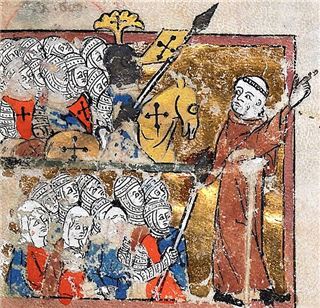
The Byzantine Empire's decline across its final four centuries was unusually self-conscious — a civilisation that could perceive its own diminishment with lucid clarity but lacked the resources to arrest it, producing a twilight of great cultural refinement alongside irreversible political contraction. The structural causes were set at the Battle of Manzikert in 1071, which opened the Anatolian plateau to permanent Turkish settlement and removed the demographic and agricultural base that had sustained Byzantine military power for four centuries. The Komnenian dynasty (1081–1185) achieved a remarkable recovery through military reorganisation and diplomatic skill, exploiting the First Crusade to regain western Anatolia, but at the cost of trading privileges for Venetian merchants that drained Byzantine commercial wealth and created the incentive for the catastrophic Fourth Crusade. In April 1204 the crusaders sacked Constantinople and established a Latin Empire that held the city until 1261: the capital that had withstood Persian, Arab, Bulgarian and Rus' sieges for eight centuries fell to fellow Christians, the Latins, its treasures were looted, Hagia Sophia was desecrated, and its aura of invincibility was permanently shattered. The Palaiologan restoration of 1261, achieved by Michael VIII from the successor state of Nicaea, recovered Constantinople but not the empire's substance — Michael and his successors ruled a diminished state dependent on Genoese commercial privileges that reproduced the Venetian dependency in another form, and fourteenth-century civil wars hastened the decay. The final century and a half was one of progressive Ottoman encirclement: the Ottomans established themselves in Europe at Gallipoli in 1354, moved their capital to Adrianople (Edirne), and reduced the empire to the city itself and scattered remnants in Greece. Constantine XI's death fighting on the walls when Mehmed II took Constantinople on 29 May 1453 — the last Roman emperor dying in defence of the last Roman city — was one of history's most symbolically complete endings, closing eleven centuries of continuous institutional existence with a final act of defiant dignity.
The Byzantine Empire's most extraordinary achievement was not territorial but temporal: surviving for 1,123 years — one of the longest continuous imperial histories on record — through Constantinople's formidable defences, the long stability of the gold solidus, the legal framework of the Corpus Juris Civilis and a diplomatic sophistication that repeatedly turned potential conquerors into clients and partners, carrying Roman civilisation into the medieval world and preserving the Greek intellectual heritage that would help ignite the European Renaissance.
References
- Haldon, J.F. (1997) Byzantium in the Seventh Century: The Transformation of a Culture. Revised edn. Cambridge: Cambridge University Press.
- Magdalino, P. (1993) The Empire of Manuel I Komnenos, 1143–1180. Cambridge: Cambridge University Press.
- Mango, C. (ed.) (2002) The Oxford History of Byzantium. Oxford: Oxford University Press.
- Ostrogorsky, G. (1968) History of the Byzantine State. Translated by J. Hussey. Revised edn. Oxford: Blackwell.
- Runciman, S. (1965) The Fall of Constantinople, 1453. Cambridge: Cambridge University Press.
- Treadgold, W. (1997) A History of the Byzantine State and Society. Stanford: Stanford University Press.
- Whittow, M. (1996) The Making of Byzantium, 600–1025. London: Macmillan.
Connections
Open the full connections map →