Islamic Caliphates & Middle East
Ottoman Empire
At a glance
- The Ottoman Empire grew from a frontier beylik in Anatolia into a power spanning three continents for over six centuries.
- Janissary infantry, gunpowder artillery and a sophisticated bureaucracy let it take Constantinople and rule a diverse realm.
- Lost wars, nationalist revolts and European debt control eroded it; defeat in the First World War ended the sultanate in 1922.
Rise & Fall
- 1302Osman I defeats a Byzantine force at the Battle of Bapheus
- 1326Orhan captures Bursa, the dynasty's first true capital
- 1453Mehmed II captures Constantinople after a siege of some fifty-three days
- 1516–1517Selim I conquers the Mamluk Sultanate, gaining Egypt, Syria and the holy cities
- 1526Suleiman the Magnificent destroys the Hungarian royal army at Mohács
- 1683Jan III Sobieski routs the Ottoman army at the second siege of Vienna
- 1839The Tanzimat reforms begin to modernise administration and law
- 1922The Grand National Assembly abolishes the sultanate
Foundation

The Ottoman Empire originated in the fractured political landscape of north-western Anatolia in the late thirteenth century, where the collapse of Seljuk authority following the Mongol victory at the Battle of Köse Dağ in 1243 had fragmented Asia Minor into a constellation of competing Turkic beyliks, petty principalities established along the shrinking Byzantine frontier. Among these, the beylik of Osman I, a Turkoman chieftain traditionally said to belong to the Kayı tribe of the Oghuz Turks, lay in the Bithynian borderlands near Bursa, directly on the frontier between the Islamic and Byzantine worlds. This position attracted ghazi warriors, fighters drawn to campaigning against non-Muslim powers, and gave the nascent state a continuous supply of manpower and ideological purpose. Osman’s victory over a Byzantine force at the Battle of Bapheus in 1302 established his military credibility, and his son Orhan captured Bursa in 1326, making it the dynasty’s first true capital and beginning the transition from raiding confederation to territorial state. The conquest of Constantinople on 29 May 1453 by Mehmed II, achieved after a siege of some fifty-three days in which great bronze cannon cast by the founder Urban breached the Theodosian walls that had resisted assault for over a thousand years, was the empire’s defining transformation: it extinguished the Byzantine Empire after eleven centuries, cast the Ottomans as heirs to Roman imperial prestige and gave them a capital commanding the junction of Europe and Asia. Selim I’s conquest of the Mamluk Sultanate in 1516–1517 brought Egypt, Syria and the holy cities of Mecca and Medina under Ottoman sovereignty, and the dynasty’s assumption of the caliphal title, traditionally said to have passed from the last Abbasid shadow caliph in Cairo, strengthened its claim to leadership of the Sunni Islamic world.
Socioeconomy
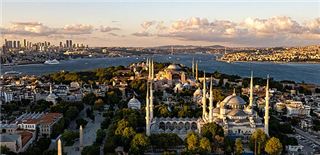
The Ottoman economy was among the most complex and geographically extensive of the early modern world, encompassing the agricultural surpluses of the Anatolian and Balkan heartlands, the commercial revenues of the eastern Mediterranean and Black Sea trade networks, and the fiscal resources of a population that at its sixteenth-century height is estimated at roughly 25–30 million across three continents. The timar system, the empire’s foundational agrarian-military institution, assigned revenues from specific agricultural lands to sipahi cavalrymen in exchange for military service, fusing land tenure, taxation and military organisation into a single mechanism. It functioned well during the classical period but declined from the late sixteenth century as military needs shifted towards salaried infantry and the state turned increasingly to tax-farming. Istanbul grew by the later sixteenth century into one of the world’s largest cities, with a population often estimated at several hundred thousand and perhaps as many as 700,000, serving as the nerve centre of an imperial economy that moved grain, textiles, metals and luxury goods across vast territories through a combination of state-directed provisioning and private enterprise. Non-Muslim populations, chiefly Orthodox Christians, Armenians and Jews, were organised into religious communities, later formalised as the millet system, which enjoyed considerable autonomy in worship, education and matters of personal status. This pragmatic pluralism eased the integration of diverse skilled populations, notably the Sephardic Jews expelled from Spain in 1492, who brought commercial networks and technical expertise such as printing to Ottoman cities. The empire’s control of the principal routes between Asia and Europe gave it great leverage over Eurasian trade, although the Portuguese rounding of the Cape of Good Hope opened a sea route that diverted part of the spice commerce away from Ottoman-controlled corridors from the early sixteenth century.
Military

The Ottoman military was among the most innovative and institutionally sophisticated fighting forces of the Mediterranean and Middle Eastern world for the better part of three centuries. Its pre-eminence rested on the janissary corps, an elite infantry force recruited through the devshirme, whereby Christian boys, mainly from the Balkans, were periodically levied, converted to Islam, educated and trained as professional soldiers loyal to the sultan rather than to any tribal or feudal allegiance. Organised as a standing salaried infantry and increasingly equipped with firearms from the fifteenth century onwards, the janissaries gave the Ottomans a decisive advantage over opponents relying on feudal cavalry levies. Ottoman artillery was among the most advanced in the world at the time of Constantinople’s fall, and Mehmed II’s deployment of massive bombards, including the great gun cast by Urban (or Orban), demonstrated a mastery of siege warfare that the empire refined in later campaigns. The reign of Suleiman the Magnificent (r. 1520–1566) produced its most ambitious campaigns: the capture of Belgrade in 1521, the destruction of the Hungarian royal army at the Battle of Mohács in 1526, the first siege of Vienna in 1529, and the naval operations of Hayreddin Barbarossa, whose victory at Preveza in 1538 secured Ottoman naval dominance in the eastern and central Mediterranean for a generation. The failed second siege of Vienna in September 1683, when a relief army of imperial German and Polish troops under Jan III Sobieski routed the forces of Grand Vizier Kara Mustafa Pasha, marked the end of Ottoman expansion in Europe and opened a long era of territorial retreat that the empire’s military institutions, increasingly resistant to reform, proved unable to reverse.
Governance & Law
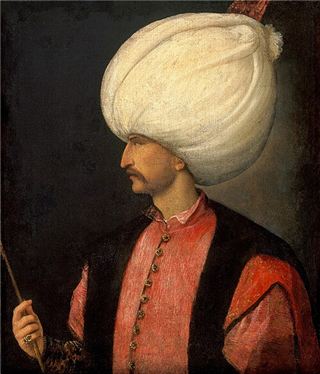
The Ottoman administrative system combined Islamic legal tradition, Persian and Byzantine bureaucratic practice and distinctively Ottoman institutions into a governing structure of considerable sophistication, which administered a multi-ethnic, multi-religious empire for over six centuries. The sultan stood at the apex of the state, commanding the military and administrative apparatus through the grand vizier and the imperial council (Divan), while religious and legal affairs were overseen by the Sheikh ul-Islam (Şeyhülislam), the empire’s chief religious authority. After the conquest of the Mamluk lands in 1517 the sultans also claimed the title of caliph, a claim whose political importance grew markedly in the eighteenth and nineteenth centuries. Suleiman the Magnificent’s legislative activity, which earned him the Ottoman epithet Kanuni, “the Lawgiver”, systematised the relationship between dynastic law (kanun) and Islamic sharia, producing codes on criminal justice, land tenure and taxation that remained in force for generations. The Sublime Porte, the grand vizier’s administration, managed a bureaucracy whose sophistication impressed European observers, with specialised departments for the treasury, correspondence and provincial affairs, and a hierarchy of governors (beylerbeys and sancakbeys) that extended the imperial writ from the Crimea to Yemen and from Algeria to the Persian Gulf. The Tanzimat reforms of 1839–1876, prompted by growing European military and economic superiority, sought to modernise administration and law, proclaiming equality before the law regardless of religion, reorganising the provinces and founding secular schools, and culminated in the short-lived constitution of 1876. These reforms, however, were implemented unevenly and could not by themselves resolve the empire’s mounting structural problems.
Global & Regional Impact

The Ottoman Empire’s global significance was exceptional in its combination of geographical reach, duration and cultural depth, exercising influence across European, Middle Eastern and North African history simultaneously. The fall of Constantinople in 1453 sent shockwaves through Christian Europe and accelerated the movement of Byzantine scholars, with their Greek manuscripts and classical learning, to Italian cities, a migration that contributed to the intellectual momentum of the Renaissance. Ottoman control of the eastern Mediterranean and its trade routes is often cited as one of the spurs to the Age of Discovery, the Portuguese and Spanish search for oceanic passages to Asia, so that the consequences of Mehmed II’s conquest reached far beyond the region. The long Ottoman-Habsburg rivalry structured European geopolitics from the 1520s to the late seventeenth century, with the Ottoman factor repeatedly shaping European alliances, including the Franco-Ottoman alliance concluded under Francis I and Suleiman. In the Islamic world, Ottoman patronage of architecture, poetry, theology and music produced a distinctive imperial aesthetic; the classical style of the architect Mimar Sinan, credited with more than three hundred buildings including the Süleymaniye Mosque in Istanbul and the Selimiye Mosque in Edirne, represents one of the most accomplished architectural achievements of the sixteenth century. The empire’s dissolution after the First World War, and the subsequent partition of its Arab provinces into British and French mandates, created state boundaries that departed significantly from Ottoman administrative geography and have shaped the political history of the Middle East ever since.
Decline & Fall
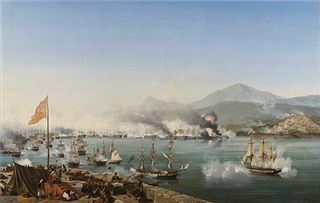
The Ottoman Empire’s decline, a concept modern historians increasingly treat as a long process of transformation rather than steady decay, extended over more than two centuries from the failed siege of Vienna in 1683 to the abolition of the sultanate in 1922. It resulted from the combined effects of military setbacks, fiscal strain, nationalist fragmentation and European imperial pressure operating across many fronts. The Treaty of Karlowitz in 1699, which surrendered most of Hungary and Transylvania to the Habsburgs and Podolia to Poland, and the Treaty of Küçük Kaynarca in 1774, which made the Crimean Khanate independent and gave Russia provisions it later interpreted as a right to protect the sultan’s Orthodox subjects, stripped the empire of vital territories and set the precedent of European powers extracting concessions through military pressure. Nineteenth-century nationalist movements among Ottoman Christian populations then progressively dismembered its European provinces: Greece achieved independence in 1830 after the Greek War of Independence, which saw British, French and Russian naval intervention at Navarino in 1827, Serbia and Romania gained full independence and Bulgaria autonomy after the Russo-Turkish War of 1877–1878, while Armenian, Macedonian and Albanian movements pressed their own claims. The Capitulations, treaty arrangements granting European nationals exemption from Ottoman jurisdiction and favourable tariffs, constrained the empire’s fiscal sovereignty, and the Ottoman Public Debt Administration established in 1881 placed much of its revenue under European creditor control. The Balkan Wars of 1912–1913, which stripped the empire of nearly all its remaining European territory, and its alignment with the Central Powers in the First World War, which led to the Allied occupation of Istanbul from 1918 and the punitive Treaty of Sèvres in 1920, created the conditions for Mustafa Kemal’s nationalist movement. The Grand National Assembly abolished the Sultanate on 1 November 1922, proclaimed the Republic of Turkey on 29 October 1923 and abolished the caliphate in March 1924.
The Ottoman Empire stands as one of history’s longest-lived empires, which for over six centuries governed a multi-ethnic, multi-religious realm across three continents and whose dissolution after the First World War reshaped the political map of the modern Middle East and south-eastern Europe.
References
- Faroqhi, S. (2004) The Ottoman Empire and the World Around It. London: I.B. Tauris.
- Finkel, C. (2005) Osman's Dream: The Story of the Ottoman Empire, 1300–1923. London: John Murray.
- Inalcik, H. (1973) The Ottoman Empire: The Classical Age, 1300–1600. Translated by N. Itzkowitz and C. Imber. London: Weidenfeld and Nicolson.
- Itzkowitz, N. (1972) Ottoman Empire and Islamic Tradition. New York: Knopf.
- Quataert, D. (2005) The Ottoman Empire, 1700–1922. 2nd edn. Cambridge: Cambridge University Press.
- Runciman, S. (1965) The Fall of Constantinople, 1453. Cambridge: Cambridge University Press.
- Shaw, S.J. and Shaw, E.K. (1976–1977) History of the Ottoman Empire and Modern Turkey. 2 vols. Cambridge: Cambridge University Press.
Connections
Open the full connections map →