Islamic Caliphates & Middle East
Mughal Empire
At a glance
- The Mughal Empire was founded by the Timurid prince Babur in 1526 and came to rule most of the Indian subcontinent.
- Akbar's cash revenue system, ranked nobility and religious accommodation built one of the largest economies of its age.
- Aurangzeb's costly wars, regional revolts and the rise of the East India Company hollowed it out before its end in 1858.
Rise & Fall
- 1526Babur defeats Ibrahim Lodi at the First Battle of Panipat and founds the empire
- 1527Babur defeats the Rajput confederacy of Rana Sanga at Khanwa
- 1555Humayun recovers Delhi after years of exile under Sher Shah Suri's rule
- 1556Akbar begins his reign, turning a fragile conquest into a stable empire
- 1564Akbar abolishes the jizya tax on non-Muslims
- 1687Aurangzeb annexes Golconda, bringing the empire near its greatest extent
- 1739Nader Shah of Persia sacks Delhi and carries off the Peacock Throne
- 1858The British exile Bahadur Shah II, the last emperor, to Rangoon
Foundation
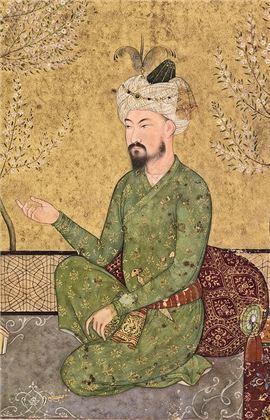
The Mughal Empire was founded in 1526 by Zahir-ud-din Muhammad Babur following his victory over Ibrahim Lodi, the last sultan of Delhi, at the First Battle of Panipat. Babur, a Timurid prince from the Fergana Valley descended from Timur on his father’s side and from Genghis Khan on his mother’s, capitalised on the political fragmentation of North India and the weakness of the Delhi Sultanate. His use of field artillery and mobile cavalry tactics marked a decisive shift in Indian warfare, enabling him to overcome numerically superior forces. After consolidating his position with victory at the Battle of Khanwa in 1527 over the Rajput confederacy led by Rana Sanga of Mewar, Babur laid the foundations of a durable imperial structure. The early Mughal state nonetheless remained precarious, and his son Humayun was driven into exile by Sher Shah Suri before recovering Delhi in 1555. Only under Akbar (r. 1556–1605) did administrative consolidation, military expansion and a policy of religious accommodation transform a fragile conquest state into a stable and expansive empire.
Socioeconomy
The Mughal socioeconomy was characterised by a highly stratified yet integrated agrarian system that sustained one of the largest premodern economies in the world. The great majority of the population were peasants producing staples such as wheat, rice and cotton, while cities such as Agra, Delhi and Lahore functioned as hubs of commerce and administration. Under Akbar, the revenue system was rationalised through the zabt system associated with his finance minister Raja Todar Mal, which assessed land revenue in cash on the basis of measured land and average yields and prices, giving the state a predictable income. The mansabdari hierarchy of ranked nobles linked military and administrative service to temporary assignments of land revenue (jagir). Trade flourished both internally and externally, with cotton textiles, indigo, spices and precious stones forming the backbone of exports to Central Asia, the Middle East and Europe. The monetisation of the economy, built on the silver rupiya introduced by Sher Shah Suri and retained by the Mughals, facilitated commercial expansion and drew large inflows of New World silver into India.
Military
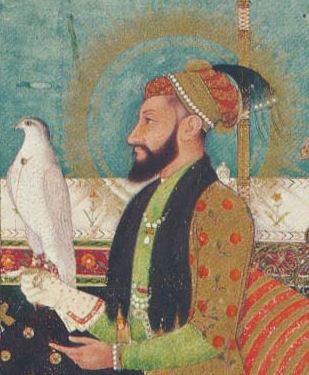
The Mughal military was a composite force combining Central Asian cavalry traditions with gunpowder technology, a combination that proved decisive in its expansion and consolidation. Babur’s early successes owed much to the effective use of matchlock firearms and artillery, which his successors developed further. The empire relied on the mansabdari system to maintain a large and flexible army, in which nobles were required to maintain and command troops in proportion to their rank. Cavalry remained the backbone of Mughal military strength, supported by infantry, artillery and war elephants used for shock and logistical purposes. Under Aurangzeb (r. 1658–1707), the empire reached its greatest territorial extent, annexing the Deccan sultanates of Bijapur in 1686 and Golconda in 1687 and waging decades of war against the Marathas. These prolonged campaigns, however, strained resources and exposed structural weaknesses, as the decentralised character of the army often produced problems of loyalty and coordination among the nobility.
Governance & Law

Mughal governance was highly centralised, with the emperor exercising supreme authority supported by a sophisticated bureaucratic apparatus. The administrative framework was standardised under Akbar, who divided the empire into provinces (subahs), each with a governor (subahdar) and a separate revenue official (diwan), so that military command and finance were held in different hands. The mansabdari system served as the backbone of both civil and military administration, securing loyalty to the emperor through the controlled distribution of ranks and revenues. Legal practice blended Islamic law (sharia) with customary local law, reflecting the empire’s diverse population. Akbar’s policy of Sulh-i-kul (“peace with all”), together with his abolition of the jizya on non-Muslims in 1564, reduced sectarian tensions and broadened the base of imperial support, whereas Aurangzeb re-emphasised Islamic orthodoxy, reimposed the jizya in 1679 and sponsored the legal compilation known as the Fatawa-i-Alamgiri. The imperial court functioned as both a political and cultural centre, where decisions emerged from a combination of formal bureaucracy and personal authority.
Global & Regional Impact

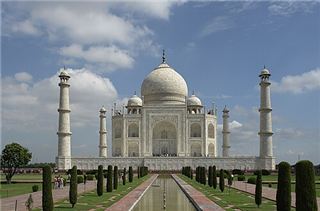
The Mughal Empire exerted profound influence on South Asia and beyond, shaping patterns of governance, culture and economic exchange. Its integration of diverse religious and ethnic groups under a centralised state provided a model of imperial rule that informed successor regimes in the region, including the British Raj, which adopted elements of Mughal revenue administration. Mughal patronage of art, architecture and literature produced enduring landmarks such as Humayun’s Tomb, Fatehpur Sikri, the Red Fort and, most famously, the Taj Mahal built by Shah Jahan, all embodying a synthesis of Persian, Indian and Islamic artistic traditions. The empire was central to early modern global trade, and European trading companies, among them the English East India Company, established commercial footholds in Mughal territories under imperial grants. This interaction facilitated the flow of goods, ideas and technologies between Asia and Europe. The Mughal legacy also persists in language and culture, including the development of Urdu and the wider Indo-Persian tradition.
Decline & Fall

The decline of the Mughal Empire began in the late seventeenth century, during the reign of Aurangzeb, whose prolonged military campaigns and religious policies strained the empire’s administrative and economic foundations. Overextension, combined with growing resistance from regional powers such as the Maratha Confederacy, Sikhs and Jats, weakened central authority. After Aurangzeb’s death in 1707, a rapid succession of weak rulers failed to hold the vast empire together, and provincial governors in Hyderabad, Bengal and Awadh established effectively autonomous states. External invasions, notably by Nader Shah of Persia, who sacked Delhi in 1739 and carried off the Peacock Throne, and later by Ahmad Shah Durrani, further destabilised the empire and depleted its wealth. The rising power of the English East India Company, confirmed by its victories at Plassey in 1757 and Buxar in 1764, steadily eroded Mughal sovereignty. The formal end followed the Indian Rebellion of 1857, after which the last emperor, Bahadur Shah II, was tried by the British and exiled to Rangoon in 1858.
The Mughal Empire stands as a pivotal example of early modern imperial governance, whose synthesis of military innovation, administrative sophistication and cultural integration left a lasting imprint on the history of South Asia.
References
- Brand, M. and Lowry, G.D. (eds.) (1987) Akbar's India: Art from the Mughal City of Victory. New York: Asia Society Galleries.
- Dale, S.F. (2004) The Garden of the Eight Paradises: Bābur and the Culture of Empire in Central Asia, Afghanistan and India (1483–1530). Leiden: Brill.
- Gascoigne, B. (1971) The Great Moghuls. London: Jonathan Cape.
- Habib, I. (2003) The Agrarian System of Mughal India, 1556–1707. Revised edn. Oxford: Oxford University Press.
- Qureshi, I.H. (1966) The Administration of the Mughal Empire. Karachi: University of Karachi.
- Richards, J.F. (1993) The Mughal Empire. Cambridge: Cambridge University Press.
- Streusand, D.E. (1989) The Formation of the Mughal Empire. Delhi: Oxford University Press.
Connections
Open the full connections map →