Europe
Hispania Tarraconensis
At a glance
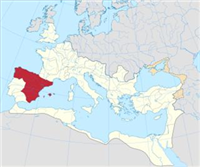
- Formed from Hispania Citerior, it stretched from the Pyrenees to Galicia and was governed from Tarraco.
- It held Rome's only Iberian legion, the VII Gemina at León, guarding the great gold mines of the north-west.
- Split by Diocletian around 293, the reduced province was the last Roman territory in Iberia, lost to the Visigoths in the 470s.
Rise & Fall
- 26–25 BCEAugustus campaigns against the Cantabri and winters at Tarraco
- 19 BCEAgrippa ends the Cantabrian Wars
- 15 CETiberius allows a temple to the deified Augustus at Tarraco
- 68 CEThe governor Galba is proclaimed emperor at Carthago Nova
- 259Bishop Fructuosus is martyred in the amphitheatre of Tarraco
- c. 293Diocletian splits off Gallaecia and Carthaginiensis
- 449Bagaudae and Suebi plunder the Ebro valley
- c. 472–475The Visigoths under Euric take Tarraco
Foundation

Hispania Tarraconensis grew out of Hispania Citerior, ‘Nearer Spain’, one of the two provinces Rome created in 197 BCE from its conquests in Iberia after the Second Punic War. Tarraco itself had been the base of the brothers Gnaeus and Publius Cornelius Scipio from 218 BCE, and over the next two centuries Roman control spread inland from the Mediterranean coast through the Celtiberian Wars, which ended with the destruction of Numantia in 133 BCE. Augustus took the province under his own control in the settlement of 27 BCE and directed the final conquest of the north. In 26–25 BCE he campaigned in person against the Cantabri and Astures but fell ill and withdrew to Tarraco, where he spent the winter and received foreign embassies, so that for a time the city was the effective centre of the empire. The Cantabrian Wars were finished by Agrippa in 19 BCE. The newly conquered lands of Gallaecia, Asturia and Cantabria were attached to Citerior, probably during Augustus' visit of 16–13 BCE, creating a vast province that stretched from the Pyrenees and the Mediterranean coast to the Atlantic shores of Galicia and south to Carthago Nova. Named after its capital, it was one of the largest provinces of the Roman Empire.
Socioeconomy
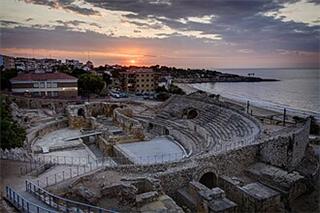
Tarraconensis contained great contrasts. The Mediterranean coast and the Ebro valley had felt Greek, Phoenician and Iberian influence for centuries and became thoroughly Roman, with cities such as Tarraco, Barcino (Barcelona), Emporiae, Valentia, Saguntum, Carthago Nova and Caesaraugusta (Zaragoza). The Meseta was the land of the Celtiberians and other Celtic-speaking peoples, and the north-west remained a region of hillforts (castros) and dispersed settlement long after the conquest. Pliny the Elder counted 179 towns in the province besides many smaller communities. Its economy was among the richest in the West. The coast around Barcino exported wine in large quantities in the first century, mostly in locally made amphorae, while Carthago Nova was famed for its silver, its esparto grass and its fish sauce. The gold mines of the north-west, worked on a vast scale by hydraulic methods at Las Médulas and other sites, were among the empire's main sources of gold; Pliny reports that Asturia, Gallaecia and Lusitania together yielded 20,000 Roman pounds a year. Latin culture flourished: the rhetorician Quintilian came from Calagurris (Calahorra) and the poet Martial from Bilbilis, near Calatayud. Christianity was established by the mid-third century, when Bishop Fructuosus of Tarraco was burned in the city's amphitheatre in 259.
Military
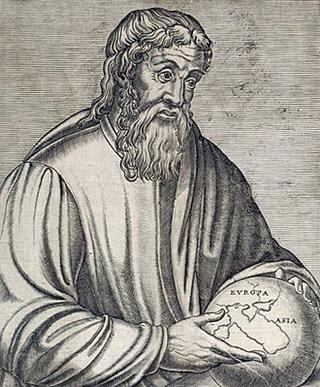
Tarraconensis was the only Iberian province with a permanent legionary garrison. Augustus' conquest of the north required perhaps seven legions, and Strabo, writing under Augustus and Tiberius, describes three legions stationed in the province. Their number fell as the north-west was pacified, and from the reign of Vespasian a single legion, the Legio VII Gemina, raised in Hispania by Galba in 68, held a camp in the north-west that grew into the city of León, whose name derives from legio. With its auxiliary units it guarded the gold-mining districts and supervised the region's roads. The province also supplied soldiers for service elsewhere, and Hispanic auxiliary units served on many frontiers. Imperial peace was broken in the third century. According to later writers, Frankish raiders crossed Gaul and reached Tarraco in the 260s, damaging the city, and in the late third and fourth centuries many towns, including Lucus Augusti (Lugo), Legio and Barcino, built strong walls; the walls of Lugo, over two kilometres long, still stand complete. In the fifth century the province's defence depended increasingly on Roman generals sent from Gaul and on Visigothic allies, while the Legio VII Gemina disappears from the record and local forces proved unable to stop either invaders or rebels.
Governance & Law
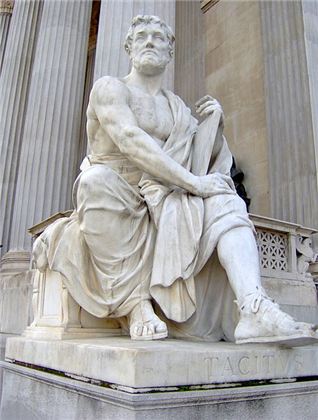
As one of the emperor's provinces, Tarraconensis was governed by a legatus Augusti pro praetore of consular rank, one of the most senior posts in the imperial service. Strabo describes how the governor was assisted by subordinate legates, one commanding the legions in the north-west and others administering justice, while a procurator managed imperial finances and the mines. The province was divided into seven judicial districts (conventus), centred on Tarraco, Carthago Nova, Caesaraugusta, Clunia, Asturica Augusta, Lucus Augusti and Bracara Augusta. Tarraco was the seat of the provincial council, which met to honour the emperor; in 15 CE Tiberius allowed the province to build a temple to the deified Augustus there, which Tacitus says set an example for all the provinces, and the upper city was later rebuilt as a monumental complex for the provincial cult and council. Its governor Servius Sulpicius Galba was proclaimed emperor at Carthago Nova in 68, and Hadrian held an assembly of the Hispanic provinces at Tarraco in the winter of 122–123. Vespasian's grant of Latin rights to Hispania around 73–74 turned hundreds of communities into self-governing municipalities. Around 293 Diocletian divided the province, creating Gallaecia in the north-west and Carthaginiensis in the south and centre, and leaving a smaller Tarraconensis in the Ebro valley and the north-east.
Global & Regional Impact
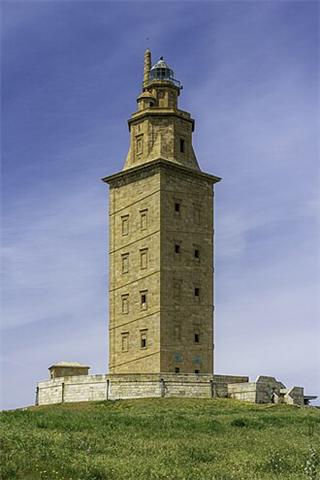
Tarraconensis was the main channel through which Roman civilisation reached most of the Iberian Peninsula. Its roads, above all the Via Augusta, which ran down the Mediterranean coast from the Pyrenees, and the network linking the Ebro valley with the Meseta and Galicia, shaped the routes of Spain for centuries. Its colonies and municipalities, from Barcino and Caesaraugusta to Toletum and Bracara Augusta, became the cities of medieval and modern Spain and Portugal, and the Latin spoken in the province developed into Catalan, Aragonese, Castilian, Galician and Portuguese. Roman engineering left lasting monuments: the aqueduct of Segovia, the Tower of Hercules lighthouse at A Coruña, still in use, the walls of Lugo, the gold-mining landscape of Las Médulas and the ruins of Tarraco are all UNESCO World Heritage Sites. The province also produced writers who shaped Latin literature, including Quintilian, whose Institutio Oratoria became a standard work on education, Martial, the master of the epigram, and, in the fourth century, the Christian poet Prudentius, probably from Calagurris. The church of Tarraco became a leading metropolitan see; the oldest surviving papal decretal, sent by Pope Siricius in 385, was addressed to Bishop Himerius of Tarraco. The ecclesiastical province of Tarragona still exists today.
Decline & Fall

The reduced province of Tarraconensis created by Diocletian remained under Roman control longer than any other part of Hispania. When the Vandals, Alans and Suebi broke into the peninsula in 409, they settled in the west and south, and the Roman government held the north-east as its base, using Visigothic allies to fight the invaders in 416–418. In the 440s and 450s, however, the province was shaken by the Bagaudae, rebels drawn from impoverished peasants and others outside imperial control. The general Asturius in 441 and his son-in-law, the poet Merobaudes, in 443 were sent against them, but in 449 a Bagaudic leader, Basilius, killed federate troops and the bishop of Turiasso (Tarazona) in his church, then joined the Suebic king Rechiar in plundering the region around Caesaraugusta and seizing Ilerda. In 456 the Visigothic king Theodoric II, acting in the name of the emperor Avitus, crushed the Suebi, and Visigothic power in Hispania grew. Euric, king from 466, broke openly with Rome: his commanders captured Pamplona and Caesaraugusta, then Tarraco and the coastal cities, probably around 472–475. With the fall of Tarraco Roman rule in Iberia ended, though the province's name, towns and church structures survived within the Visigothic Kingdom.
Hispania Tarraconensis, the largest Roman province of Iberia, was governed from Tarraco for some five centuries, guarded the gold mines of the north-west with Rome's only Iberian legion, gave Latin literature Quintilian and Martial, and was the last part of Hispania to remain under Roman rule before the Visigoths took it.
References
- Burgess, R.W. (1993) The Chronicle of Hydatius and the Consularia Constantinopolitana. Oxford: Clarendon Press.
- Curchin, L.A. (1991) Roman Spain: Conquest and Assimilation. London: Routledge.
- Keay, S.J. (1988) Roman Spain. London: British Museum Publications.
- Kulikowski, M. (2004) Late Roman Spain and Its Cities. Baltimore: Johns Hopkins University Press.
- Richardson, J.S. (1986) Hispaniae: Spain and the Development of Roman Imperialism, 218–82 BC. Cambridge: Cambridge University Press.
- Richardson, J.S. (1996) The Romans in Spain. Oxford: Blackwell.
Connections
Open the full connections map →