Inventions & Discoveries · Energy and power
Electric motor
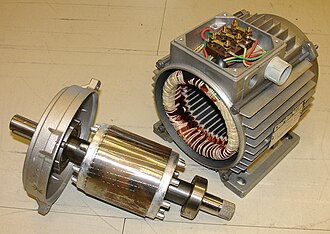
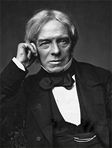
An electric motor is a machine that converts electrical energy into mechanical energy, usually through the interaction of a magnetic field and the current in a wire winding. Michael Faraday first showed electromagnetic rotation on 3 September 1821 at the Royal Institution, where a wire carrying a current turned around a magnet in a pool of mercury. Ányos Jedlik built a device with a stator, rotor and commutator in 1828, William Sturgeon a DC motor able to turn machinery in 1832, and Frank Julian Sprague the first practical DC motor in 1886. Galileo Ferraris and Nikola Tesla invented AC induction motors in 1885 and 1887.
On the inventions tree
- First known
- 1821
- Where
- Royal Institution
- Credited to
- Michael Faraday
NoteAndrew Gordon and Benjamin Franklin described electrostatic motors in the 1740s and 1750s, but these were never put to practical use; Faraday's device of 1821 was the first electromagnetic one.
See also

Cite this entry
- APA
- The Epoch Institute. (2026). Electric motor. In The Epoch Institute Encyclopedia. https://the-epoch-institute.org/encyclopedia/electric-motor
- MLA
- “Electric motor.” The Epoch Institute Encyclopedia, The Epoch Institute, 2026, https://the-epoch-institute.org/encyclopedia/electric-motor. Accessed .
- Chicago
- The Epoch Institute. “Electric motor.” The Epoch Institute Encyclopedia. 2026. https://the-epoch-institute.org/encyclopedia/electric-motor.
- Harvard
- The Epoch Institute (2026) ‘Electric motor’, The Epoch Institute Encyclopedia. Available at: https://the-epoch-institute.org/encyclopedia/electric-motor (Accessed: ).
Last reviewed October 2026Random entry ↻