Inventions & Discoveries · Building and engineering
Crane
A crane is a machine that lifts and moves loads with a boom, hoist, ropes or chains and sheaves, using levers and pulleys for mechanical advantage. The shaduf, a crane-like lever for lifting irrigation water, was used in ancient Mesopotamia and Egypt, but building cranes appear in Greece in the late 6th century BCE, attested by cuttings for lifting tongs and Lewis irons on temple blocks. The Romans added pulleys and treadwheels: a polyspastos worked by four men could lift 3,000 kg. Treadwheel cranes returned to Europe in the High Middle Ages for Gothic cathedrals and harbours, and steam engines, then internal combustion engines and electric motors, later powered them.
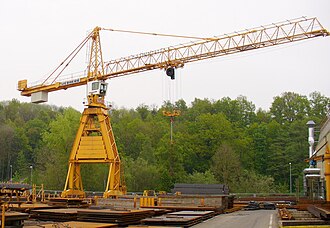
On the inventions tree
- First known
- late 6th century BCE
- Where
- Greece
NoteThe shaduf of ancient Mesopotamia is sometimes counted as the first crane, but it was a lever for lifting irrigation water.
See also






Cite this entry
- APA
- The Epoch Institute. (2026). Crane. In The Epoch Institute Encyclopedia. https://the-epoch-institute.org/encyclopedia/crane-machine
- MLA
- “Crane.” The Epoch Institute Encyclopedia, The Epoch Institute, 2026, https://the-epoch-institute.org/encyclopedia/crane-machine. Accessed .
- Chicago
- The Epoch Institute. “Crane.” The Epoch Institute Encyclopedia. 2026. https://the-epoch-institute.org/encyclopedia/crane-machine.
- Harvard
- The Epoch Institute (2026) ‘Crane’, The Epoch Institute Encyclopedia. Available at: https://the-epoch-institute.org/encyclopedia/crane-machine (Accessed: ).
Last reviewed October 2026Random entry ↻