Inventions & Discoveries · Farming and food
Shadoof
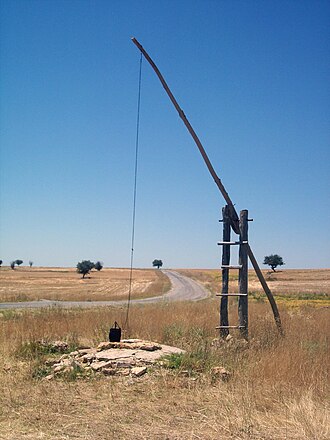
The shadoof is a tool for lifting water from a well, river or pond onto land or into a channel: a long pole pivoted on an upright frame, with a bucket at one end and a counterweight of clay or stone at the other. The earliest evidence of it is a cylinder seal from Mesopotamia of about 2200 BCE; it appeared in Upper Egypt sometime after 2000 BCE and reached China around the same time. One man can lift 39 to 130 litres a minute with it, and it is still used for irrigation in Africa, Asia and parts of Europe.
On the inventions tree
- First known
- c. 2200 BCE
- Where
- Mesopotamia
NoteSome historians hold that it began on the Nile, citing tomb drawings at Thebes from 1250 BCE; another theory, with little evidence, places its origin in India.
Mentioned in 1 profile
See also







Cite this entry
- APA
- The Epoch Institute. (2026). Shadoof. In The Epoch Institute Encyclopedia. https://the-epoch-institute.org/encyclopedia/shaduf
- MLA
- “Shadoof.” The Epoch Institute Encyclopedia, The Epoch Institute, 2026, https://the-epoch-institute.org/encyclopedia/shaduf. Accessed .
- Chicago
- The Epoch Institute. “Shadoof.” The Epoch Institute Encyclopedia. 2026. https://the-epoch-institute.org/encyclopedia/shaduf.
- Harvard
- The Epoch Institute (2026) ‘Shadoof’, The Epoch Institute Encyclopedia. Available at: https://the-epoch-institute.org/encyclopedia/shaduf (Accessed: ).
Last reviewed October 2026Random entry ↻