Place · site
Joya de Cerén
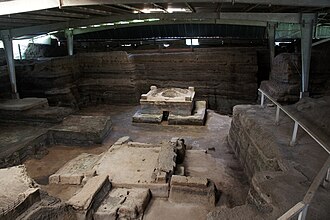
Joya de Cerén is an archaeological site in La Libertad Department, El Salvador, holding the remains of a pre-Columbian Maya farming village about 36 kilometres north-west of San Salvador. Thought to have been occupied between 200 and 600 CE, the village of an estimated 200 people was buried by ash from an eruption of the Loma Caldera around 600, apparently after its people had fled, for no human remains have been found. The ash preserved its houses, ceremonial buildings, stored food and fields, among them a manioc field, the earliest known evidence of manioc cultivation in the New World. Found by a bulldozer driver in 1976, it was inscribed on the UNESCO World Heritage List in 1993.
See also



Cite this entry
- APA
- The Epoch Institute. (2026). Joya de Cerén. In The Epoch Institute Encyclopedia. https://the-epoch-institute.org/encyclopedia/joya-de-ceren
- MLA
- “Joya de Cerén.” The Epoch Institute Encyclopedia, The Epoch Institute, 2026, https://the-epoch-institute.org/encyclopedia/joya-de-ceren. Accessed .
- Chicago
- The Epoch Institute. “Joya de Cerén.” The Epoch Institute Encyclopedia. 2026. https://the-epoch-institute.org/encyclopedia/joya-de-ceren.
- Harvard
- The Epoch Institute (2026) ‘Joya de Cerén’, The Epoch Institute Encyclopedia. Available at: https://the-epoch-institute.org/encyclopedia/joya-de-ceren (Accessed: ).
Last reviewed October 2026Random entry ↻