Inventions & Discoveries · Tools and materials
Lathe
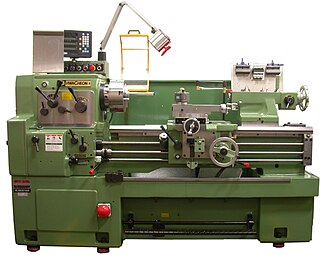
A lathe is a machine tool that turns a workpiece about an axis while tools cut, sand, drill or shape it into a form symmetrical about that axis. Clear evidence of turning comes from the 6th century BCE: fragments of a wooden bowl in an Etruscan tomb in northern Italy and two wooden dishes with turned rims from present-day Turkey. A painting in the tomb of Petosiris in 4th-century BCE Egypt is the first known picture of a lathe, and in China rotary lathes sharpened tools and weapons by about 400 BCE. Andrey Nartov built a lathe with a tool-carrying carriage and gears in 1718, and by the 1770s precision lathes with a slide-rest had become practical.
On the inventions tree
- First known
- 6th century BCE
- Where
- Etruscan tomb, northern Italy
- Credited to
- Etruscans
Also arose independentlyChina (c. 400 BCE)
NoteTenuous evidence of a turned artifact at a Mycenaean Greek site may go back to the 13th or 14th century BCE.
Mentioned in 1 profile
See also







Cite this entry
- APA
- The Epoch Institute. (2026). Lathe. In The Epoch Institute Encyclopedia. https://the-epoch-institute.org/encyclopedia/lathe
- MLA
- “Lathe.” The Epoch Institute Encyclopedia, The Epoch Institute, 2026, https://the-epoch-institute.org/encyclopedia/lathe. Accessed .
- Chicago
- The Epoch Institute. “Lathe.” The Epoch Institute Encyclopedia. 2026. https://the-epoch-institute.org/encyclopedia/lathe.
- Harvard
- The Epoch Institute (2026) ‘Lathe’, The Epoch Institute Encyclopedia. Available at: https://the-epoch-institute.org/encyclopedia/lathe (Accessed: ).
Last reviewed October 2026Random entry ↻