Great work · Central & East Asia

Terracotta Army

Periodc. 246 BCE – present
Made byMade for the mausoleum of Qin Shi Huang in workshops by government labourers and local craftsmen; Sima Qian says the mausoleum project involved 700,000 conscripted workers; the sculptors signed their names in the figures’ armpits, and each workshop inscribed its name on what it made
FormLife-sized terracotta figures, typically 1.75 to about 2 metres tall, of infantry, cavalry, charioteers, archers and officers, with chariots and horses, once painted and armed with real bronze weapons; estimated in 2007 at more than 8,000 soldiers, 130 chariots with 520 horses and 150 cavalry horses in three pits
Where it is nowFor the most part in situ, in pits about 1,500 m east of the emperor’s tomb mound at Mount Li in Lintong County, outside Xi’an, Shaanxi, under a museum complex; figures have travelled to exhibitions around the world
Known forthe largest pottery figurine group ever found; individual faces, no two figures exactly alike; ranks shown by height, uniform and hairstyle; more than 40,000 bronze weapons; the painted colours lost on exposure; the unopened tomb of the first emperor; the acrobats and other non-military figures

6 min read · Last reviewed October 2026

At a glance

  • The figures were buried with Qin Shi Huang in 210–209 BCE, laid out in military formation to guard his tomb from the east in the afterlife.
  • Heads, limbs and torsos were made separately, the faces from moulds, and clay was added after assembly to give each figure its own features, so that each face appears different.
  • Farmers digging a well found the first figures in 1974; most remain in situ, and the emperor’s tomb itself is still unopened, possibly over concerns for the preservation of its contents.

Timeline

  1. 246 BCEWork begins on the mausoleum of the future first emperor, then aged 13 and newly King of Qin
  2. 210–209 BCEThe terracotta army is buried with the emperor in his mausoleum
  3. 1974Farmers digging a well near Mount Li find the first figures, prompting archaeologists to investigate
  4. 1982The first exhibition of the figures outside China opens at the National Gallery of Victoria in Melbourne
  5. 1999Excavation of Pit K9901 uncovers the figures dubbed the Acrobats
  6. 2003A grave pit holding 121 skeletons attributed to the site’s workers is excavated
  7. 2007The British Museum opens “The First Emperor: China’s Terracotta Army”, which made 2008 its most successful year

Origins

Qin Shi Huang
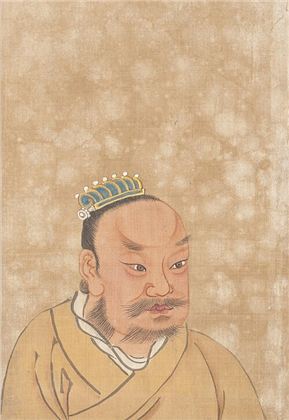
Qin Shi HuangUnknown (18??–18??), Public domain

The Terracotta Army belongs to the mausoleum of Qin Shi Huang, the first emperor of China. Work on the mausoleum began in 246 BCE, soon after the future emperor, then aged 13, succeeded his father as King of Qin, and according to the historian Sima Qian the project eventually involved 700,000 conscripted workers. The geographer Li Daoyuan, writing six centuries after the emperor’s death in the Shui Jing Zhu, recorded that Mount Li was chosen for its auspicious geology, famed for its jade and gold. The emperor is also well documented as a builder of monumental statues in human form, such as the Twelve Metal Colossi, now lost.

Sima Qian, writing in the Records of the Grand Historian a century after the mausoleum was completed, described the emperor’s burial with palaces, towers, officials and valuable objects, a hundred rivers simulated in mercury and a ceiling decorated with the heavenly bodies; his text makes no mention of the terracotta army. High levels of mercury found in the soil of the tomb mound have since given credence to his account. Before this army only rare and very small terracotta warrior figurines are known, from the end of the Zhou dynasty in the 4th–3rd century BCE, such as the Taerpo horserider, so its humanistic style may have appeared dramatically new to its contemporaries.

What It Is

Mount Li
Mount LiYuan Jiang (袁江) activity :1680-1730., Public domain

The army is part of a much larger necropolis of about 98 square kilometres, built as a microcosm of the emperor’s palace around his pyramidal tomb mound at the foot of Mount Li, with offices, halls, stables and an imperial park. Four main pits about 7 m deep lie some 1,500 m east of the mound, and the soldiers in them were laid out as if to protect the tomb from the east, where the emperor’s conquered states lay. Pit 1, 230 m long and 62 m wide, holds the main army of more than 3,000 figures in eleven parallel corridors under a wooden ceiling; Pit 2 has cavalry, infantry and war chariots and is thought to represent a military guard; Pit 3 is the command post; Pit 4 is empty, perhaps left unfinished.

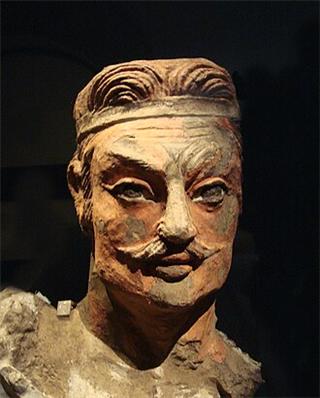
The figures are life-sized, typically 1.75 to about 2 metres tall, and vary in height, uniform and hairstyle according to rank, the generals being the tallest. They include armoured and unarmoured infantry, cavalrymen, chariot drivers, kneeling crossbowmen and standing archers, and officers, with terracotta horses among them, and their faces appear different for each figure. Other pits hold bronze carriages, figures of acrobats, strongmen and officials, stone armour suits, burials of horses and rare animals, and bronze cranes and ducks set in an underground park.
How It Was Made

The figures were made in workshops by government labourers and local craftsmen using local materials. Heads, arms, legs and torsos were created separately and joined by luting, and the faces were formed in moulds, at least ten of which may have been used, before clay was added to give each figure its own features; the legs were probably made much as terracotta drainage pipes were. The process is therefore classed as assembly-line production. Under tight imperial control each workshop had to inscribe its name on what it made, and the sculptors signed their names in the figures’ armpits. The finished figures were placed in the pits in precise military formation according to rank and duty.

They were originally painted with pigments including cinnabar, malachite, azurite, charcoal and Chinese purple over a coloured lacquer finish, with the faces in pink. Most held real weapons, and more than 40,000 bronze items have been recovered, mostly arrowheads in bundles of 100, whose chemistry suggests self-sufficient workshops working in a cellular system of production. Some swords carry inscriptions dating their manufacture to between 245 and 228 BCE. A grave pit excavated in 2003 held 121 skeletons attributed to the site’s workers, mostly aged 15 to 40; DNA analysis of 19 of them showed a diverse range of ethnicities, with a particular concentration from southern China.

Reception

Khalchayan
KhalchayanALFGRN, CC BY-SA 2.0

Since their discovery the figures have been noted for their realism and individuality, and where that style came from has divided scholars. In 1986 the art historian German Hafner first suggested a Hellenistic link, and Duan Qingbo, the site’s chief archaeologist from 1998 to 2006, saw a close parallel only in the later Khalchayan statuary of Central Asia. Li Xiuzhen of the Mausoleum Site Museum was quoted as saying the army was inspired by Greek sculpture, but later said the BBC had taken her words out of context: the warriors may be inspired by Western culture, she said, but were uniquely made by the Chinese. Zhang Weixing, the museum’s chief archaeologist, found “no substantial evidence at all” for such a link; Johanna Hanink and Felipe Rojas Silva argued that the speculation rests on old Eurocentric ideas; and Darryl Wilkinson, comparing the Moche culture of Peru, argued that “the Greeks did not invent naturalism”.

Scientific study has added other readings. In 2007 researchers at Stanford University reported that the Chinese purple pigment drew on knowledge gained by Taoist alchemists trying to make jade, and microscope marks give evidence of the earliest industrial use of lathes for polishing. Morphological studies in 2021 found a strong resemblance between the figures and the region’s present inhabitants, leading some scholars to suggest they were modelled on actual soldiers.

Survival & Rediscovery

Xiang Yu
Xiang YuUnknown Chinese artist, Public domain

Later historical accounts say that the mausoleum was looted by Xiang Yu, a contender for the throne after the first emperor’s death, though there are indications that the tomb itself may not have been plundered. Fire damage on figures in Pits 1 and 2, burnt ceiling rafters and the missing weapons have been taken as evidence of that looting and of a fire that brought the roof down and crushed the figures; those on display have been restored from the fragments. Over two millennia up to 5 metres of soil built up over the site. For centuries there were occasional reports of terracotta fragments, and graves of the 18th and 19th centuries show diggers striking pieces and discarding them as worthless.

On 29 March 1974 the farmers Yang Zhifa, his five brothers and their neighbour Wang Puzhi, digging a well about 1.5 km east of the tomb mound, struck the figures, and archaeologists including Zhao Kangmin went on to reveal the largest pottery figurine group ever found. A museum complex now covers the area. Exposure has its costs: in Xi’an’s dry climate much of the colour flaked off within minutes of the mud being removed, and the emperor’s tomb, a sealed space about 100 by 75 metres, remains unopened. Research in 2019 indicated that the burial soil, rather than a chromium coating as once believed, most likely preserved the bronze weapons.

Legacy

The army left a legacy in the tombs of later rulers. Funeral terracotta armies are known from later dynasties, though in a less stern and militaristic style and with much smaller statuettes, such as the Western Han Yangjiawan terracotta army of 195 BCE and the Yangling terracotta army of 141 BCE. Scholars see the human-sized monumental style of the first emperor as a relatively short-lived phase that did not reappear until monumental Buddhist sculpture began in China in the 4th–6th centuries CE.

In modern times the figures have become one of the most widely exhibited groups of ancient objects. The first exhibition outside China was held at the National Gallery of Victoria in Melbourne in 1982. At the British Museum, “The First Emperor: China’s Terracotta Army” ran from 2007 to 2008, brought the most visitors since the Tutankhamun exhibition of 1972, and sold 400,000 advance tickets so fast that the museum extended its opening hours until midnight. Exhibitions have since gone to Barcelona, Madrid, Bogotá, Santiago de Chile, North America, Sweden, New South Wales, Montreal, New York, Liverpool, Perth and Budapest, and the army has been described as the only set of historic artefacts besides the remains of the Titanic that can draw a crowd by its name alone.

The Terracotta Army is a collection of life-sized terracotta figures of soldiers, chariots and horses buried with Qin Shi Huang, the first emperor of China, in 210–209 BCE to protect him in the afterlife. Found by farmers digging a well in 1974, its more than 8,000 soldiers stand mostly in situ outside Xi’an, beside a tomb that remains unopened.

Test yourself

5 questions on this page, from its key events and facts.

The questions open here once the page has loaded.

References

  • Jonathan Clements, The First Emperor of China (Sutton, 2007)
  • Jane Portal, The First Emperor: China’s Terracotta Army (Harvard University Press, 2007)
  • Lothar Ledderose, Ten Thousand Things: Module and Mass Production in Chinese Art (Princeton University Press, 2000)
  • Corinne Debaine-Francfort, The Search for Ancient China (Thames & Hudson, 1999)