
Great work · Central & East Asia

Analects

Periodc. 475 BCE – present
Made bySayings attributed to Confucius, who died in 479 BCE, and his contemporaries, traditionally believed to have been compiled by his followers; many scholars now think it was compiled over about two hundred years in the Warring States period, reaching its final form in the mid-Han dynasty.
FormA classical Chinese text, the Lunyu (“edited conversations” or “selected speeches”), in twenty chapters of short passages, many opening with ziyue, “The Master said”, grouped by theme but without a continuous stream of thought.
Where it is nowThe received text descends from Zhang Yu's composite Zhang Hou Lun; early copies include the Stone Classics of the Xinping Era at Luoyang (c. 175 CE), the Dingzhou and Pyongyang Analects (c. 50 BCE), the Haihunhou Analects and Warring States bamboo strips acquired by Anhui University.
Known forren, an all-encompassing virtue; li, ritual propriety; filial piety; de, a ruler's moral force; the rectification of names; “Do not do to others what you would not like done to yourself”; one of the Four Books

7 min read · Last reviewed October 2026

At a glance

  • Traditionally held to be records kept by Confucius's disciples, the Analects is now thought to have been compiled over about two centuries, and manuscripts of around 300 BCE show that his sayings were being gathered by the mid-Warring States period.
  • Its sayings teach the cultivation of ren, an all-encompassing virtue, through filial piety and li, ritual propriety, and hold that a ruler should lead by de, moral force and example, rather than by punishment.
  • Promoted by Zhu Xi as one of the Four Books, it was memorised with his commentary by all who sought office in China until 1905, and its ideas still influence East Asian thought and values.

Timeline

  1. 479 BCEConfucius dies; by tradition his disciples then collect and jointly edit their records of his conversations
  2. c. 300 BCEThe bamboo manuscripts now called Zhongni Said and Kongzi Said record sayings of Confucius in a format like that of the Analects
  3. 157–141 BCEIn the reign of Emperor Jing of Han an Old Text version is found hidden in a wall of the house believed to have been Confucius's
  4. c. 50 BCEThe Dingzhou and Pyongyang Analects, two handwritten copies later found in tombs, are written in the Western Han dynasty
  5. 248 CEHe Yan's Collected Explanations of the Analects is written, for nearly 1,000 years the standard guide to the text
  6. 12th centuryZhu Xi promotes the Analects as one of the Four Books and writes the commentary that later displaces He Yan's
  7. 14th centuryThe Ming state endorses Zhu Xi's commentary on the Analects
  8. 2011The Qi version, lost for about 1,800 years, is found in the tomb of the Marquis of Haihun

Origins

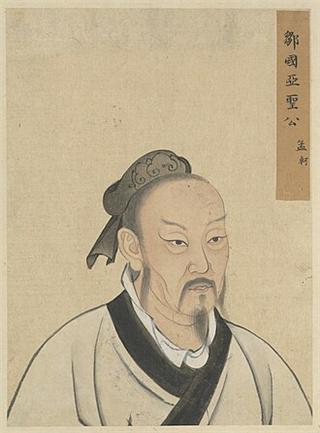
Mencius
Menciusanonymous, Public domain

Confucius viewed himself as a “transmitter” of social and political traditions that began in the early Zhou dynasty (c. 1000–800 BCE) and claimed to have originated nothing (§7.1), yet his ideals were not popular in his own time. His political theories ran directly against the Legalist orientation of China's rulers, and he failed to popularise them among the leaders of his day. He believed that the social chaos of his age came largely from a ruling elite claiming titles of which they were unworthy. Very few reliable sources about him exist besides the Analects: the principal biography, in Sima Qian's Records of the Grand Historian, holds much unverifiable and possibly legendary material, so the Analects is arguably the most reliable source on his life.

According to Ban Gu, writing in the Book of Han, the work began as records kept by Confucius's disciples of his conversations with them, collected and jointly edited after his death in 479 BCE. Its title, Lunyu, may mean “edited conversations” or “selected speeches”, hence “analects”. The Song dynasty scholar Zhu Xi likewise called it the records of Confucius's first- and second-generation pupils. A larger body of his teachings existed in the Warring States period than the Analects preserves: 75% of the sayings of Confucius cited by Mencius are not in the received text, and the Han writer Wang Chong claimed that every Han copy was only part of a much larger work.

What It Is

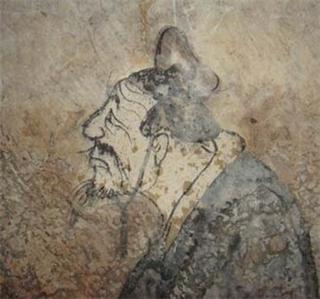
Confucius
ConfuciusAnonymous Chinese painter of the Western Han period, Public domain

The Analects is a collection of short passages in twenty chapters. The traditional chapter titles are mostly their opening words, the chapters are grouped by individual themes but not arranged as a continuous stream of thought, and central themes recur, sometimes in exactly the same wording. Many passages open with ziyue, “The Master said”, though without punctuation in classical Chinese it is unclear whether a direct quotation or a paraphrase follows. Chapter 10 describes Confucius's behaviour in daily activities in detail, and the archaic first verse of Chapter 20, an admonition by Yao to Shun, seems only tangentially related to Confucius.

At its centre is ren, which Confucius used for an all-encompassing state of virtue that no living person had fully attained; asked about it, he answered with examples rather than definitions. Its most basic step is devotion to one's parents and older siblings, and it is cultivated through the inverted Golden Rule, “Do not do to others what you would not like done to yourself”, and through li, the rituals and forms of propriety by which people show respect for others and their roles in society. A good ruler leads by de, a moral force that wins loyalty without coercion, and by example; good government “consists in the ruler being a ruler, the minister being a minister, the father being a father, and the son being a son”, and a ruler's first task is the rectification of names.
How It Was Made

The traditional account has been challenged by Chinese, Japanese and Western scholars. The Qing dynasty philologist Cui Shu argued on linguistic grounds that the last five books were produced much later than the rest; Itō Jinsai distinguished an “upper Analects” (Books 1–10) from a “lower Analects” (Books 11–20); Arthur Waley speculated that Books 3–9 are the earliest parts; and E. Bruce Brooks and A. Taeko Brooks proposed a “four stratum theory”. An “accretion theory” sees the text growing over a 230-year period from Confucius's death to the conquest of Lu in 249 BCE. Many modern scholars believe the work was compiled over about two hundred years during the Warring States period, and some proposed dates as late as 140 BCE for its final compilation.

Manuscripts of the 2010s moved the evidence earlier. Bamboo strips acquired by Anhui University in 2015, the “Zhongni Said”, and the “Kongzi Said” strips recovered from a tomb at Wangjiazui in Hubei between 2019 and 2021 both date to around 300 BCE, confirming that Confucius's sayings were being preserved and organised by the mid-Warring States period. At the start of the Han dynasty there were two versions, the Lu of twenty chapters and the Qi of twenty-two, and an Old Text version of twenty-one chapters was later found hidden in a wall of the house believed to have been Confucius's. Zhang Yu, tutor to Emperor Cheng of Han, combined the Lu and Qi versions into the Zhang Hou Lun, the text recognised as the Analects today.

Reception

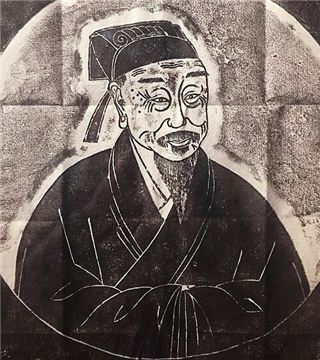
Zhu Xi
Zhu Xi向史公哲曰, CC BY-SA 4.0

For most of the Han period the Analects was not a principal text of Confucianism. Under Han Wudi (141–87 BCE), when the government began promoting Confucian studies, only the Five Classics were canonical, and the Analects was thought merely a collection of Confucius's oral commentary on them. By the Eastern Han it was widely read by schoolchildren and anyone aspiring to literacy, often before the Five Classics, and the heir apparent was given a tutor to teach it to him. It joined the Five Classics and the Classic of Filial Piety in the “Seven Classics”, and its style was imitated: the Sui dynasty writer Wang Tong wrote his Explanation of the Mean in its manner.

Chinese readers have long approached it through commentaries. He Yan's Collected Explanations, written in 248 CE and guided by his belief that Daoism and Confucianism complemented each other, remained the standard guide for nearly 1,000 years and is the oldest complete commentary that survives. It was displaced by the Collected Commentaries of Zhu Xi (1130–1200), who read the Analects through the other Four Books and promoted it as one of them, so that by the late Song dynasty it was generally held more insightful than the Five Classics. The Ming state endorsed Zhu's commentary in the fourteenth century, and until 1905 it was read and memorised with the Analects by all Chinese aspiring to literacy and to employment as government officials.

Survival & Rediscovery

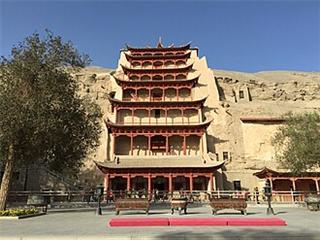
Dunhuang
Dunhuang慕尼黑啤酒, CC BY-SA 3.0

Neither the Lu version nor the Old Text version survives complete, though fragments of the Old Text were found at Dunhuang. According to Huan Tan, the Old Text differed from the Lu by four hundred characters and seriously in 27 places, and the received text agrees with it in only two of them. Before the late twentieth century the oldest known copy was in the Stone Classics of the Xinping Era, the Confucian classics written in stone at Luoyang c. 175 CE. Archaeologists have since found two handwritten copies of about 50 BCE in Western Han tombs: the Dingzhou Analects, found in 1973 but not transcribed in print until 1997, and the Pyongyang Analects, found in 1992.

Both have their difficulties. The Dingzhou copy was damaged by fire soon after it was entombed and by an earthquake soon after its recovery, and the surviving text is just under half the size of the received one; where they overlap it is shorter, which implies that the Analects was still expanding when it was buried. Academic access to the Pyongyang copy has been highly restricted by the North Korean government, and no academic study of it appeared until 2009. The Qi version, lost for about 1,800 years, was found in 2011 in the tomb of the Marquis of Haihun, whose copy circulated at least seventeen years before the other two. Of the Wangjiazui manuscript only a third of its 330 strips survive, and it has not yet been published in full.

Legacy

Voltaire
VoltaireNicolas de Largillière, CC0

The Analects has been one of the most widely read and studied books in China for more than two millennia, and its ideas continue to have a substantial influence on East Asian thought and values. It and its commentaries are applied in many cultural expressions across East and South-East Asia, in China, Japan, North and South Korea, Thailand and Vietnam, above all in education, and it has long influenced traditional East Asian martial arts, where it still shapes practice and teaching. Later Confucian philosophers read its ren as a kind manner, “humane” or “benevolent”, a sense that few of the sixty instances in the text have.

Writers outside China have found in it a portrait of a person. Voltaire and Ezra Pound took Chapter 10 to show that Confucius was a mere human; Simon Leys, its translator into English and French, said that it may have been the first book in history to describe the life of an individual, historic personage; and Elias Canetti called it “the oldest complete intellectual and spiritual portrait of a man”. Its translations run from James Legge's Chinese Classics of 1861 and Arthur Waley's version of 1938 to D. C. Lau's for Penguin in 1979 and Edward Slingerland's of 2003, with the French versions of Séraphin Couvreur and Anne Cheng and Kōjirō Yoshikawa's Japanese Rongo.

The Analects gathers short sayings attributed to Confucius and his contemporaries, compiled over generations after his death in 479 BCE and fixed in its received form under the Han dynasty. Its teaching of ren, li and rule by virtue made it, once Zhu Xi named it one of the Four Books, a text memorised by all who sought office in China until 1905, and it still influences East Asian thought.

References

  • James Legge, Confucian Analects, the Great Learning, and the Doctrine of the Mean, The Chinese Classics, vol. 1 (Trübner, 1861)
  • Arthur Waley, The Analects (George Allen and Unwin, 1938)
  • D. C. Lau, Confucius, The Analects (Lun yü) (Penguin Books, 1979)
  • E. Bruce Brooks and A. Taeko Brooks, The Original Analects: Sayings of Confucius and His Followers (Columbia University Press, 2001)
  • Edward Slingerland, Analects of Confucius: With Selections from Traditional Commentaries (Hackett Publishing Company, 2003)
  • Martin Kern, “Early Chinese literature, Beginnings through Western Han”, in Stephen Owen (ed.), The Cambridge History of Chinese Literature, Volume 1: To 1375 (Cambridge University Press, 2010)