Great work · South & Southeast Asia

Mahabharata

Periodc. 400 BCE – present
Made byTraditionally ascribed to the sage Vyasa, himself a major figure in the epic; it began as an orally transmitted tale of charioteer bards and grew through several redactions, its bulk probably compiled between the 3rd century BCE and the 3rd century CE, its final form reached by the early Gupta period.
FormA Sanskrit epic, the Mahābhārata (“Great Bharata”), in 18 parvas or books, told as tales within tales; its longest version has over 100,000 shlokas (couplets), or over 200,000 lines, with long prose passages, about 1.8 million words in all.
Where it is nowManuscripts from across India and abroad, the oldest surviving Sanskrit text dating to the Kushan Period; the Critical Edition of the Bhandarkar Oriental Research Institute, Pune, on 13,000 pages in 19 volumes; translations and retellings in Tamil, Kannada, Telugu, Bengali, Persian, Javanese and many other languages.
Known forthe rivalry of the Kauravas and Pandavas; Draupadi; the dice game and the thirteen-year exile; the 18-day Kurukshetra War; the Bhagavad Gita, Krishna's teaching to Arjuna; dharmayuddha, the theory of just war; the stories of Shakuntala, of Savitri and Satyavan and of Damayanti

6 min read · Last reviewed October 2026

At a glance

  • Ascribed by tradition to Vyasa, the Mahabharata grew from an oral tale of bards into one of the longest epic poems known, its bulk probably compiled between the 3rd century BCE and the 3rd century CE.
  • It tells of the struggle between the Kaurava and Pandava cousins for the throne of Hastinapura, ending in the Kurukshetra War, and holds the Bhagavad Gita, a prominent sacred text in Hindu traditions.
  • Retold in Tamil, Kannada, Telugu, Bengali and many other languages, in Persian at Akbar's court and in Javanese, it lives on in drama, film, television and folk ritual, and the Gita helped inspire the Indian independence movement.

Timeline

  1. 4th century BCEPanini's grammar, the Ashtadhyayi, gives the earliest known references to bharata and mahabharata, though whether it means the epic is uncertain
  2. 3rd century BCE – 3rd century CEThe bulk of the Mahabharata is probably compiled in these centuries
  3. c. 4th century CEThe text probably reaches its final form by the early Gupta period
  4. 533–534 CEA copper-plate inscription of Maharaja Sharvanatha from Khoh describes the epic as a collection of 100,000 verses
  5. 16th centuryFaizi and ʽAbd al-Qadir Badayuni produce the Razmnameh, a Persian translation commissioned by the Mughal emperor Akbar
  6. 1883–1896Kisari Mohan Ganguli's prose version, the first complete English translation, is published
  7. 1919–1966Scholars at the Bhandarkar Oriental Research Institute in Pune produce the Critical Edition of the Mahabharata
  8. 1988B. R. Chopra's television series Mahabharat is broadcast on India's national television, Doordarshan

Origins

Vedas
VedasMs Sarah Welch, CC BY-SA 4.0

The Mahabharata's setting has a historical precedent in Iron Age (Vedic) India, where the Kuru kingdom was the centre of political power during roughly 1200 to 800 BCE, and some elements of the epic can be traced back to Vedic times. A dynastic conflict of that period could have inspired the Jaya, the foundation of the corpus, with a climactic battle that came to be viewed as an epochal event. The historicity of the Kurukshetra War is unclear; many historians date it to the 10th century BCE, and F. E. Pargiter's reckoning from Puranic genealogies gives about 950 BCE. Indian tradition holds other dates: Aryabhata's 3102 BCE has become widespread, the Aihole inscription of Pulakeshin II implies 3137 BCE, and Varāhamihira and Kalhana place the war around 2449 BCE.

The epic started as an orally transmitted tale of the charioteer bards. Unlike the Vedas, which had to be preserved letter-perfect, it was a popular work whose reciters followed changes in language and style, so its earliest surviving parts are believed to be no older than the earliest outside references to it. It drew on Vedic literature: the snake sacrifice of King Janamejaya has a close connection to Vedic (Brahmana) literature, and the Panchavimsha Brahmana names Dhritarashtra and Janamejaya among the priests of such a sacrifice, and the Suparnakhyana, a late Vedic poem counted among the earliest traces of epic poetry in India, is a shorter precursor of the Garuda legend in the Adi Parva.

What It Is

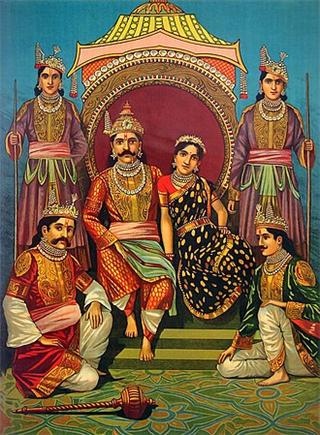
Pandavas
PandavasRaja Ravi Varma, Public domain

The core story is a dynastic struggle for the throne of Hastinapura, ruled by the Kuru clan, between two branches of the family: the Kauravas, the hundred sons of the blind king Dhritarashtra led by Duryodhana, and the Pandavas, the five sons of Pandu, Yudhishthira, Bhima, Arjuna, Nakula and Sahadeva, who all marry the princess Draupadi. The Pandavas escape a plot to burn them in a house of lac and build a new capital at Indraprastha, but Yudhishthira loses everything, his brothers, himself and Draupadi, in a dice game against Duryodhana's uncle Shakuni, and the Pandavas are sent into exile for 12 years, with a 13th year in disguise. When talks fail, the two sides meet at Kurukshetra, and after an 18-day battle the Pandavas are victorious.

Before the battle Arjuna, seeing his kin and teachers in the opposing army, refuses to fight, and his charioteer Krishna reminds him of his duty as a Kshatriya; this dialogue is the Bhagavad Gita. The epic ends with the death of Krishna, the end of his dynasty and the Pandavas' ascent to heaven, and marks the beginning of the Kali Yuga. Along the way it tells many other stories, among them those of Shakuntala, of Savitri and Satyavan and of Damayanti, and an abbreviated Ramayana, and it discusses the four goals of life and dharmayuddha, just war, with rules such as the fair treatment of captives and the wounded.
How It Was Made

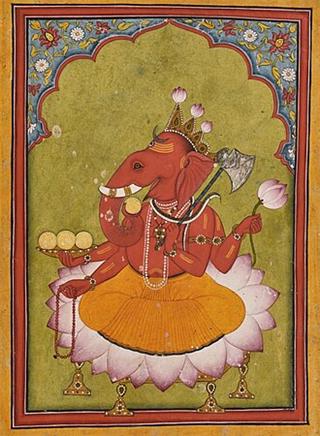
Ganesha
Ganeshaanonymous, Public domain

The epic is traditionally ascribed to the sage Vyasa, who is also a major figure in it. Its first section says that Ganesha wrote the text down to Vyasa's dictation, but scholars regard this as a later interpolation, and the Critical Edition does not include it. The story is told as a frame tale: Vaisampayana, a disciple of Vyasa, first recites it at Taxila to King Janamejaya, great-grandson of Arjuna, and many years later the storyteller Ugrashrava Sauti recites it again to sages at a twelve-year sacrifice in the Naimisha Forest.

Research has put an enormous effort into dating the text's layers. The epic itself distinguishes a core of 24,000 verses, the Bharata proper, and at least three redactions are commonly recognised: the Jaya of 8,800 verses attributed to Vyasa, the Bharata of 24,000 recited by Vaisampayana, and the Mahabharata of over 100,000 recited by Ugrashrava Sauti, though John Brockington argues that Jaya and Bharata are the same text. The redaction followed formal principles that emphasised the numbers 18 and 12. The bulk was probably compiled between the 3rd century BCE and the 3rd century CE, with the oldest preserved parts not much older than around 400 BCE, and the text probably reached its final form by the early Gupta period (c. 4th century CE); a mention of the Huna implies that the Bhishma Parva may have been edited around the 4th century.

Reception

Andhra Mahabharatam
Andhra Mahabharatambazaar art, Public domain

Early references show the epic's spread. Panini's grammar of the 4th century BCE knows the words bharata and mahabharata and some of the epic's figures, though whether it refers to the epic itself is uncertain. The Greek writer Dio Chrysostom (c. 40 – c. 120 CE) reported that Homer's poetry was sung even in India, which many scholars take as evidence of a Mahabharata at that date. A copper-plate inscription of Maharaja Sharvanatha (533–534 CE) from Khoh calls it a “collection of 100,000 verses”. Its stories took on lives of their own in Classical Sanskrit literature: Kalidasa's Abhijnanashakuntala draws on one, and Bhasa's play Urubhanga on the slaying of Duryodhana by Bhima. Within the Indian tradition it is sometimes called the fifth Veda.

It was translated and retold across India and beyond: in Tamil from the 9th century, in the Javanese Kawi Mahabharata of the late 10th century, in Kannada by Pampa and Kumaravyasa, in the Telugu Andhra Mahabharatam of the 11th to 14th centuries, in Bengali, Odia, Assamese, Marathi, Punjabi and Hindi, and in Persian, first for Sultan Zayn al-Abidin and then in the Razmnameh commissioned by Akbar. Jain authors told their own versions, in which Krishna is reborn in hell for his exploits but will one day be reborn as a Tirthankara. Some early 20th-century Indologists judged the text chaotic: Hermann Oldenberg called the full text a “horrible chaos”.

Survival & Rediscovery

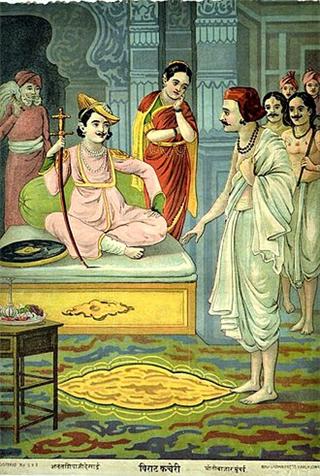
Virata
VirataRavi Varma Press, Public domain

Manuscript evidence for the epic is somewhat late, given its materials and the climate of India, but very extensive. The oldest surviving Sanskrit text dates to the Kushan Period (200 CE), and the absence of the Anushasana Parva and the Virata Parva from the “Spitzer manuscript” helps to date the latest additions. Because the text was fluid, Vishnu Sukthankar, editor of the first great critical edition, held that it was useless to seek an original shape; the aim could only be “to reconstruct the oldest form of the text which it is possible to reach based on the manuscript material available.”

Between 1919 and 1966 scholars at the Bhandarkar Oriental Research Institute, Pune, compared manuscripts from India and abroad and produced the Critical Edition, on 13,000 pages in 19 volumes, with the Harivamsha in two more volumes and six index volumes; it is the text usually used in Mahabharata studies today. Complete English versions include Kisari Mohan Ganguli's Victorian prose (1883–1896), now in the public domain, P. Lal's verse rendering of all slokas in all recensions, and Bibek Debroy's unabridged ten volumes (2010–2014). A prose translation based on the Critical Edition, begun by J. A. B. van Buitenen and continued by several scholars after his death, is still in progress at the University of Chicago Press, and the Clay Sanskrit Library has published 15 volumes of a projected 32.

Legacy

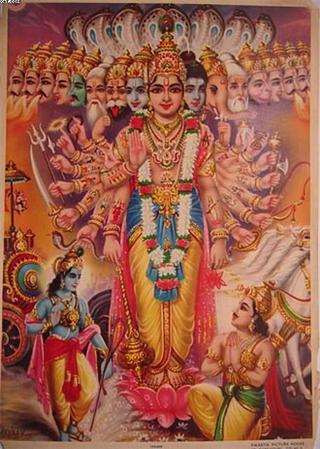
Bhagavad Gita
Bhagavad GitaUnknown artist, Public domain

In the Bhagavad Gita, Krishna explains to Arjuna his duties as a warrior and prince and sets out Yogic and Vedantic philosophies, and the Gita is often described as a concise guide to Hindu philosophy and a practical guide to life. In modern times Swami Vivekananda, Netaji Subhas Chandra Bose, Bal Gangadhar Tilak, Mahatma Gandhi and many others used it to help inspire the Indian independence movement. The epic's discussion of dharmayuddha is one of the first instances of theorising about just war, setting out standards of proportionality, just means, just cause and the treatment of captives and the wounded that would later be debated across the world.

Modern writers keep returning to it: Ramdhari Singh Dinkar's Rashmirathi (1952), centred on Karna, Dharamvir Bharati's play Andha Yug (1955), Pratibha Ray's novel Yajnaseni (1984) and Chitra Banerjee Divakaruni's The Palace of Illusions (2008), both told from Draupadi's perspective, and a 1,260-page comic book version by Amar Chitra Katha. Film versions date back to 1920; Peter Brook's nine-hour play premiered in Avignon in 1985, and B. R. Chopra's television series Mahabharat was shown on Doordarshan in 1988. Every year villagers in the Garhwal region of Uttarakhand perform the Pandav Lila, a ritual re-enactment of episodes from the epic through dancing, singing and recitation.

The Mahabharata, traditionally ascribed to the sage Vyasa, is one of the two major Sanskrit epics of ancient India: the story of the war between the Kaurava and Pandava cousins, framed with many other tales and teachings, among them the Bhagavad Gita. Grown over centuries to about 1.8 million words, it is revered in Hinduism and has been retold in many languages and media.

References

  • J. Brockington, The Sanskrit Epics (Leiden, 1998)
  • Alf Hiltebeitel, The Ritual of Battle: Krishna in the Mahabharata (SUNY Press, 1990)
  • E. W. Hopkins, The Great Epic of India (New York, 1901)
  • Vishnu S. Sukthankar and Shrimant Balasaheb Pant Pratinidhi, The Mahabharata: for the first time critically edited (Bhandarkar Oriental Research Institute, 1933)
  • J. A. B. van Buitenen, The Mahābhārata, 3 vols (University of Chicago Press, 1978)
  • John D. Smith, The Mahabharata (Penguin Classics, 2009)