Great work · Europe

Parthenon

Period447 BCE – present
Made byBuilt for Athens in the building project of Pericles; the sculptor Phidias had general supervision and charge of its sculptural decoration; the architects Ictinos and Callicrates; marble workers, carpenters, metalworkers and labourers, slaves and foreigners working beside citizens for the same pay
FormAn octastyle peripteral Doric temple of Pentelic marble, with eight columns at each end and seventeen on each side, a two-chambered cella, an Ionic frieze, 92 metopes and two sculpted pediments; its cella once held Phidias’ chryselephantine statue of Athena Parthenos
Where it is nowStanding, much damaged and under restoration, on the Acropolis of Athens; most surviving sculptures are in the Acropolis Museum in Athens and the British Museum in London, others in the Louvre, the National Museum of Denmark and the Kunsthistorisches Museum in Vienna
Known forits Doric architecture and optical refinements; the Ionic frieze, often read as the Panathenaic procession; the metopes and pediments; the lost statue of Athena Parthenos; the explosion of 1687; the dispute over the sculptures removed by Elgin; its standing as a symbol of ancient Greece, Western civilisation and democracy

6 min read · Last reviewed October 2026

At a glance

  • Begun in 447 BCE in thanksgiving for the Greek victory over the Persians, it was completed in 438 BCE, with work on its decoration continuing until 432 BCE, and also served as a treasury.
  • It was in turn a temple of Athena, a church of the Virgin Mary and a mosque, until a Venetian mortar round blew up the Ottoman gunpowder magazine inside it in 1687.
  • Agents of the 7th Earl of Elgin removed about half its surviving sculptures; in 1983 Greece formally asked for the return of those in the British Museum, which has consistently refused.

Timeline

  1. 480 BCEThe Persians sack Athens and raze the Acropolis while the Older Parthenon is still under construction
  2. 447 BCEThe architects Ictinos and Callicrates begin the present temple in the building project of Pericles
  3. 435Theodosius II decrees that all pagan temples in the Eastern Roman Empire be closed
  4. 1018The emperor Basil II goes on pilgrimage to Athens for the sole purpose of worshipping at the Parthenon, then a church of the Virgin Mary
  5. 15th centuryAfter the Ottoman conquest of Athens the Parthenon becomes a mosque, its tower extended into a minaret
  6. 1687During the Morean War a Venetian mortar round blows up the Ottoman gunpowder magazine in the Parthenon, wrecking its central part
  7. 1801–1812Agents of Thomas Bruce, 7th Earl of Elgin, remove about half the surviving sculptures and send them to Britain
  8. 1975The Greek government sets up the Committee for the Conservation of the Acropolis Monuments to preserve and restore the buildings

Origins

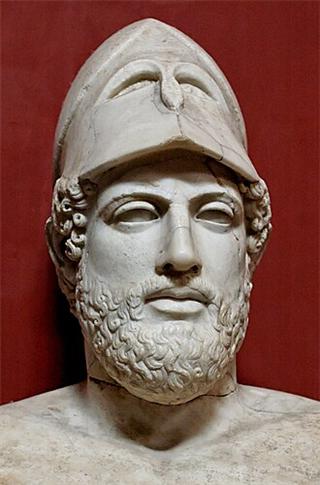
Pericles
PericlesCopy of Kresilas, Public domain

The Parthenon was built in the 5th century BCE in thanksgiving for the Greek victory over the Persian invaders in the Greco-Persian Wars. An earlier sanctuary for Athena Parthenos, the Older Parthenon, had been begun on the same site shortly after the Battle of Marathon, on a limestone foundation that extended the southern part of the Acropolis summit; it was still under construction when the Persians sacked the city in 480 BCE and razed the Acropolis. The site then lay in ruins for thirty-three years, perhaps because of an oath sworn before the Battle of Plataea not to rebuild the sanctuaries the Persians had destroyed, from which the Athenians were absolved only by the Peace of Callias in 450 BCE, and at least as likely because of the cost of rebuilding Athens. Excavators have long debated whether one or two earlier temples stood there.

In the mid-5th century BCE, when the Athenian Acropolis became the seat of the Delian League, Pericles began a building project that lasted the rest of the century and produced the Parthenon, the Propylaia, the Erechtheion and the Temple of Athena Nike. Like most Greek temples the Parthenon also served as a treasury, for a time that of the Delian League itself, which later became the Athenian Empire.

What It Is

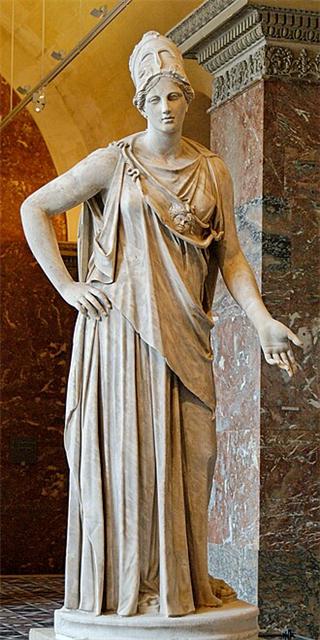
Athena
AthenaJastrow, Public domain

The Parthenon is an octastyle peripteral Doric temple: a two-chambered cella surrounded by columns, with eight columns at each end instead of the six usual in Doric temples and seventeen along each side. The rear room, the opisthodomos, held the monetary contributions of the Delian League. The decorative stonework was originally coloured. Above the outer colonnade ran 92 metopes carved in high relief, showing the gods against the Giants on the east, the Athenians against the Amazons on the west, the Lapiths against the Centaurs on the south and, it seems, the sack of Troy on the north. Around the cella walls ran an Ionic frieze, often interpreted as an idealised Panathenaic procession; Joan Breton Connelly reads it instead as a scene from the myth of King Erechtheus, a reading William St Clair rejects. The pediments, according to Pausanias, showed the birth of Athena and her contest with Poseidon for Athens.

The cella housed the colossal chryselephantine statue of Athena Parthenos by Phidias, dedicated in 439 or 438 BCE and now lost. Although the building is architecturally a temple, some scholars argue that it never hosted the official cult of Athena Polias, whose olive-wood image stood in another temple on the Acropolis, and that it should be seen as a grand setting for a votive statue. According to Thucydides, Pericles said that the statue’s gold could be used as a reserve if Athens needed it.
How It Was Made

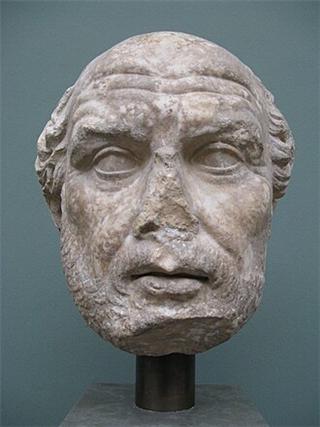
Phidias
PhidiasYair-haklai, CC BY-SA 3.0

The Parthenon was built under the general supervision of Phidias, who also had charge of its sculptural decoration. The architects Ictinos and Callicrates began work in 447 BCE, and work on the decoration continued until 432 BCE; according to the building records the metopes date to 446–440, and the frieze was carved in place c. 443–438. The temple was raised on the foundations of the Older Parthenon. Its builders were above all men who knew how to work marble: quarrymen able to cut blocks of Pentelic marble to exact measurements and avoid its many faults, using iron picks, points, punches, chisels and drills. Stonemasons came from far and wide, and slaves and foreigners worked beside Athenian citizens, doing the same jobs for the same pay, with carpenters, metalworkers and unskilled labourers.

Close measurement in the 19th century showed that the temple departs from straight lines: the stylobate bulges upward by 10.3 cm over 70 m, the columns swell slightly, and columns and walls lean a little inward. Francis Penrose in 1851 explained these refinements as corrections for the eye, others as structural or aesthetic choices, and the mathematician Alain Goriely has argued that the optical corrections are a myth. No ancient Greek text on architecture survives, so the system of proportion its architects used, whether a 9:4 ratio or the Golden Section, is still debated.

Reception

Basil II
Basil IIfrom the Middle Ages, unknown, Public domain

In 5th-century BCE accounts the building is simply called “the temple”; the name Parthenon, linked to the statue of Athena Parthenos, first certainly refers to the whole building in the 4th-century BCE orator Demosthenes. A fire in the 3rd century CE destroyed its roof and much of its interior, the Heruli sacked Athens in 276, and repairs were made in the 4th century. After Theodosius II decreed in 435 that all pagan temples in the Eastern Roman Empire be closed, it was closed as a temple at some point in the 5th century, and Athena’s cult image was looted by one of the emperors and taken to Constantinople.

The Parthenon then became a church of the Parthenos Maria, the Virgin Mary, its entrance moved to the west and an apse built at the east. It became the fourth most important Christian pilgrimage destination in the Eastern Roman Empire, and in 1018 the emperor Basil II went to Athens for the sole purpose of worshipping there. Under the Latin occupation it was for about 250 years a Catholic church of Our Lady, and in 1436 Cyriacus of Ancona became the first since antiquity to describe it under its ancient name, as “the wonderful temple of the goddess Athena”. After the Ottoman conquest it became a mosque before the end of the 15th century, its tower extended into a minaret. In 1667 the Turkish traveller Evliya Çelebi marvelled at its sculptures and wished that it might “remain standing for all time”.

Survival & Rediscovery

Francesco Morosini
Francesco MorosiniDidier Descouens, Public domain

Christian iconoclasts in late antiquity deliberately mutilated the figures of the east, north and west metopes, but through its use as church and mosque the structure remained basically intact. During the Morean War the Venetians under Francesco Morosini besieged the Acropolis, where the Ottomans used the Parthenon as a gunpowder magazine and as a shelter. In September 1687 a Venetian mortar round blew up the magazine: the explosion blew out the building’s central portion, brought down columns, architraves and metopes, and killed about three hundred people. Accounts written at the time conflict over whether the destruction was deliberate. Morosini’s attempt to take sculptures from the west pediment then smashed the figures of Poseidon and Athena’s horses, and Jacques Carrey’s drawings of 1674 are sometimes the only evidence of what was lost.

From 1801 to 1812 agents of Thomas Bruce, 7th Earl of Elgin, removed about half the surviving sculptures and sent them to Britain; Elgin stated that he had the permission of the Ottoman officials, and the legality of his actions has been disputed. In 1832 independent Greece demolished the visible minaret. Since 1975 the Committee for the Conservation of the Acropolis Monuments has documented and restored the building, dismantling earlier reconstructions found to be incorrect and moving fragile sculptures to the Acropolis Museum; the fully restored west pediment was unveiled in June 2026.

Legacy

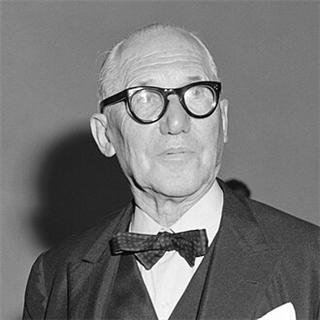
Le Corbusier
Le CorbusierJoop van Bilsen for Anefo, CC0

The Parthenon is considered an enduring symbol of ancient Greece, Western civilisation and democracy. In the 18th century its ruins were much drawn and painted, spurring a rise in philhellenism and helping to arouse sympathy in Britain and France for Greek independence; James Stuart and Nicholas Revett produced its first measured drawings, published in 1787 in Antiquities of Athens Measured and Delineated. In the later 19th century Americans and Europeans widely considered it the pinnacle of human architectural achievement, and painters such as Frederic Edwin Church and Sanford Robinson Gifford took it as a subject. Theories of its proportions travelled beyond scholarship: Jay Hambidge’s Dynamic Symmetry, which mapped root rectangles onto the temple, influenced George Bellows and Le Corbusier. Today it attracts millions of tourists every year.

The sculptures removed by Elgin remain in dispute. In 1983 the Greek government formally asked the UK government to return those in the British Museum and later listed the dispute with UNESCO, which in 2021 called on the UK government to resolve the issue at the intergovernmental level. The British Museum has consistently refused, and British governments have been unwilling to force it to return them, which would require legislation; discussions continue. Four pieces have been repatriated to Greece, three from the Vatican and one from a museum in Sicily.

The Parthenon, a Doric temple of Athena built on the Acropolis of Athens from 447 BCE in the building project of Pericles, served in turn as temple, treasury, church and mosque. Wrecked by an explosion in 1687 and stripped of about half its surviving sculptures by Elgin’s agents, it is under restoration and remains a symbol of ancient Greece and democracy.

Test yourself

5 questions on this page, from its key events and facts.

The questions open here once the page has loaded.