
Great work · Europe

Hagia Sophia

Period532 CE – present
Made byBuilt for the Byzantine emperor Justinian I as the Christian basilica of Constantinople; designed by the geometers Isidore of Miletus and Anthemius of Tralles; more than ten thousand people employed; the dome rebuilt by Isidore the Younger after 558; buttresses and minarets added under the Ottomans by the architect Mimar Sinan
FormA domed basilica of brick and mortar on a vast oblong plan, its central dome on four pendentives rising 55.6 m above the floor on an arcade of 40 windows, extended by two half domes; marble revetment and floors, mosaics, and four Ottoman minarets
Where it is nowStanding in Istanbul, Turkey, where it is the Hagia Sophia Grand Mosque, with parts open to visitors outside prayer times; the Fossati brothers’ drawings of its mosaics are kept in the Archive of the Canton of Ticino
Known forits pendentive dome and the light that makes it appear to hover; the world’s largest church for more than five hundred years; its mosaics, among them the Deësis; the coronations and ceremonies of the Byzantine emperors; its conversions from cathedral to mosque, museum and mosque again; its influence on Orthodox churches and Ottoman mosques

6 min read · Last reviewed October 2026

At a glance

  • Completed in 537 as the cathedral of Constantinople, it became the world’s largest interior space and among the first buildings to employ a fully pendentive dome.
  • It served as a cathedral until 1453, except for 1204–1261, when the Latin Crusaders installed their own hierarchy; then as a mosque, from 1935 as a museum, and since 2020 as a mosque again.
  • It became the model for Eastern Orthodox church architecture, and its style was emulated by Ottoman mosques a thousand years later.

Timeline

  1. 360The first church on the site, the Great Church, is consecrated in the reign of Constantius II
  2. 532The second church burns in the Nika Revolt, and weeks later Justinian I begins the present building
  3. 537Justinian and Patriarch Menas inaugurate the new basilica, 5 years and 10 months after construction started
  4. 1054The excommunication of Patriarch Michael I Cerularius is delivered in the church, an act considered the start of the East–West Schism
  5. 1204The Crusaders sack Constantinople, and the church becomes a Latin Catholic cathedral until 1261
  6. 1453After the Ottoman conquest of Constantinople, Mehmed II orders the church converted into a mosque
  7. 1935The building reopens as a museum under the secular Republic of Turkey
  8. 2020The Council of State annuls the decision that made it a museum, and the Hagia Sophia is reclassified as a mosque

Origins

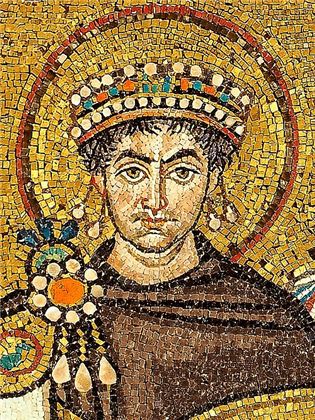
Justinian I
Justinian IPetar Milošević, CC BY-SA 4.0

The present Hagia Sophia is the last of three churches built one after another on the site by the Eastern Roman Empire. The first, known as the Magna Ecclesia or Great Church for its size, was consecrated in 360, in the reign of the emperor Constantius II, by the Arian bishop Eudoxius of Antioch; it had a timber roof and stood next to the area where the Great Palace was being developed. It was largely burnt down in the riots that followed the exile of the patriarch John Chrysostom in 404. A second church, built by the architect Rufinus, was inaugurated by Theodosius II in 415; unlike its successor it had colourful floor mosaics and external sculpture, of which fragments survive, among them a frieze of 12 lambs representing the 12 apostles.

That church was burnt to the ground in January 532 in a fire started during the Nika Revolt, which had begun in the nearby Hippodrome of Constantinople. The court historian Procopius wrote that the rioters had taken up arms “no less against God himself”, and that God had permitted it, foreseeing the beauty the shrine was destined to take on. Only a few weeks later, in February 532, Justinian I began a third and entirely different basilica, larger than its predecessors, formally called the Temple of God’s Holy Wisdom.

What It Is

Allah
AllahThe original uploader was Mr100percent at Wikipedia., Public domain

Hagia Sophia is built of brick and mortar on a vast oblong plan. Its nave is covered by a central dome that rises 55.6 m above the floor and rests on an arcade of 40 arched windows; to the west and east, half domes of the same diameter, carried on smaller semi-domed exedrae, extend the interior to a clear span of 76.2 m. The dome stands on four spherical triangular pendentives, one of the first large-scale uses of this element, and the light from its windows gives it the appearance of hovering. The interior was sheathed in polychrome marbles and gold mosaics, and its floor, mostly of Proconnesian marble crossed by bands of Thessalian verd antique likened to rivers, was repeatedly compared to a sea. A horseshoe-shaped upper gallery encloses the nave on three sides, and from its loggia the empress and her ladies watched the proceedings below.

The figurative mosaics now visible date from after the period of Iconoclasm: the Virgin and Child in the apse; emperors and empresses making donations to Christ or the Virgin in the Empress Zoe and Comnenus mosaics; and the Deësis, which probably dates from 1261 and is widely considered the finest. Ottoman additions include the minarets, the mihrab and eight great medallions painted by the calligrapher Kazasker Mustafa Izzet Efendi with the names of Allah, Muhammad, the first four caliphs, and Hasan and Husayn.
How It Was Made

Justinian appointed two architects, the mathematician Anthemius of Tralles and the geometer and engineer Isidore of Miletus. According to John the Lydian, the praetorian prefect Phocas funded the first work with 4,000 Roman pounds of gold. Columns and other marble elements were imported from throughout the Mediterranean; according to Cyril Mango only the porphyry from Egypt was reused. More than ten thousand people were employed. The bricklayers used more mortar than brick and did not let it cure before laying the next layer, so that the weight of the dome made the walls lean outward. Svenshon and Stiffel have proposed that the architects used values given by Hero of Alexandria for constructing vaults. Justinian and Patriarch Menas inaugurated the church in December 537, 5 years and 10 months after work began, and the emperor reportedly said, “Solomon, I have surpassed thee”.

Earthquakes in 553 and 557 cracked the dome, and after a further earthquake in 558 the eastern semi-dome collapsed, according to the Chronicle of John Malalas. Justinian entrusted the restoration to Isidore the Younger, who used lighter materials, rebuilt the whole vault 20 Byzantine feet higher and gave the dome 40 ribs, so that its weight flows between the windows and down the pendentives. The work, which gave the church its present 6th-century form, was completed in 562, and the poet Paul the Silentiary composed a long visual poem for its rededication.

Reception

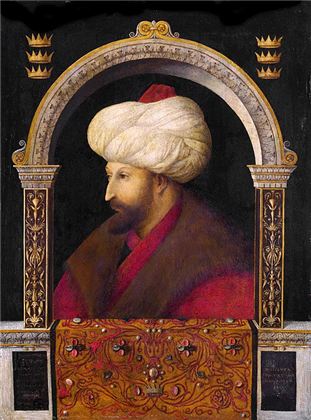
Mehmed II
Mehmed IIGentile Bellini, Public domain

For nearly a thousand years Hagia Sophia was the cathedral of Constantinople, the seat of its patriarch and a principal setting for imperial ceremonies such as coronations, which the emperor Constantine VII described in his Book of Ceremonies. Envoys of the pagan ruler of the Kievan Rus’ reported that inside it “we did not know where we were, in heaven or on earth”, and Olga of Kiev was probably baptised in its baptistery. In 1054 Humbert of Silva Candida, the envoy of Pope Leo IX, delivered there the excommunication of Patriarch Michael I Cerularius. After the Crusaders sacked the city in 1204 it was a Latin Catholic cathedral until 1261, and the doge Enrico Dandolo was buried inside.

When Constantinople fell to the Ottomans in 1453, crowds took refuge in the church; of those who sheltered there, most of the old, sick and injured were killed and the rest enslaved. Mehmed II performed the Friday prayer there and ordered its conversion into a mosque, and it became the first imperial mosque of Istanbul. In 1935 the Republic of Turkey under Mustafa Kemal Atatürk made it a museum. In 2020 the Council of State annulled that decision and President Recep Tayyip Erdoğan signed a decree reverting it to a mosque. The government said it would be open to all and its Christian icons protected; the change drew condemnation from the Turkish opposition, UNESCO, the World Council of Churches and numerous international leaders, while several Muslim leaders in Turkey and other countries welcomed it.

Survival & Rediscovery

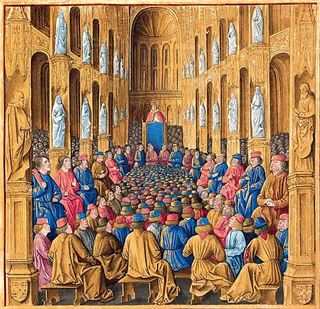
Crusader states
Crusader statesJean Colombe, Public domain

Earthquakes damaged the building again and again: one in 869 brought down a half-dome, one in 989 the western dome arch, which the Armenian architect Trdat rebuilt by 994, and in 1346 several parts collapsed. The figurative mosaics were destroyed in the iconoclastic controversy of 726–843, and in 1204 the Crusaders stripped the church of its remaining metal ornaments and smashed its altar. Under the Ottomans, Mimar Sinan strengthened the structure with buttresses, and many mosaics were covered with plaster, in stages; a renovation of the crumbling plaster in 1717 indirectly preserved many of them.

In 1847–1849 the Swiss-Italian brothers Gaspare and Giuseppe Fossati restored the building for Sultan Abdulmejid I, binding the dome with an iron chain and recording the mosaics they uncovered before painting them over again; their records are the primary source for images believed lost in the 1894 Istanbul earthquake. In the 1930s a team of the Byzantine Institute of America led by Thomas Whittemore uncovered all the major mosaics. The World Monuments Fund placed the building on its watch lists in 1996 and 1998 and had restored the dome by 2006. Restorers still weigh Christian mosaics against historic Islamic art, above all the calligraphy that may cover a Christ Pantocrator in the dome, and in 2025 work began to strengthen the dome against earthquakes.

Legacy

Süleymaniye Mosque
Süleymaniye MosqueHunanuk, CC0

Hagia Sophia became the model for Eastern Orthodox church architecture. It remained the world’s largest church for more than five hundred years, until the abbey church at Cluny was completed in the 12th century, and its main dome was the largest pendentive dome in the world until the completion of St Peter’s Basilica. Its plan of a large central dome on pendentives, buttressed by two semi-domes, was widely copied: among Byzantine churches it shaped the Hagia Sophia in Thessaloniki and the remodelled Hagia Irene, and in modern times the Kronstadt Naval Cathedral reproduces it almost exactly in size and geometry, while churches from Sofia and London to St. Louis and São Paulo, and synagogues such as the Hurva Synagogue and the Great Synagogue of Florence, drew on it.

Ottoman mosques emulated its style a thousand years later: the Şehzade Mosque, the Süleymaniye Mosque, the Rüstem Pasha Mosque and the Bayezid II Mosque among them. The cathedral of Kiev, Saint Sophia’s, probably took its name in memory of Olga’s baptism, and in 1923 Greece issued 500 drachma banknotes that featured the building. As a museum it was Turkey’s most visited tourist attraction as of 2019; since 2020 it has been a working mosque, its upper galleries reopened to visitors in 2024.

Hagia Sophia was built in 532–537 for Justinian I as the cathedral of Constantinople, and its pendentive dome made it the world’s largest interior space. A church until 1453, it then served as a mosque, from 1935 as a museum and, after a contested decision in 2020, as a mosque again, and it shaped Orthodox churches and Ottoman mosques alike.

Test yourself

5 questions on this page, from its key events and facts.

The questions open here once the page has loaded.