What It Is
After an opening in praise of God and Wisdom, the poem recounts the creation of the world and of man as the Sasanians believed it, then the reigns of Iran's kings in three ages. The mythical age, some 2100 verses or four percent of the whole, runs from Keyumars, the first man and first king, and his grandson Hushang, who discovered fire and founded the Sadeh Feast, through Tahmuras, Jamshid, Zahhak, Kaveh, and Fereydun and his three sons Salm, Tur and Iraj, to Manuchehr.
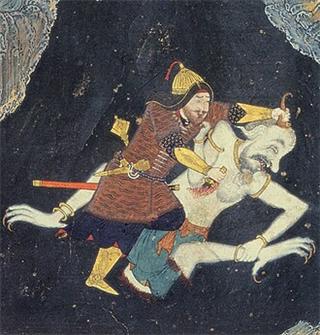
Almost two-thirds of the work belongs to the heroic age, from Manuchehr to the conquest of Alexander the Great: the kingdom of the Kayanians, in which the heroes of Sistan are the backbone of the empire, Sam, his son Zal, Zal's son Rostam and then Faramarz. Its stories include the romance of Zal and Rudaba, the Seven Stages (or Labours) of Rostam, Rostam and Sohrab, Siyavash and Sudaba, Bijan and Manijeh, the wars with Afrasiab, and Rostam and Esfandyar. Three sections on Alexander, over 2,500 verses, mark the turn from mythic to historical rulers. The historical age mentions the Arsacids briefly, relates Sasanian history with a good deal of accuracy and narrates the fall of the Sasanians and the Arab conquest romantically.
Jalal Khaleghi Mutlaq finds in it moral virtues such as worship of one God, patriotism, love of family and help for the poor; other scholars read in it a contrast of good and evil drawn from Zoroastrian dualism, and Dariush Zolfaghari a war for the survival of Iranian cultural identity.