
Great work · South & Southeast Asia

Angkor Wat

Period1122 CE – present
Made byCommissioned by the Khmer king Suryavarman II (ruled 1113–c. 1150) as his state temple, on the suggestion of Divākarapaṇḍita; built by Khmer architects and a labour force that probably ran into the thousands, including many highly skilled artisans
FormA sandstone temple joining the temple-mountain and galleried forms: three rising galleries and a central quincunx of towers, the central tower 65 m above the ground, inside an outer wall of 1,024 m by 802 m and a moat 190 m wide
Where it is nowAngkor, near Siem Reap, Cambodia, on a site of 162.6 hectares; still a Buddhist monastery and place of worship, within the Angkor World Heritage Site
Known forthe largest religious structure in the world; its west-facing orientation; the bas-relief friezes of the Ramayana and the Mahabharata; the Churning of the Sea of Milk; more than 1,796 devatas on its walls; its place on the Cambodian national flag

6 min read · Last reviewed October 2026

At a glance

  • Built from 1122 to 1150 as Suryavarman II's state temple to Vishnu, Angkor Wat was gradually turned into a Buddhist site and, unlike most Angkor temples, was never completely abandoned.
  • Its plan is commonly read as Mount Meru, home of the gods: the five central towers stand for the mountain's peaks, the walls and moat for the ranges and ocean around it.
  • Restoration begun by the École française d'Extrême-Orient in 1908 was broken off in the Khmer Rouge era and has been coordinated internationally under UNESCO since 1993.

Timeline

  1. 1122Construction of the temple begins under Suryavarman II, on the suggestion of Divākarapaṇḍita
  2. 1150The temple is completed; work stops after the king's death, leaving some of the bas-reliefs unfinished
  3. 1178The Chams sack Angkor; Jayavarman VII restores the empire and builds a new capital at Angkor Thom
  4. 1586The Capuchin friar António da Madalena visits, one of the first recorded European visitors
  5. 1632The Japanese pilgrim Ukondayu Kazufusa celebrates the Khmer New Year at Angkor Wat
  6. 1860Henri Mouhot visits; his travel notes, published in 1864, popularise the site in the West
  7. 1908The École française d'Extrême-Orient sets up the Conservation d'Angkor to clear and restore the temples
  8. 1992The Angkor area becomes a UNESCO World Heritage Site, listed as in danger until 2004

Origins

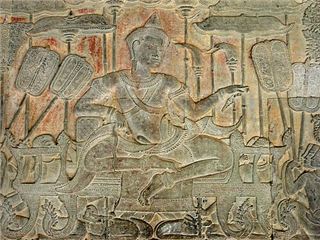
Suryavarman II
Suryavarman IIMichael Gunther, CC BY-SA 4.0

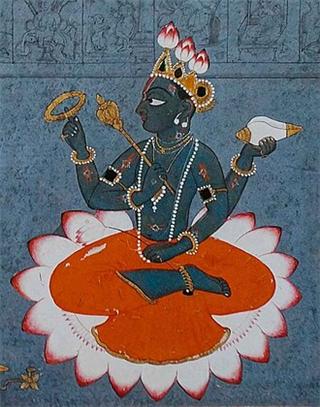
Angkor Wat was commissioned by the Khmer king Suryavarman II (ruled 1113–c. 1150) in the early 12th century at Yaśodharapura, present-day Angkor, the capital of the Khmer Empire. It was built as the king's state temple and dedicated to the Hindu god Vishnu, on the suggestion of Divākarapaṇḍita (1040–c. 1120), and is generally considered to have been intended as Suryavarman's mausoleum. No foundation stela or contemporary inscription naming it has been found, so its original name is unknown; it may have been called Vrah Viṣṇuloka or Parama Viṣṇuloka, "the sacred dwelling of Vishnu", after its presiding deity.

The temple drew on long-established Khmer traditions. It joins the temple mountain, the standard design for the empire's state temples, to the later plan of concentric galleries, and the skills needed to carve it had developed over hundreds of years: some artefacts that show them date to the seventh century, before the Khmer came to power. By the 12th century Khmer architects had become skilled and confident in using sandstone rather than brick or laterite as their main material. The modern name means "Temple City" or "City of Temples" in Khmer: angkor, "city", comes from the Sanskrit or Pali nagara, and wat, "temple", from vāṭa, "enclosure".

What It Is

Vishnu
VishnuManaku of Guler, Public domain

Angkor Wat stands on a site of 162.6 hectares and is considered the largest religious structure in the world. An outer wall 1,024 m by 802 m encloses the precinct, which is ringed by a moat 190 m wide. A sandstone causeway from the west, the main entrance, leads through a gopura to the temple proper, which rises on a terrace as three rectangular galleries, each higher than the last, to a central quincunx of towers; the tower over the central shrine reaches 65 m above the ground. The plan represents Mount Meru, home of the gods in Hindu mythology: the five towers stand for its peaks, the walls and moat for the surrounding ranges and ocean. Unlike most Khmer temples it faces west, which led Maurice Glaize and George Coedès to see it as a funerary temple; Freeman and Jacques link the orientation instead to Vishnu, who was associated with the west.

The inner walls of the outer gallery carry large bas-relief friezes, mainly of episodes from the Ramayana and the Mahabharata, which Charles Higham called "the greatest known linear arrangement of stone carving". The southern gallery holds the only historical scene, a procession of Suryavarman II, beside the 32 hells and 37 heavens of Hinduism, and the eastern gallery the Churning of the Sea of Milk. More than 1,796 depictions of devatas have been documented on the walls.

How It Was Made

Construction began in 1122 CE and the temple was completed in 1150 CE, though work stopped after the king's death and some of the bas-reliefs were left unfinished. Most visible areas are of Kulen sandstone blocks, while laterite was used for the outer wall and hidden structural parts; LIDAR scans show that the temple rests on roughly 3 million cubic metres of fill. Five to ten million sandstone blocks, each weighing at most 1.5 tons, were quarried at Mount Kulen, about 40 km to the northeast. One suggested route ran 90 km by canal, across the Tonlé Sap lake and up the Siem Reap River; in 2011 Etsuo Uchida and Ichita Shimoda of Waseda University found a shorter canal of 35 km in satellite imagery and believe the Khmer used it instead.

The binding agent that joins the blocks is yet to be identified, though natural resins or slaked lime have been suggested. Experiments suggest that the labour force needed to quarry, transport, carve and set so much stone ran into the thousands. Lines of sight within the temple place certain towers at the sunrise of the solstices, and the main tower aligns with the morning sun of the spring equinox, an alignment generally regarded as intentional. The researcher Eleanor Mannikka reads its measurements as solar and lunar time cycles built into the sacred space, a view received with both interest and scepticism.

Reception

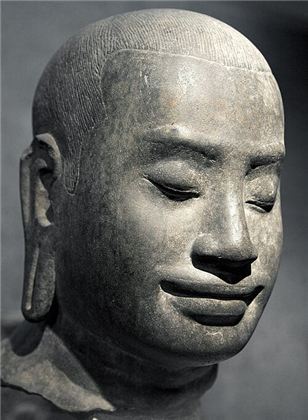
Jayavarman VII
Jayavarman VIISuzan Black, CC BY 3.0

Access to the upper levels was progressively more exclusive, the laity being admitted only to the lowest. Modern analyses suggest that between 3,000 and 4,300 people lived in the precinct, and in 2015 a University of Sydney team reported a road grid, ponds, mounds and low-density housing there, evidence that it was not used only by a priestly elite. After the Chams sacked Angkor in 1178, Jayavarman VII restored the empire, built a new capital at Angkor Thom with the Bayon as its state temple, and dedicated it to Buddhism, encouraged by his wife Indradevi, a devout Mahayana Buddhist. Angkor Wat was gradually converted into a Buddhist site, many Hindu sculptures being replaced by Buddhist art, and from the late 13th century it was associated above all with Theravada Buddhism.

The Chinese envoy Zhou Daguan visited it. Over the centuries pilgrims left Buddha images in the cloister of Preah Poan, "The Thousand Buddhas" gallery, with inscriptions in Khmer, Burmese and Japanese. In the 17th century Japanese pilgrims identified Angkor Wat as Jetavana, the monastic garden associated with the Buddha, and inscriptions record their small settlements; in 1632 Ukondayu Kazufusa celebrated the Khmer New Year there. Local folklore came to see the temple as a place of merit-making, meditation and spiritual ascent, and some held that its Hindu reliefs encode hidden Buddhist teachings.

Survival & Rediscovery

Angkor Wat is unusual among the Angkor temples in that, although largely neglected after the 16th century, it was never completely abandoned. After the Khmer empire fell to Ayutthaya in 1431 its ponds were still regularly maintained, and its wooden parts were replaced throughout its occupation. Portuguese traders and missionaries reached the Angkor temples in the 16th century; the Capuchin friar António da Madalena explored them in 1586, and Diogo do Couto recorded his account. In 1860 the French naturalist Henri Mouhot visited with the help of the missionary Charles-Émile Bouillevaux, and his travel notes, published in 1864, popularised the site in the West.

The École française d'Extrême-Orient set up the Conservation d'Angkor in 1908 to clear the vegetation and restore the temples. Work stopped in the Khmer Rouge era: the Conservation was disbanded in 1975, Khmer Rouge forces burned the remaining wood as fuel, and a shoot-out with Vietnamese forces left bullet holes in some reliefs. Art thieves did far more damage in the late 1980s and early 1990s. The Archaeological Survey of India worked on the temple from 1986 to 1992, and both its work and the early French restorations have been criticised for the damage done by chemicals and cement. Since 1993 the international committee ICC-Angkor has coordinated the work under UNESCO, and the German Apsara Conservation Project found around 20% of the reliefs in very poor condition.

Legacy

Angkor Wat is the prime example of the classical Khmer style named after it, the Angkor Wat style, with its ogival towers shaped like lotus buds, half-galleries, axial galleries and cruciform terraces. A depiction of the temple has been part of the Cambodian national flag since its first version in 1863, and the temple has become a symbol of Cambodia itself. Seen in a trans-cultural perspective, it did not become a symbol of national pride by itself but within a wider process of French colonial heritage-making: France made Cambodia a protectorate in 1863, partly because of the artistic legacy of Angkor, and a life-size replica of Angkor Wat was shown at colonial and universal exhibitions in Paris and Marseille between 1889 and 1937, while plaster casts filled Louis Delaporte's musée Indo-chinois in the Trocadero Palace.

The temple remains a Buddhist monastery and an active place of worship and is widely regarded as a symbol of the country's Buddhist heritage. The Angkor area became a UNESCO World Heritage Site in 1992, and the APSARA authority was set up in 1995 to manage it. Visitors grew from 7,650 in 1993 to 2.6 million in 2018, bringing graffiti, effects on the water table that strain the temples' stability, and calls from critics to close the site to tourism. In 2012 Borobudur and Angkor Wat were made sister sites.

Angkor Wat was built from 1122 to 1150 for the Khmer king Suryavarman II as a state temple to Vishnu, an image in stone of Mount Meru with three rising galleries, five towers and long bas-relief friezes. Gradually converted to Buddhist use, it was never completely abandoned, and after a century of restoration it remains a place of worship and a symbol of Cambodia.

Test yourself

5 questions on this page, from its key events and facts.

The questions open here once the page has loaded.

References

  • Briggs, Lawrence Robert, The Ancient Khmer Empire (White Lotus, 1999)
  • Freeman, Michael; Jacques, Claude, Ancient Angkor (River Books, 1999)
  • Glaize, Maurice, Les monuments du groupe d'Angkor (J. Maisonneuve, 1993)
  • Higham, Charles, The Civilization of Angkor (Phoenix, 2001)
  • Falser, Michael, Angkor Wat – A Transcultural History of Heritage (De Gruyter, 2020)